Double Robotics Double 3 vs. temi V3
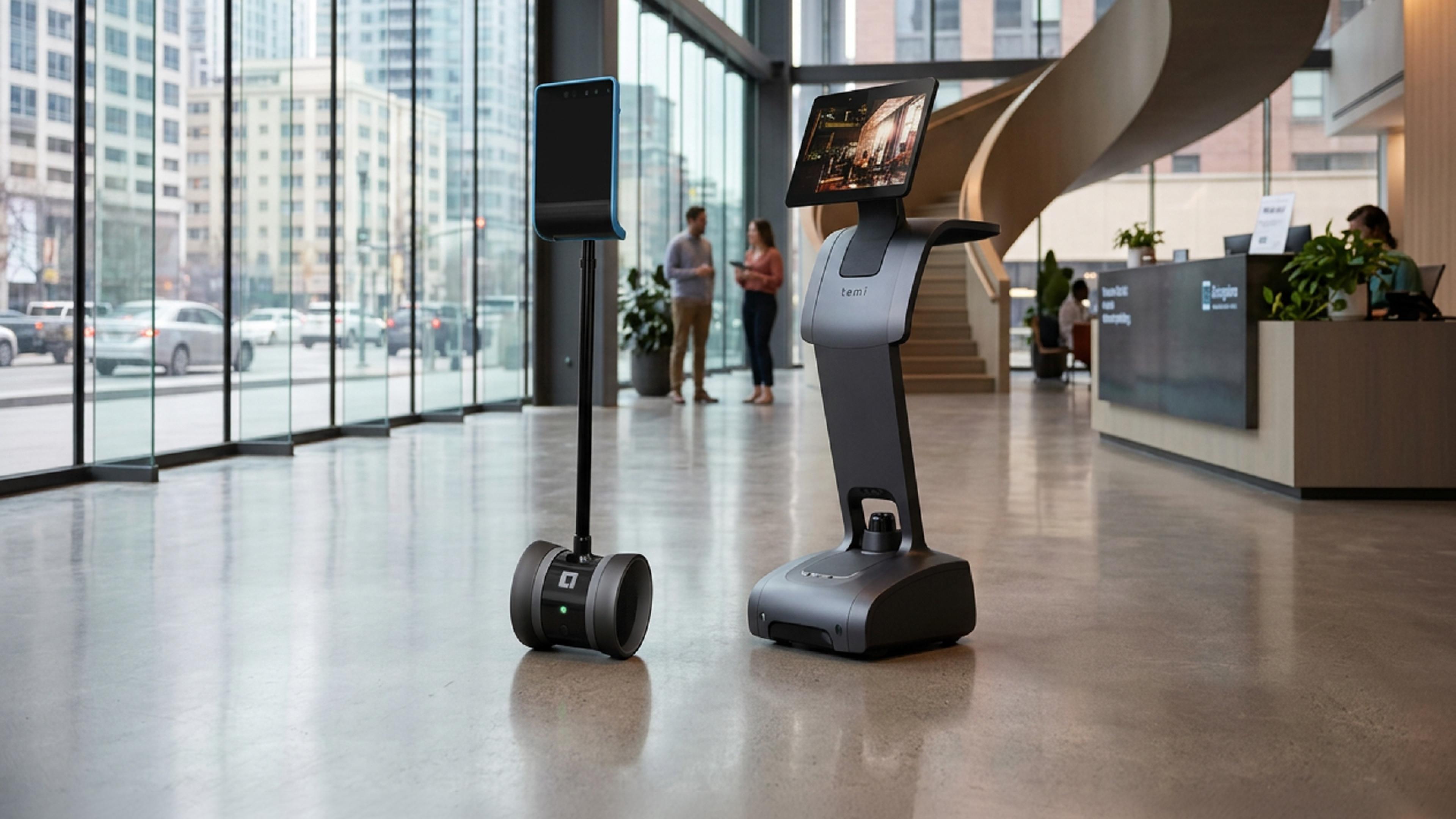
Double Robotics Double 3 and temi V3 are commercially positioned mobile robots designed to support remote interaction and communication in indoor environments. While Double 3 focuses on telepresence, temi V3 combines autonomous mobility with interactive assistance. We compare their physical dimensions, battery endurance, displays, audio systems, connectivity and commercial availability.

November 13, 2026 by Business Desk Team
Introduction
Mobile robots are increasingly being used to connect people across different locations and support communication in workplaces, educational institutions, healthcare facilities and hospitality environments.
These robots allow users to interact with people remotely while providing a mobile platform that can move through indoor spaces. However, not all mobile communication robots are designed for the same purpose. Some primarily focus on telepresence, allowing a remote user to participate in activities through a robot.
Others combine video communication with autonomous navigation, voice interaction and additional service functions. Double Robotics Double 3 and temi V3 represent these different approaches.
Double 3 is a mobile telepresence robot developed by the American company Double Robotics. It is designed to support remote participation in workplaces, classrooms and other professional environments. temi V3 is a mobile personal and service robot developed by the Israeli company temi. Its applications include home assistance, healthcare and hospitality.
Both robots include touchscreen displays, wireless connectivity and onboard sensors. However, their recorded specifications reveal differences in height, operating endurance, weight, audio equipment and connectivity options. Their commercial availability also differs, with Double 3 currently listed as sold out by its manufacturer while temi V3 is listed as commercially available.
Based on ROBOT24.com market-research data records, this comparison examines their mobility, communication capabilities, operating requirements and suitability for different indoor applications.
At A Glance
| Height | 119.38–152.4 (motorized adjustment; 47–60 inches) cm | 100 cm |
|---|---|---|
| IMU | Yes 9-Axis | Yes |
| Runtime pr charge | 4 hours | Up to 8 hours |
| Audio | 6 Beamforming Microphones | Harman Kardon Speakers |
| Availability | Manufacturer store lists Double 3 as sold out. Current new-unit supply requires confirmation; some regional providers have ended sales and service. | Commercially Available |
| Cloud Connectivity | Yes | Supported |
| Connectivity | Wi-Fi | Wi-Fi 5 (2.4/5 GHz), Bluetooth 5.1 BLE, USB-C/USB-A; optional cellular model |
| Display | Integrated 9.7" Touchscreen | 10-inch HD Touchscreen |
| Nationality | American | Israeli |
| Runtime | Up to 4 Hours | Up to 8 hours |
| Weight | ~15 kg | 12 (global specification); China V3 page lists 13 kg |
| Wi-Fi | Yes | Yes |
| Typical use | Enterprise Automation, Education & Training, Healthcare | Home Assistance, Healthcare, Hospitality |
| Status | Commercial | Commercial |
How They Compare
Product design and operational focus
Double 3 and temi V3 are two mobile robots that aim to provide a means of interaction between individuals and technology; however, there are differences in their purposes.
Double 3 is mainly a telepresence robot. The main function of this robot is to enable an individual in one location to participate in events that take place elsewhere. An individual can control the movement of the robot and communicate with others using the audiovisual capabilities of the robot.
Such a feature can make Double 3 useful in workplaces, schools and many other locations where the physical presence of an individual might not be possible. temi V3 integrates mobility communication services with navigation and interactive services.
This robot has the ability to carry out video communication, voice interaction and indoor movement. Such features might be applicable in healthcare facilities, hospitality facilities and homes. This distinction is essential since telepresence robot and service robot are evaluated according to different criteria.
Height and design
Double 3 is fitted with a motorized mechanism to regulate height adjustment. Double 3 has a recorded height that varies between 119.38 cm and 152.4 cm, equal to 47–60 inches.
temi V3 has a recorded height of 100 cm. Therefore, Double 3 is higher than temi V3 in terms of their maximum adjustable heights. It features a height adjustment mechanism enabling it to adjust the display at various heights. This may help when communicating remotely with seated and standing individuals.
temi V3 is built with a low height and is fixed. This makes it possible to use temi V3 in cases where low-profile mobile robots are needed. Nevertheless, height alone does not define maneuverability or accessibility. The provided data cannot help to compare the minimum passage widths, turning radius or the floor footprints.
Weight and portability
Double 3 has a recorded weight of approximately 15 kg. temi V3 weighs approximately 12 kg according to its global specification, while a China-market V3 page lists 13 kg.
Based on these figures, temi V3 is approximately 2–3 kg lighter. This difference may influence transportation, repositioning and installation. A lighter robot may be easier for staff to move manually when necessary. However, weight alone does not establish portability.
Wheel configuration, lifting points and handling procedures can also affect how easily a robot can be transported. The supplied records do not establish directly comparable carrying or storage requirements.
Mobility and navigation
Both Double 3 and temi V3 are created to navigate indoor spaces. Double 3 has telepresence capabilities, with control over the robot's navigation conducted using its interface. In addition, the system incorporates features aimed at helping a remote user to navigate occupied areas.
Autonomy in mobility and navigation is a key feature of temi V3. This allows the robot to go to the supported destinations without any need for remote control throughout all trips.
This difference may affect the use cases for each platform. The robot will be especially useful in case a remote participant has to navigate occupied spaces.
temi V3 can be more effective in workflow requiring navigation from one predetermined indoor destination to another. However, the provided information does not include maximum speed and obstacle detection range for each platform. Thus, a comparative analysis of their mobility and navigation cannot be provided.
Inertial measurement systems
Both robots include inertial measurement units. Double 3 has a recorded nine-axis IMU. temi V3 also includes an IMU, although the supplied records do not specify its axis configuration.
An IMU can provide information about a robot's motion and orientation. This information may support movement control, stabilization and navigation. However, a nine-axis specification does not automatically establish superior navigation performance.
The effectiveness of an inertial system depends on sensor quality, software processing and how its measurements are combined with other information. The supplied records do not provide enough detail to compare the performance of the two IMU systems.
Touchscreen displays
Both robots include integrated touchscreen displays. Double 3 has a 9.7-inch touchscreen. temi V3 has a 10-inch HD touchscreen. The difference in diagonal display size is approximately 0.3 inches.
This is a relatively small difference in screen size. For Double 3, the display is central to its telepresence function, allowing people near the robot to see and interact with a remote participant. For temi V3, the touchscreen supports visual interaction and compatible applications.
However, display size alone does not establish image quality. Resolution, brightness, viewing angles and software design also influence usability. The supplied records do not provide directly comparable display-resolution or brightness specifications.
Video communication and telepresence
The Double 3 robot is made mainly for telepresence purposes. The robot's mobility feature enables one to be engaged in talks and travel around different places.
It may come in handy for those people who work remotely, attend certain events from a distance or take part in various meetings. The temi V3 robot can also be used for communication purposes.
The robot's features such as a touchscreen, speakers, internet connection and mobility may be important for video communications and interactions. Yet the available information does not prove the fact that both robots have similar controls for telepresence.
Remote control of the robot, choosing destinations, camera controls and communication platforms may differ. One needs to assess their own communication process instead of just having a display and audio equipment.
Battery longevity and operating time
Operation longevity is one of the most straightforward distinctions from the presented specifications. Double 3 has an operating time of up to four hours.
temi V3 has an operating time of up to eight hours.From the above numbers, it is clear that temi V3 has double the longest operating time. It could be important for facilities where robots are expected to work for long stretches of time.
For instance, in a health care facility or at a hospitality establishment, a robot should be able to interact with people during hours of its operation. But, these numbers do not confirm that the tests were conducted in identical circumstances for both robots.
Battery depletion depends on movement, using a display, communication via sound, network communication, and periods when the robot stays idle. Also, there is no information about charging times in the provided specifications.
Wi-Fi and wireless connectivity
Both Double 3 and temi V3 support Wi-Fi. Wi-Fi connectivity is indicated as the recorded connectivity type of Double 3.
temi V3 works with Wi-Fi 5 at both 2.4 GHz and 5 GHz frequencies, Bluetooth 5.1 BLE and USB-C/USB-A connectivity. Also, the provided documentation includes the record about the possibility of using a cellular version of temi V3. Additional connectivity types could be important for organizations in terms of connecting the robot with other compatible devices and systems.
But multiple types of connectivity do not automatically imply that the network capabilities are going to be higher. Network reliability is determined by network coverage, software compatibility and application communication needs. Companies should determine which features use the Internet and which work only with local networks.
Cloud connectivity
Both robots support cloud connectivity according to the supplied records. Cloud-connected functions may support compatible communication services, software management or other remote features. For telepresence robots, reliable connectivity is particularly important because the user may be operating the platform from another location.
Double 3's cloud connectivity is relevant to its remote communication functions. temi V3 also supports cloud-connected capabilities. However, the supplied records do not establish identical cloud services, subscription arrangements or data-management policies.
Organizations should verify how each platform handles user accounts, remote access and stored information. This is especially important in healthcare and enterprise environments.
Enterprise and workplace applications
Enterprise automation is included among Double 3's recorded applications. Its telepresence design may be relevant to organizations with employees working across multiple locations.
A remote participant can use the robot to interact with colleagues and participate in activities without being physically present. temi V3 is not listed under enterprise automation in the supplied typical-use categories. However, its mobile communication capabilities may also be relevant to certain commercial workflows.
The distinction is that Double 3's primary design emphasizes remote human presence, while temi V3 combines communication with autonomous service functions. Organizations should evaluate which approach best supports their intended activities.
Education and training
Education and training are included among Double 3's recorded applications. Telepresence robots can support remote participation in educational settings.
For example, a student or instructor may use a mobile telepresence platform to interact with people in a classroom or training facility. Double 3's adjustable height and communication-oriented design may be relevant to these activities. temi V3 is not specifically listed under education and training in the supplied records.
This does not necessarily exclude educational use, but the available data does not establish equivalent educational capabilities. Institutions should confirm software compatibility, accessibility requirements and support arrangements before deployment.
Healthcare applications
Healthcare is a shared application category for Double 3 and temi V3. In healthcare environments, mobile communication robots may support appropriate remote interaction workflows. Double 3's telepresence capabilities may be relevant to communication between people in different locations. temi V3's autonomous mobility and interactive features may support other communication-oriented activities.
However, healthcare applications can involve additional requirements concerning privacy, safety and integration with existing systems. The supplied records do not establish that either robot is certified as a medical device or suitable for clinical decision-making. Organizations should verify the exact application and any relevant regulatory requirements before deployment.
Hospitality and home assistance
temi V3 has hospitality and home assistance among its recorded applications. Its combination of autonomous navigation, interactive communication and touchscreen functions may be relevant to these environments. In hospitality settings, mobile robots may support guest-facing information and communication tasks. In homes, interactive robots may provide supported communication or information services.
However, home assistance should not automatically be interpreted as physical household assistance. The supplied records do not establish that temi V3 can manipulate objects or independently perform domestic chores.
Double 3's recorded applications focus on enterprise automation, education and healthcare. Its telepresence functions may still be relevant to certain home or hospitality scenarios, but those are not included among its listed typical uses.
Commercial availability and purchasing considerations
Both robots have commercial status in the supplied records. However, their current availability differs. Double 3's manufacturer store lists the product as sold out. The supplied records also note that some regional providers have ended sales and service. This means organizations seeking a new Double 3 should confirm current stock, service availability and support arrangements before planning a deployment.
temi V3 is listed as commercially available. However, commercial availability may still vary by region and configuration. Organizations should confirm purchasing arrangements, warranty coverage, technical support and software-service terms for both platforms.
Deployment and long-term support
Successful deployment depends on more than the robot's technical specifications. Organizations need to consider network connectivity, charging arrangements, operating procedures and staff training.
For Double 3, the availability of replacement parts and continued technical support may be particularly important given its recorded sales status. For temi V3, businesses should confirm the capabilities and support arrangements of the exact configuration being purchased.
Cloud-service continuity, software updates and compatibility with existing communication systems may also influence long-term usability. These considerations can be especially important for organizations relying on mobile robots for regular communication activities.
Summary
Double Robotics Double 3 and temi V3 are mobile robots designed to support communication and interaction in indoor environments. Double 3 is primarily a telepresence platform, with a motorized height-adjustment system, 9.7-inch touchscreen and six-microphone beamforming array. Its recorded runtime is up to four hours.
temi V3 combines autonomous mobility with interactive service capabilities. It has a 10-inch HD touchscreen, broader recorded connectivity options and a stated runtime of up to eight hours.
Double 3 may appeal to organizations prioritizing remote participation in workplaces, educational institutions and healthcare environments.
temi V3 may be relevant to organizations seeking a mobile platform for autonomous navigation, communication and interactive assistance in healthcare, hospitality or home environments.
However, Double 3's current new-unit availability requires confirmation, while temi V3 is listed as commercially available.
The choice depends on whether the primary requirement is remote telepresence or broader autonomous interaction, along with battery endurance, connectivity, purchasing arrangements and long-term support.
This comparison is based on ROBOT24.com market-research data records rather than controlled performance testing. Runtime, navigation capabilities, software compatibility and commercial availability should be verified against current manufacturer documentation before drawing conclusions about overall performance.
More articles on this topic
157 articles ReportRichtech DUST-E S vs. Gausium Phantas
 ReportEngineAI SE01 vs. AGIBOT RAISE A1ReportRichtech DUST-E S vs. KEENON KLEENBOT C20
 Report1X Technologies NEO Gamma vs. AGIBOT A2 Max
 ReportAI² Robotics AlphaBot 2 vs. AGIBOT A2-W
 ReportAGIBOT D1 Pro vs. Unitree Go2 Edu Plus
 ReportAGIBOT G2 vs. Astribot S1
 ReportAGIBOT D1 vs. ARAT 4.2
 ReportANYbotics ANYmal C vs. Deep Robotics Lynx M-20S
 ReportAGIBOT D1 vs. ANYbotics ANYmal C
 ReportAeiROBOT AIMY vs. AGIBOT G2 Genie
 ReportAGIBOT A2 vs. UBTECH Walker C
BUSINESS NEWS WEEKLY LETTER
The Weekly Letter for Robotics Professionals, Summarizing the Most Important Industry Moves, Launches, Deals and Signals.