AGIBOT D1 vs. ARAT 4.2
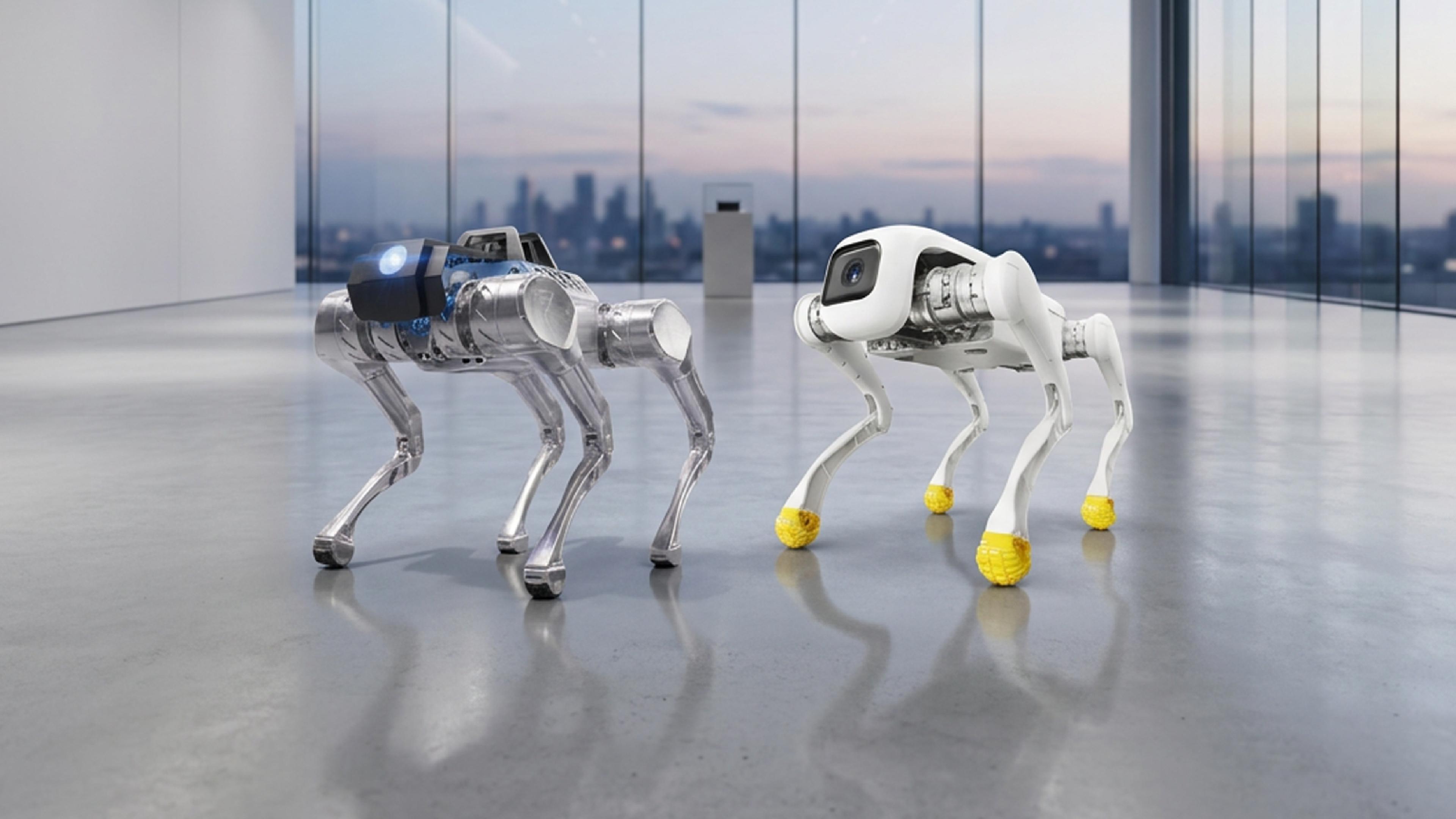
AGIBOT D1 and ARAT 4.2 are Chinese and Turkish quadruped robotic platforms associated with different applications. While AGIBOT D1 is positioned for research, education and public demonstrations, ARAT 4.2 focuses on security, surveillance and search-and-rescue exploration. We compare their physical weight, intended applications, commercial availability and deployment requirements.

November 13, 2026 by Business Desk Team
Introduction
Quadruped robots are being developed for an expanding range of applications, from robotics laboratories and educational institutions to security operations and exploration.
Their four-legged designs can support movement through environments where conventional wheeled platforms may face limitations. However, not all quadruped robots are intended for the same tasks.
Some are developed as accessible platforms for robotics research, programming and demonstrations.
Others are positioned for field operations involving inspection, surveillance or exploration. AGIBOT D1 and ARAT 4.2 represent these different application categories. AGIBOT D1 is a Chinese quadruped robot associated with research and development, education and training, and public demonstrations.
ARAT 4.2 is a Turkish quadruped platform positioned for security, surveillance and search-and-rescue exploration. Both robots have commercial status in the supplied records, although their availability differs.
AGIBOT D1 is listed as commercially available, while ARAT 4.2 is available for requests or demonstrations, with its commercial sales status not clearly confirmed. Their recorded weights also differ substantially.
AGIBOT D1 weighs 15.5 kg, including its battery, while ARAT 4.2 weighs 27 kg. Based on ROBOT24.com market-research data records, this comparison examines their physical characteristics, intended applications, commercial positioning and deployment considerations.
At A Glance
| Availability | Commercially Available | Available for request/demo; commercial sales status not clearly confirmed |
|---|---|---|
| Nationality | Chinese | Turkish |
| Weight | 15.5 kg (including battery) | 27 kg |
| Typical use | Research & Development, Education & Training, Exhibition & Public Demonstrations | Security & Surveillance, Search & Rescue Exploration |
| Status | Commercial | Commercial |
How They Compare
Product positioning and intended applications
How They Compare
Product positioning and intended applications
AGIBOT D1 and ARAT 4.2 are associated with different categories of quadruped robotics. AGIBOT D1 is positioned for research, education and public demonstrations.
These applications typically involve studying robotic movement, developing software or presenting robotic capabilities to audiences. ARAT 4.2 is associated with security, surveillance and search-and-rescue exploration.
These applications can involve operating in environments where remote observation and mobility are important. The distinction suggests different priorities in their recorded market positioning.
However, the listed applications do not establish that either robot can perform every task associated with those fields. A complete assessment would require technical specifications and evidence from representative deployments.
Weight and physical characteristics
One of the clearest differences between the robots is their recorded weight. AGIBOT D1 weighs 15.5 kg, including its battery. ARAT 4.2 weighs 27 kg. Based on these figures, ARAT 4.2 is 11.5 kg heavier, approximately 74% more than AGIBOT D1.
This difference may be relevant when transporting the robots between operating locations. A lighter robot may be easier for personnel to carry, reposition or prepare for demonstrations.
A heavier platform may require different handling arrangements. However, weight alone does not establish payload capacity, structural strength or stability. The supplied records do not include dimensions or carrying-capacity specifications for either robot. It would therefore be inappropriate to conclude that ARAT 4.2 can carry heavier equipment simply because it weighs more.
Quadruped mobility
Quadruped robots use four-legged locomotion to move through their operating environments. This design can provide advantages when navigating certain surfaces and obstacles that are difficult for wheeled robots. However, the practical mobility of a quadruped depends on its actuators, control system, balance capabilities and mechanical design.
AGIBOT D1's research and demonstration positioning makes mobility an important area for evaluation. ARAT 4.2's field-oriented applications also place importance on reliable movement through its intended operating environments.
The supplied records do not include walking speed, maximum slope, obstacle clearance or supported terrain specifications. Consequently, they do not establish which robot is more capable on uneven ground. A meaningful mobility comparison would require standardized tests under equivalent conditions.
Research and development
Research and development is a listed application for AGIBOT D1. Quadruped platforms can be useful for studying locomotion, robotic perception and autonomous control.
Researchers may use such systems to investigate how robots maintain balance, respond to changing surfaces or execute programmed movements. However, the suitability of a robot for research depends heavily on its software and hardware accessibility.
Programming interfaces, sensor data access, simulation support and developer documentation can all influence its usefulness. The supplied records do not identify AGIBOT D1's software development kit, programming languages or supported research tools.
ARAT 4.2 is not specifically categorized as a research platform in the supplied table. This does not necessarily exclude research applications, but its developer accessibility would need to be confirmed separately.
Education and training
Education and training are included among AGIBOT D1's recorded applications. Quadruped robots can provide students with a physical platform for exploring robotics concepts. These may include movement control, sensor processing, navigation and programming. A robot's size and weight can influence how easily it is used in classrooms and training facilities.
At 15.5 kg, AGIBOT D1 is lighter than ARAT 4.2. However, weight alone does not establish classroom suitability.
Safety controls, programming tools, operating procedures and maintenance requirements are also important. The supplied records do not provide enough information to compare the robots' educational software or training resources.
Exhibitions and public demonstrations
AGIBOT D1 is associated with exhibitions and public demonstrations. Quadruped robots can attract attention through their movement and ability to perform programmed routines.
They may be used to demonstrate robotic locomotion or introduce audiences to embodied robotics. For these applications, repeatability, operating endurance and ease of setup can be important. AGIBOT D1's lower recorded weight may be relevant to teams transporting equipment between venues.
However, the supplied records do not establish its battery runtime, charging time or supported demonstration routines. ARAT 4.2 does not have exhibitions among its listed typical uses. Its suitability for public demonstrations would therefore require separate evaluation.
Security and surveillance applications
Security and surveillance are recorded applications for ARAT 4.2. Quadruped robots may be considered for remotely observing environments or supporting patrol-related workflows. Potential requirements include mobility, reliable communications and the ability to carry appropriate sensing equipment.
However, the supplied records do not identify ARAT 4.2's camera systems, surveillance capabilities or supported patrol functions. They also do not establish whether the robot can perform autonomous patrols. Its security positioning should therefore be interpreted as an intended application rather than proof of a particular operational capability.
AGIBOT D1 does not have security or surveillance explicitly included among its listed applications. This does not necessarily prevent it from being used in research related to those tasks, but such use would require additional verification.
Search-and-rescue exploration
Search-and-rescue exploration is another recorded application for ARAT 4.2. Robots used in exploration scenarios may need to move through challenging environments while providing information to human operators.
Relevant capabilities can include obstacle traversal, remote operation, environmental sensing and communication over suitable distances. However, the supplied records do not establish ARAT 4.2's operating range, sensor configuration or ability to navigate debris.
They also do not confirm any completed search-and-rescue deployment. The distinction between a robot intended for exploration and one proven in operational rescue environments is important. Organizations should request field-test results and application-specific evidence before evaluating the robot for emergency-response use.
Navigation and autonomy
Navigation is an important consideration for both platforms. In research and educational environments, autonomous navigation may be studied or developed as part of a robotics project. In security and exploration environments, navigation capabilities may influence how effectively a robot can operate across designated routes.
However, the supplied records do not specify the autonomy level of either AGIBOT D1 or ARAT 4.2. They also do not identify localization methods, mapping systems or obstacle-detection sensors.
It would therefore be inappropriate to assume that both robots can navigate independently without operator input. A direct comparison would require confirmation of their supported autonomous and remote-control modes.
Payload and equipment integration
Payload capacity can influence the range of tasks a quadruped robot can perform. Research platforms may need to accommodate experimental sensors or computing equipment.
Field-oriented platforms may require cameras or other application-specific devices. However, the supplied records do not provide payload specifications for either robot. Although ARAT 4.2 is heavier, this does not establish that it has a greater payload capacity.
Payload limits depend on mechanical design, actuator performance and operating conditions. Organizations should verify the maximum supported payload and available equipment interfaces for each platform.
Battery endurance and charging
Battery endurance is important for both demonstration and field applications. Educational institutions may need robots to operate across scheduled training sessions.
Security and exploration applications may require extended operation away from charging infrastructure. However, the supplied records do not include battery capacity, runtime or charging time for either robot.
These omissions prevent a meaningful comparison of operating endurance. For ARAT 4.2, runtime under representative field conditions would be particularly relevant to its listed applications.
For AGIBOT D1, endurance during repeated demonstrations or research experiments may be an important consideration. Manufacturers should provide workload-specific battery specifications before deployment planning.
Communication and remote operation
Communication capabilities influence how operators interact with quadruped robots. Research and demonstration platforms may require reliable connections for programming and monitoring. Security and exploration robots may need remote-control capabilities and transmission of sensor information.
However, the supplied records do not identify the wireless communication systems supported by AGIBOT D1 or ARAT 4.2. They also do not establish remote-operation range, video transmission capabilities or network requirements. These details are necessary before comparing their suitability for applications involving remote observation or control.
Commercial availability
AGIBOT D1 is listed as commercially available.ARAT 4.2 is available for requests or demonstrations, but its commercial sales status is not clearly confirmed. Both robots have commercial status in the supplied records.
However, the ARAT 4.2 availability description introduces an important qualification. A product that can be demonstrated or requested is not necessarily available for immediate purchase or deployment.
Organizations interested in ARAT 4.2 should confirm whether the manufacturer accepts commercial orders, what configurations are offered and whether delivery schedules have been established. For AGIBOT D1, buyers should confirm local availability, pricing and support arrangements.
Deployment and maintenance
Deployment requirements can vary significantly between research-oriented and field-oriented quadruped robots. For AGIBOT D1, organizations may prioritize programming access, technical documentation and maintenance support. For ARAT 4.2, potential field users may place greater emphasis on environmental durability, communications reliability and servicing arrangements.
However, the supplied records do not establish ingress-protection ratings, operating temperature ranges or maintenance schedules for either robot. These specifications would be particularly important when evaluating outdoor or emergency-response applications. Organizations should confirm the operating limits and support arrangements of the exact configuration being considered.
Summary
AGIBOT D1 and ARAT 4.2 are quadruped robotic systems related to different areas of application. AGIBOT D1 is suitable for research & development, educational and training purposes, and presentations and exhibitions. It weighs 15.5 kg including the battery, being considerably lighter than ARAT 4.2. ARAT 4.2 is a Turkish quadruped robotic system used in security, surveillance and search & rescue exploration.
It weighs 27 kg and is available upon request or demonstrations, but its commercial availability needs to be verified. The provided records do not provide any data that allow making direct comparisons in regard to mobility, navigation, payload, battery or sensor performance.
Therefore, there is no enough information to state which system is superior. AGIBOT D1 would be relevant to those organizations that assess the research, education and presentation robots. ARAT 4.2 would be relevant to those organizations interested in the security and field robotics applications if their capabilities and commercial availability can be verified.
The comparison was performed according to ROBOT24.com market-research data records. The applicability, technical characteristics and commercial availability need to be checked against the current information from the manufacturers.
More articles on this topic
157 articles ReportRichtech DUST-E S vs. Gausium Phantas
 ReportEngineAI SE01 vs. AGIBOT RAISE A1ReportRichtech DUST-E S vs. KEENON KLEENBOT C20
 Report1X Technologies NEO Gamma vs. AGIBOT A2 Max
 ReportAI² Robotics AlphaBot 2 vs. AGIBOT A2-W
 ReportAGIBOT D1 Pro vs. Unitree Go2 Edu Plus
 ReportAGIBOT G2 vs. Astribot S1
 ReportDouble Robotics Double 3 vs. temi V3
 ReportANYbotics ANYmal C vs. Deep Robotics Lynx M-20S
 ReportAGIBOT D1 vs. ANYbotics ANYmal C
 ReportAeiROBOT AIMY vs. AGIBOT G2 Genie
 ReportAGIBOT A2 vs. UBTECH Walker C
BUSINESS NEWS WEEKLY LETTER
The Weekly Letter for Robotics Professionals, Summarizing the Most Important Industry Moves, Launches, Deals and Signals.