AGIBOT A2 vs. UBTECH Walker C
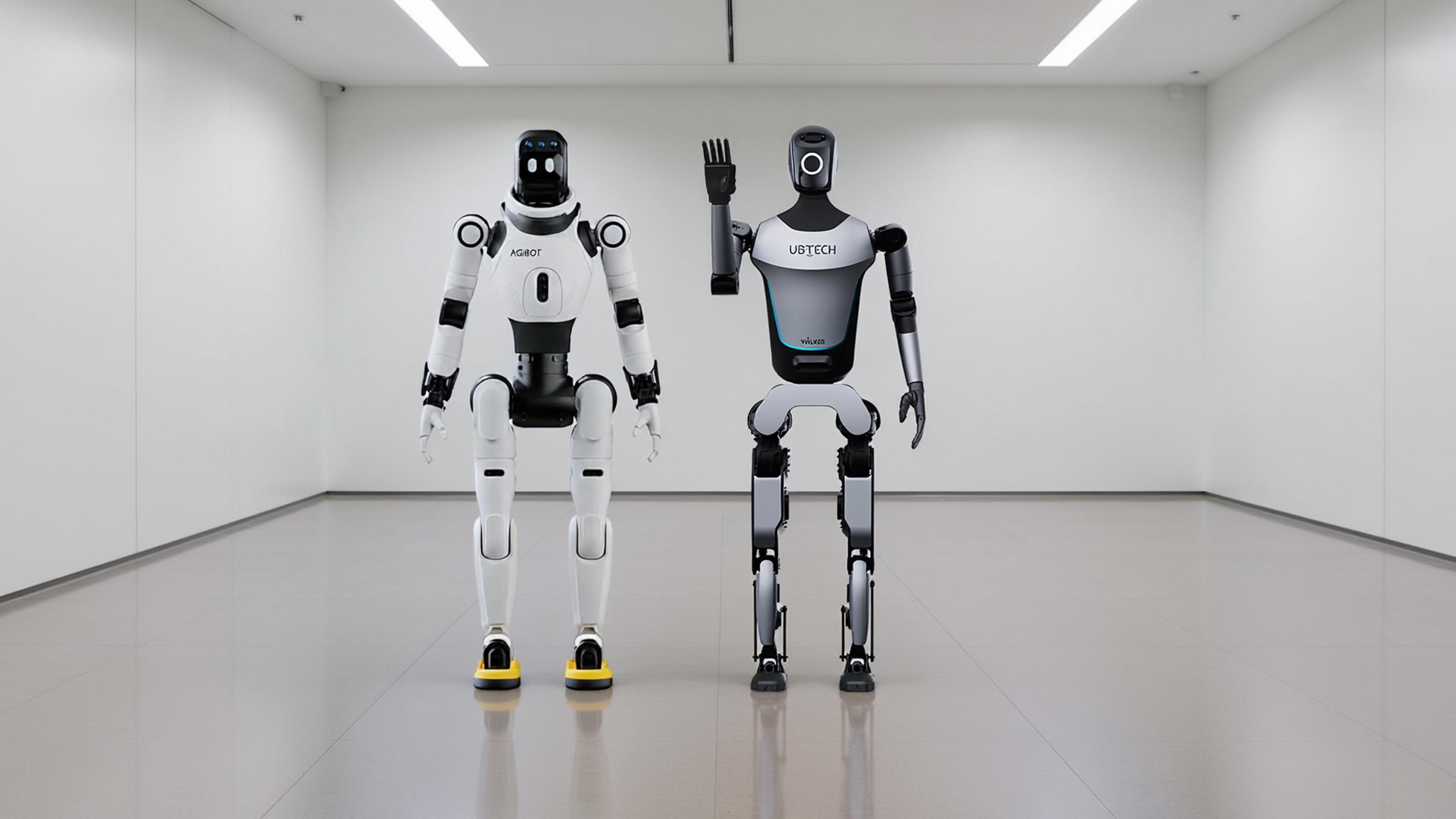
AGIBOT A2 and UBTECH Walker C are both full-size bipedal humanoid robots compared here on locomotion, manipulation capabilities, degrees of freedom, perception systems, human–robot interaction, operating endurance and commercial deployment.

November 13, 2026 by Business Desk Team
Introduction
AGIBOT A2 & UBTECH Walker C (2) are two full-size bipedal humanoid robots intended for human-facing settings and field deployment. The main difference between these two robots is their field capabilities and intended deployment setting. AGIBOT A2 offers autonomous mobility, multimodal interaction and a humanoid structure with a high degree of freedom. Walker C accentuates whole-body movement, engagement with visitors, multilingual interaction and guided experience.
AGIBOT A2 supports autonomous mobility, multi-modal interaction, enterprise applications, and light-duty manipulation. UBTECH Walker C is more targeted at visitor greeting, multilingual guidance, exhibitions, and media campaigns for direct public interaction. The main question is which platform supports the target workflow better-not which robot simply has a higher speed or strength figure.
At a Glance
| Metric | AGIBOT A2 | UBTECH Walker C |
|---|---|---|
| Robot type | Full-size bipedal humanoid | Full-size bipedal humanoid service robot |
| Best-fit use cases | Commercial interaction, retail, showrooms, manufacturing, industrial operations and R&D | Reception, exhibition guidance, office buildings, service centres, shopping malls and public entertainment |
| Height | 169 cm (manufacturer specification) | 163 cm |
| Weight | Approximately 69 kg (A2 Ultra) | 43 kg |
| Degrees of freedom | 40+ active DOF (A2 Ultra); 23 DOF (A2 Lite) | 20 DOF |
| Mobility / speed | Bipedal locomotion; up to 1.2 m/s (A2 Ultra) | Bipedal locomotion; advertised running pace of 6 km/h |
| Manipulation / arm capacity | 2 kg maximum arm load with dexterous hand (A2 Ultra) | 500 mm arm wingspan; payload capacity not specified |
| Runtime / charging | Approximately 2 h on general product specification; A2 Ultra documentation lists around 1.5 h walking or 3 h standing with voice broadcast; 2 h charging | 2 h walking, 4 h standing; approximately 1.5 h charging |
| Navigation / sensing | 3D LiDAR, RGB-D, RGB and fisheye cameras; autonomous navigation and obstacle avoidance | Two RGB-D cameras, two structured-light 3D cameras, high-precision IMU and U-SLAM navigation |
| Interaction / AI | Multimodal dialogue, large-language-model integration, enterprise knowledge bases, sound localisation and facial recognition | Embodied Interactive Large Model, multilingual interaction, customised database Q&A and adaptive guided narration |
| Connectivity | Wi-Fi and cellular connectivity; 4G/5G support listed for A2 Ultra | Wi-Fi and Bluetooth |
| Distinctive capabilities | Autonomous mobility, light-duty manipulation, modular humanoid design and battery swapping | Visitor guidance, multilingual interaction, whole-body motion control and public-facing entertainment |
| Key limitation / caveat | A2 Ultra and A2 Lite have different articulation, perception and manipulation capabilities | Manufacturer's 6 km/h figure refers to a running pace; payload capacity is not specified |
Specifications refer to the identified manufacturer configurations. A2 Ultra and A2 Lite figures should not be treated as interchangeable.
How They Compare
Operational role: AGIBOT A2 is suited for commercial and enterprise applications, such as retail and showroom operations, customer engagement, demonstration and industrial use. Multimodal AI and enterprise knowledge-base integration allow it to serve as a business adviser and demonstration guide. UBTECH Walker C leans further toward visitor-facing services, such as reception, exhibition guidance, multilingual guided tours and entertainment. It was used as a tour guide at the China Pavilion in Expo 2025 Osaka.
Physical configuration and articulation: AGIBOT A2 Ultra is 169cm tall & 69kg with 40+ active DoF A2 Lite: 23 DoF (separate configuration) Walker C: 163cm tall & 43kg & 20 DoF Walker C is lighter, but A2 Ultra has greater published articulation. DoF does not on its own tell us which robot will be more dexterous, perform tasks better, and move more effectively.
Locomotion and speed: A2 Ultra is said by the manufacturer to enable self-paced bipedal walking at up to 1.2 m/sec. Walker C is claimed to walk at 6 km/hr., with whole-body motion control and adaptable mobility. These are two different metrics describing different walking conditions that cannot be equated to a comparable walking speed. When testing these robots, consider stability, turning, stop distance, terrain travel and movement in close proximity to people.
Manipulation and load capacity: A2 Ultra is limited to light task manipulation, with a listed maximum arm load of 2kg (4.4 lb) on dexterous hands. The documentation separates grasping capability according to grip orientation. Specification from publication: Walker C's origin documentation lists a 5kg (11lb) arm weight but gives a published specification of a 500mm (20 inch) arm wingspan with a 6kg (13 lb) arm mass; there is no comparable published payload specification. The 10kg (22lb) A2 Ultra and 6kg (13lb) Walker C strengths should not be taken as officially recognised arm payloads.
Location and mobility: A2 Ultra includes 3D LiDAR, RGB-D cameras, RGB camera and fish-eye camera for viewing and mapping the environment, with autonomous navigation. Its documentation details obstacle avoidance and autonomous walking in real time. Walker C uses RGB-D and structured-light 3D camera, high precision IMU, and the U-SLAM navigational system from UBTECH for position and guided walking. Both Walker C and A2 Ultra have perception and navigation skills.
Perception and interaction: A2 applies large-language-model-based interaction, retrieval-augmented generation and customised enterprise knowledge bases to enable business consultation, guided presentation and conversational experiences. Its perception system powers audio-source localisation and facial recognition. Walker C applies UBTECH's Embodied Interactive Large Model to provide multilingual conversation, proactive greeting, customised database-based answer and dynamic tour narration. The enterprise-use interaction and visitor-guidance of A2 and Walker C respectively are three key factors to consider as part of the evaluation.
Run-time and deployment: as general A2 specs for AGIBOT on the A2 product page, about 2 hours of run-time and battery exchange. More detailed specs of A2 Ultra technical document write-out the working condition: walking for about 1.5 hours on a flat road and standing and voice broadcast for about 3 hours (charging time is about 2 hours), walker C specified 2 hours walk, 4 hours standing and the time to charge is about 1.5 hours. The run time comparison shall discern the walk while running and also the walking and the workload during the demonstration.
Important Qualification
AGIBOT A2: The A2 designation reflects a variety of configurations. The factory specifications have A2 Ultra (40 DOF) versus A2 Lite (23 DOF). The quoted 60kg, 40-49+ DOF, 1.9m/sec and 10kg strength figures should not be published as specifications for a single A2, as these figures are confirmed in a single configuration without documentation. The manufacturer lists approximately 69 kg for A2 Ultra, and a maximum arm load of approximately 2 kg.
UBTECH Walker C: The published specification of the manufacturer said 20 DOF, 43 kg, 2 hours walking endurance, 4 hours standing endurance and 1.5 hours charging. The supplied record claims 26 DOF and 3 hours runtime which does not match with the published specs. Its claim of 6 km/h is referred by UBTECH as running speed, not a walking speed.
Commercial status: The provided table specifies both robots as being commercial, but Walker C's manufacturer page only records particular application deployments, not a truly global commercial product. Verify existing orderability, support, software availability and delivery clauses with each producer.
Summary
Select AGIBOT A2 if you need: most humanoid features, autonomous mobility, multimodal interaction, enterprise knowledge-base integration, a higher-articulation A2 Ultra configuration. Select UBTECH Walker C if you need: visit reception, multi-lingual guiding, exhibition interaction, full body inter active demo, etc.
This is a context-appropriate comparison, not a controlled performance ranking. Before you issue your final claims on payload, speed, or runtime, verify exactly the A2 variant and Walker C config – and all specifications – are from the latest manufacturer documentation. Ask for demos under representative operating conditions, including walking with interaction on; obstacle crossing; manipulation; and battery runtime.
This comparison is based on ROBOT24.com market-research data records and manufacturer-reported specifications rather than controlled performance testing.
More articles on this topic
157 articles ReportRichtech DUST-E S vs. Gausium Phantas
 ReportEngineAI SE01 vs. AGIBOT RAISE A1ReportRichtech DUST-E S vs. KEENON KLEENBOT C20
 Report1X Technologies NEO Gamma vs. AGIBOT A2 Max
 ReportAI² Robotics AlphaBot 2 vs. AGIBOT A2-W
 ReportAGIBOT D1 Pro vs. Unitree Go2 Edu Plus
 ReportAGIBOT G2 vs. Astribot S1
 ReportAGIBOT D1 vs. ARAT 4.2
 ReportDouble Robotics Double 3 vs. temi V3
 ReportANYbotics ANYmal C vs. Deep Robotics Lynx M-20S
 ReportAGIBOT D1 vs. ANYbotics ANYmal C
 ReportAeiROBOT AIMY vs. AGIBOT G2 Genie
BUSINESS NEWS WEEKLY LETTER
The Weekly Letter for Robotics Professionals, Summarizing the Most Important Industry Moves, Launches, Deals and Signals.