AGIBOT G2 vs. Astribot S1
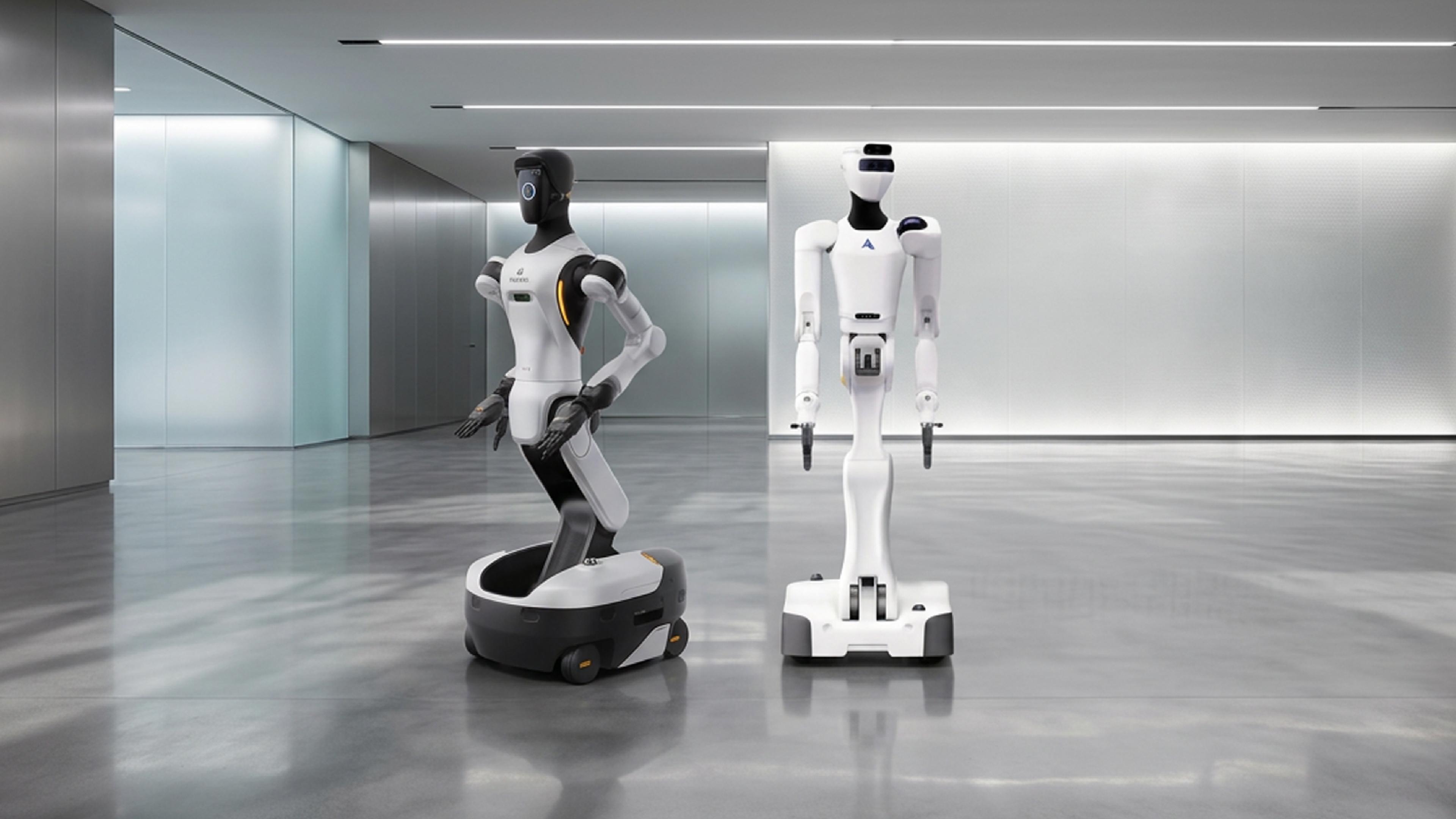
AGIBOT G2 and Astribot S1 are both wheeled humanoid robots for industrial manipulation compared here on mobility, arm configuration, payload capacity, force-controlled manipulation, perception systems, operating endurance and deployment versatility.

November 14, 2026 by Business Desk Team
Introduction
AGIBOT G2 and Astribot S1 are wheeled humanoid robot platforms to allow bringing manipulation skills as part of industrial or practical operational environments. While both combines wheeled mobility, manipulator arms, force-sensitive interaction and independent navigation, they have different mechanical structures and usage priorities.
AGIBOT G2 is an industrial-grade mobile manipulation platform based on a rugged omnidirectional chassis with two force-controlled manipulator arms. Astribot S1 is designed for high-speed, dexterous bimanual manipulation with seven- degree-of-freedom arms within a human-like workspace. The challenge here is determining which platform offers the most appropriate manipulation capabilities, working space, payload and environment-not which robot has the longest mission duration or the lightest frame.
At a Glance
| Metric | AGIBOT G2 | Astribot S1 |
|---|---|---|
| Robot type | Wheeled humanoid mobile manipulation robot | Wheeled humanoid dual-arm manipulation robot |
| Best-fit use cases | Manufacturing, industrial operations, precision handling and embodied AI development | Industrial manipulation, manufacturing, research and selected home-assistance applications |
| Height | 1,225–1,795 mm (adjustable) | 170 cm |
| Weight | 185 kg | 80 kg |
| Mobility | Four-wheel omnidirectional chassis; lateral movement and in-place rotation | Mobile wheeled platform with articulated upper body |
| Degrees of freedom | 26 body DOF (manufacturer brochure; some documentation lists 25) | 7 DOF per arm; total system DOF not confirmed in the supplied record |
| Manipulation / payload | 5 kg rated payload per arm | 5 kg rated payload per arm at horizontal reach |
| Runtime | Approximately 4 hours | 4–6 hours |
| Navigation / sensing | Autonomous navigation, dual 3D LiDAR, RGB-D and stereo cameras, fisheye cameras and ultrasonic sensors | Autonomous navigation, force/torque sensing and IMU; detailed navigation sensor configuration requires confirmation |
| Force control | Full-joint force control and force/torque sensing | Force/torque sensors and compliant manipulation architecture |
| Interaction / communication | Microphone array, Ethernet, Wi-Fi and interactive communication capabilities | Microphone array, Ethernet and Wi-Fi |
| Distinctive capabilities | Adjustable-height torso, omnidirectional mobility, dual-arm force control and industrial manipulation | High-speed bimanual manipulation, 194 cm arm span and ±0.1 mm positioning repeatability |
| Key limitation / caveat | 185 kg mass requires appropriate floor loading, workspace and deployment planning | Limited deployment status and task-specific manipulation performance require validation |
Specifications are for the supplied Robot24 record and available manufacturer and/or technical documentation. The number of DOF (s) in the G2 varies among published documents and the total system DOF in the S1 is not specified in the supplied record.
How They Compare
Operational role: AGIBOT G2 can work in manufacturing and industrial environments where mobile manipulation and force-controlled handling and interaction with the workstation are fundamental needs. Its height-adjustable structure and omnidirectional chassis enable operating in various working positions. Astribot S1 is driven by a dexterous bimanual operation platform based on human-scale manipulation, new research, and development in industrial applications, and the manufacturer also puts forward some home-related assist applications.
Mobility and physical configuration: G2 has a four-wheeled omnidirectional platform in place of a traditional bipedal walk. It can operate in a height range of 1,225 mm to 1,795 mm; and, as a heavy industrial robot, weighs 185 kg. Astribot S1 is about 170 cm tall, and it weighs about 80 kg. S1's light weight and different shape make it clearly a different kind of robot than G2, which was not built to be a walking humanoid. G2 has a flat chassis primarily designed for side-to-side motion and in-place rotation, while S1's mobile base was designed to support a dual-arm manipulation job.
Manipulation and payload: Each platform provides a 5 kg rated payload per arm. G2 combines seven-axis force-controlled arms with all-joint torque sensing, enabling controlled manipulation and accurate industrial handling. Astribot S1 also offers seven degrees of freedom per arm, with listed 5 kg payload at horizontal reach. The published end-effector velocity figure of at least 10 m/sec and positional repeatability of ±0.1 mm are both different kinds of performance specification, with payload rating defining the maximum rated load at a given set of conditions, and speed and repeatability not sufficiently defined terms of application throughput or handling accuracy.
Navigation and perception: G2's more mature industrial perception package comprises two 3D LiDAR sensors, head and wrist RGB-D cameras, stereo imaging, fisheye cameras and ultrasonic sensors, which allow G2 to perceive its environment, localise itself and move autonomously around industrial environments. The data provided with S1 demonstrates some autonomous navigation, IMU and force/torque sensor use but not to the same level of detail as G2's navigation sensors. Customers should confirm the map-building process, obstacle detection and localising effectiveness and autonomous route-planning features before assessing the two systems for navigation performance.
Force control and task execution: G2 is based on a full-joint force-control architecture to enable controlled physical interaction through manipulation. Astribot S1 focuses on compliant high-speed bimanual operation; the manufacturer's intent is a software-hardware architecture focused on AI manipulation capabilities. Both are applicable for tasks that involve more than straightforward pick and place; performance will need to be assessed based on the particular tools, end effectors, shapes of objects, gripping distance and orientation needed in the application.
Endurance and deployment: AGIBOT G2 reports around four hours' endurance with dual hot-swappable batteries; Astribot S1 reports four to six hours' endurance with plug-in power. Although the S1 has the longer claimed operating range, these numbers are not directly comparable without the same information on working conditions, frequently of movement, manipulation power configuration. Also factor in the heavier industrial platform of G2 with consideration of floor loading, access routes and workstation clearances.
Important Qualification
AGIBOT G2: Robot24 provided specifications says height is adjustable, weighs 185 kg and runs for four hours. Technical paper shows four-wheel omnidirectional chassis – not bipedal walking. Several versions of the published G2 number of body degrees of freedom range from 25 to 26 depending on paper and counting method. 5 kg payload per arm – not total payload capacity! – ends effectors, computer systems and battery configuration to be confirmed before ordering.
Astribot S1: Published specifications from the manufacturer show 170 mm height, 80 kg weight, seven degrees of freedom in each arm, 5 kg payload at the arms' horizontal reach, and four-to-six hours endurance. The provided release states "commercial adoption is limited," so prospective purchasers should verify availability in their region, as well as integration assistance, software availability, and post-sales support. Do not assume the published end-effector speed and repeatability numbers from the manufacturer are independently confirmed performance for all application environments.
Force/torque sensing and autonomous navigation cannot be used as the sole indicators that the robots are safe to physically interact with without restrictions. Verify operating limits, safety functions, emergency stop procedures and certification, if applicable, for the application.
Summary
Use AGIBOT G2 when industrial mobile manipulation with robot arm endpoints, variable height adjustment, omnidirectional capabilities, full-joint force control and a well-documented perception system are important. Use Astribot S1 when high-speed bimanual manipulation, a lighter mobile platform, human-sized reach and accurate end-effector positioning are significant.
This is a quality-specific, not controlled performance ranking. Verify the actual G2 configuration, Astribot S1 deployment capability and rated payload conditions of each system. Arrange for on-site trials with comparable items, equipment, workstations and paths of movement prior to any claims of superiority or final buying decision.
This comparison is based on ROBOT24.com market-research data records and manufacturer-reported specifications rather than controlled performance testing.
More articles on this topic
157 articles ReportRichtech DUST-E S vs. Gausium Phantas
 ReportEngineAI SE01 vs. AGIBOT RAISE A1ReportRichtech DUST-E S vs. KEENON KLEENBOT C20
 Report1X Technologies NEO Gamma vs. AGIBOT A2 Max
 ReportAI² Robotics AlphaBot 2 vs. AGIBOT A2-W
 ReportAGIBOT D1 Pro vs. Unitree Go2 Edu Plus
 ReportAGIBOT D1 vs. ARAT 4.2
 ReportDouble Robotics Double 3 vs. temi V3
 ReportANYbotics ANYmal C vs. Deep Robotics Lynx M-20S
 ReportAGIBOT D1 vs. ANYbotics ANYmal C
 ReportAeiROBOT AIMY vs. AGIBOT G2 Genie
 ReportAGIBOT A2 vs. UBTECH Walker C
BUSINESS NEWS WEEKLY LETTER
The Weekly Letter for Robotics Professionals, Summarizing the Most Important Industry Moves, Launches, Deals and Signals.