AGIBOT D1 Pro vs. Unitree Go2 Edu Plus
AGIBOT D1 Pro vs. Unitree Go2 Edu Plus are both quadruped robots compared here on mobility, navigation, sensing capabilities, programmability and deployment.

November 14, 2026 by Business Desk Team
Introduction
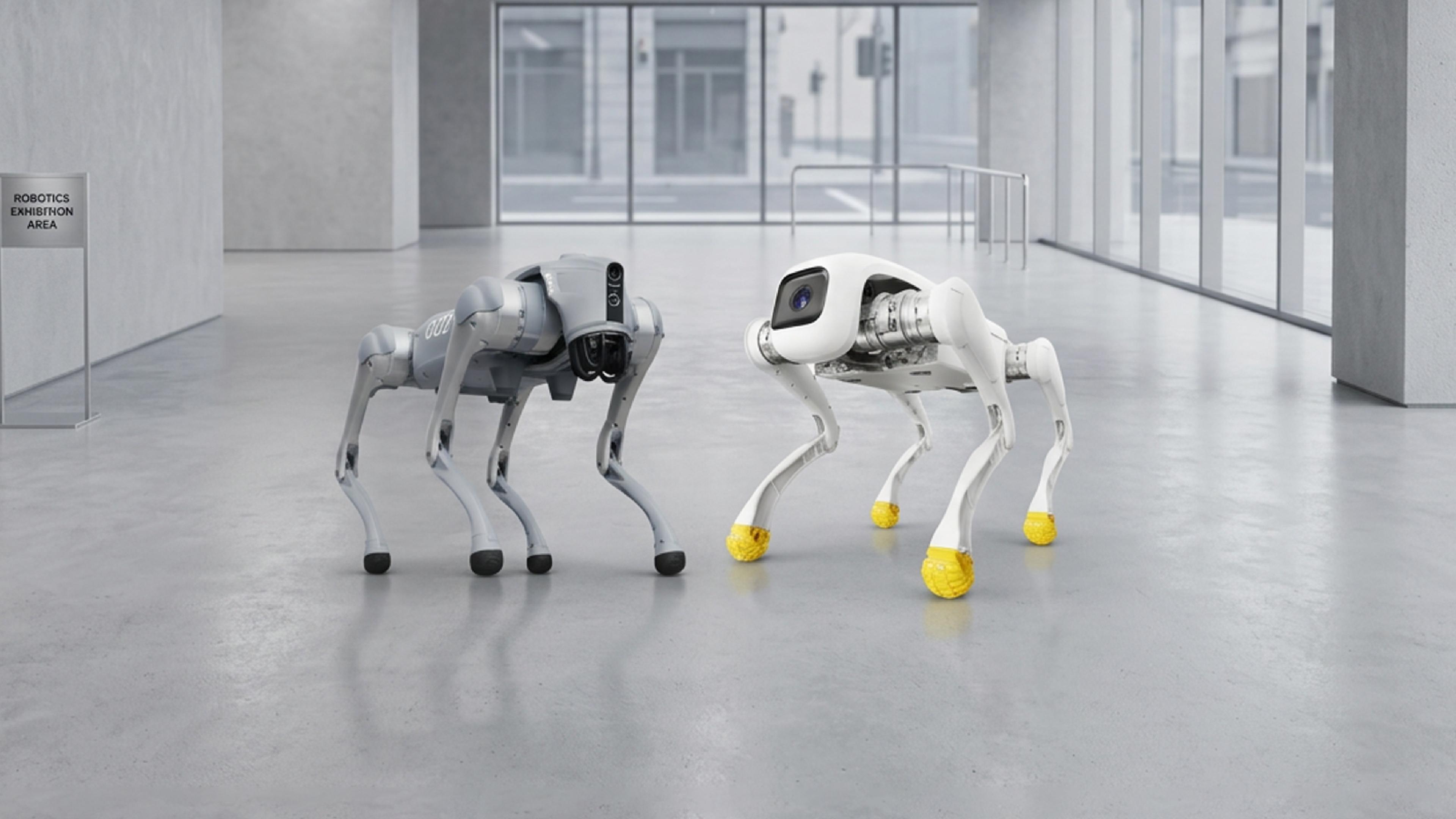
AGIBOT D1 Pro and Unitree Go2 Edu Plus are quadruped robots for research, education, training and industrial applications. Both models operate using a 12-degree-of-freedom platform and are capable of dynamic movement, but there are various differences between the two robots.
AGIBOT D1 Pro is a remotely controlled quadruped with autonomous gait adaptation. Unitree Go2 Edu Plus is an AI research quadruped with autonomous navigation. Of course this is a broad headline comparison: one is a remotely operated platform, the other has autonomous mobility as a baseline feature. The comparison must necessarily be about navigation, locomotion, the mechanicals, and the deployment/competition scenarios rather than headline speed.
At a Glance
| Metric | AGIBOT D1 Pro | Unitree Go2 Edu Plus |
|---|---|---|
| Robot type | Remote-operated quadruped robot | AI research quadruped robot |
| Best-fit use cases | Education, training, security, surveillance and industrial operations | Research, development, education, training and industrial operations |
| Degrees of freedom | 12 total; 3 per leg | 12 total |
| Dimensions | Standing: 635 × 360 × 420 mm; lying: 675 × 435 × 145 mm (L × W × H) | 760 × 310 × 200 mm (crouching configuration) |
| Maximum joint torque | 48 N·m | 45 N·m |
| Maximum speed | 3.5 m/s | 3.7 m/s; up to 5 m/s maximum |
| Navigation | Remote operation with automatic gait adaptation; autonomous navigation unverified | Autonomous navigation |
| Inertial sensing | Standard IMU | IMU |
| Locomotion | Quadrupedal locomotion with remote operation | Quadrupedal locomotion with autonomous navigation |
| Availability | Commercially available | Commercially available |
| Key limitation / caveat | Autonomous navigation is not confirmed in the supplied record | Maximum speed of 5 m/s should not be treated as sustained operating speed |
How They Compare
Operational role: AGIBOT D1 Pro is designed for education, training, security and surveillance, and manufacturing and industrial processes. Its full remote-operation system, together with its automatic gait adjustment, means operator-controlled deployment features prominently in its documented profile. Unitree Go2 Edu Plus is designed for research and development, education and training, and industrial applications. Its autonomous navigation system endows it with a distinct operational profile, especially for projects that involve autonomous quadruped motion.
Locomotion and mechanical configuration: Both robots feature 12 degrees of freedom, but D1 Pro specifies three degrees of freedom per leg, providing push and lying dimensions separately, and Go2 Edu Plus specifies its dimensions in a crouching state, so they are different postures and cannot be simply considered as a chassis size. They are both developed from the bionic quadrupedal platform, but gait control is a key factor for mobility.
Joint torque and speed: D1 Pro provides maximum joint torque of 48 Nm against 45 Nm for Go2 Edu Plus. It is also listed as maximum standard speed of 3.5 m/s in comparison to 3.7 m/s for Go2 Edu Plus, but Go2 Edu Plus also includes an alternate maximum speed of up to 5 m/s. This information does not alone determine better locomotion or payload. Joint torque alone does not determine load carrying and maximum speed should be demonstrated in similar terrain and battery and operating conditions.
Navigation and control: This is the most significant difference in the supplied specs. D1 Pro can be operated remotely with auto gait adaptation, but no auto navigation in the record. Go2 Edu Plus has dedicated screen for auto navigation. If you are buying for an autonomous inspection / mapping / research function, this difference relates to the degree of engagement a pilot may need, and the requirements of the software you'll need to integrate. Please doublecheck navigation features supported, remote control input options and limitations on the level of autonomy for each specific configuration.
Sensing and deployment: Each robot has an IMU and can use inertial measurements for navigation and orientation. The information given does not allow a full comparison of the robots' cameras, LiDAR, obstacle detection hardware, or perception ability in the environment. This needs to be verified before using either platform for autonomous inspection or human/equipment operation.
Important Qualification
AGIBOT D1 Pro: Included specification mentions 12 DOF, 48 Nm max joint torque, 3.5 m/s max speed, remote control and auto gait adaption. Autonomous navigation is not verified. Standing and lying sizes are for the body postures, not for the product.
Unitree Go2 Edu Plus: The provided record lists 12 DOF, 45 Nm max joint torque and autonomous navigation. Listed speed is 3.7 m/s, with 5 m/s as maximum speed. Assume the maximum speed is not indicative of continuous usage over certain types of terrain or desired workload. Dimensions are listed for the crouching configuration.
Both robots' torque and navigation parameters do not provide an officially certified payload or allow for unrestricted operation in the presence of people. Customers need to confirm payload capacity, sensor configuration, terrain capability, safety features, battery life and software support for the model.
Summary
Select AGIBOT D1 Pro if you need remote operation, automatic gait switching and operator-controlled deployment of your quadruped for education, surveillance or industrial applications. Consider the Unitree Go2 Edu Plus if you need autonomous navigation, research development and autonomous quadruped experimentation.
This provides a fit for purpose conclusion not a controlled performance ranking. Confirm the actual hardware and software configuration, compare the locomotion under comparable conditions and request demonstrations with similar terrain and operational tasks, before claiming superiority or final purchasing decisions.
This comparison is based on ROBOT24.com market-research data records and manufacturer-reported specifications rather than controlled performance testing.
More articles on this topic
157 articles ReportRichtech DUST-E S vs. Gausium Phantas
 ReportEngineAI SE01 vs. AGIBOT RAISE A1ReportRichtech DUST-E S vs. KEENON KLEENBOT C20
 Report1X Technologies NEO Gamma vs. AGIBOT A2 Max
 ReportAI² Robotics AlphaBot 2 vs. AGIBOT A2-W
 ReportAGIBOT G2 vs. Astribot S1
 ReportAGIBOT D1 vs. ARAT 4.2
 ReportDouble Robotics Double 3 vs. temi V3
 ReportANYbotics ANYmal C vs. Deep Robotics Lynx M-20S
 ReportAGIBOT D1 vs. ANYbotics ANYmal C
 ReportAeiROBOT AIMY vs. AGIBOT G2 Genie
 ReportAGIBOT A2 vs. UBTECH Walker C
BUSINESS NEWS WEEKLY LETTER
The Weekly Letter for Robotics Professionals, Summarizing the Most Important Industry Moves, Launches, Deals and Signals.