XPENG's IRON Humanoid Adapts to Changing Human Gestures in Real Time
Processing visual information every 0.2 seconds, the system aims to make human-robot interactions more natural, though reliability remains unproven.
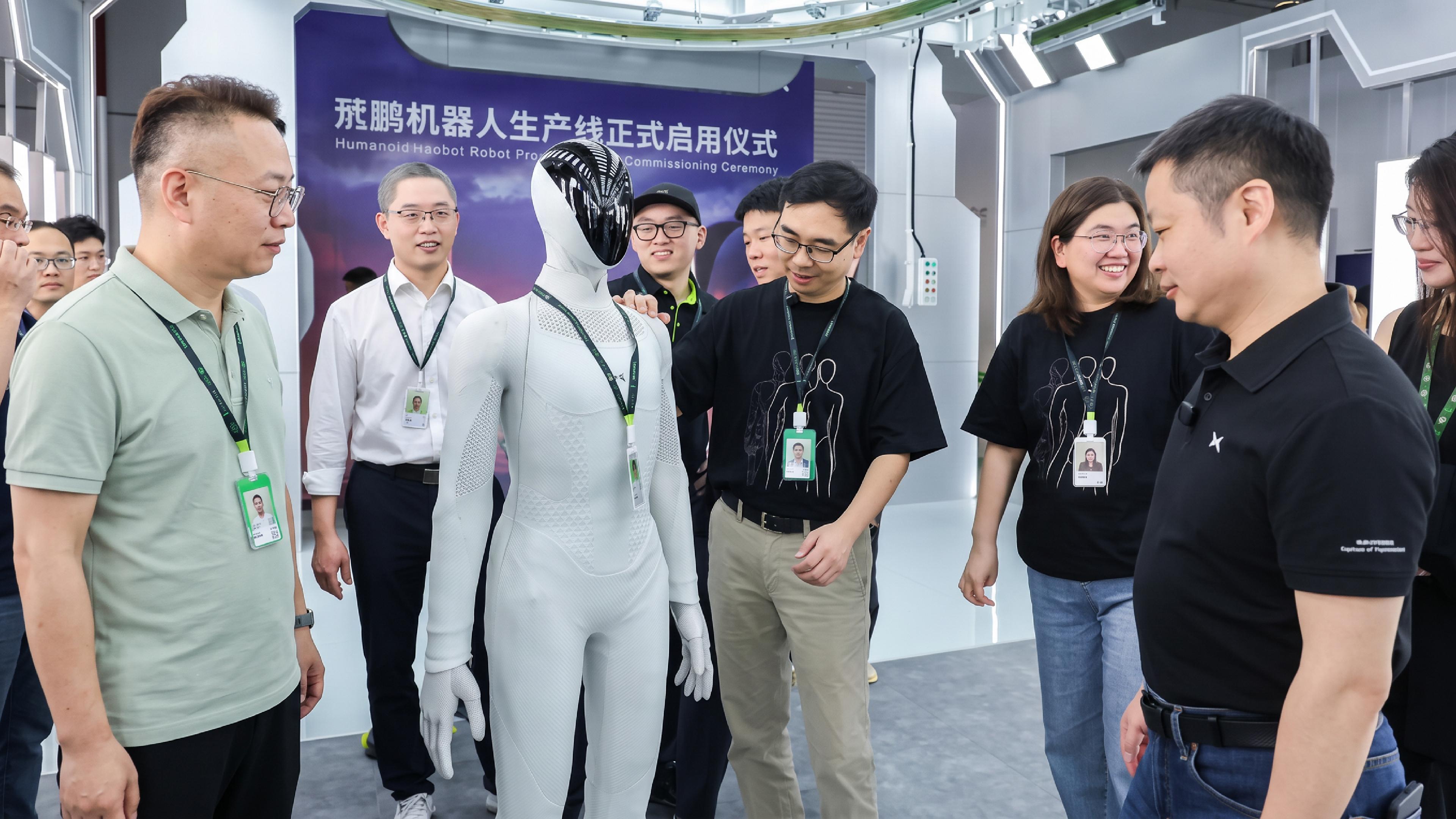
XPENG, the Chinese tech firm, has demonstrated a novel feature of its IRON humanoid, showing its ability to react to unanticipated changes in human gestures without requiring spoken instructions.
A video from October 22 shows IRON dealing with an individual who keeps altering his movements, going from a handshake to a fist bump or high-five and back again as the robot attempts to respond. The humanoid does not wait to finish a predetermined motion; it will alter course when the other person’s hand does. At one point, the tester extends an open hand for a handshake then abruptly makes a fist, whereupon IRON modifies its gesture in kind. In a later part of the footage, the person repositions for a high-five and the robot obliges by using the other hand.
How VLA 2.0 Works
XPENG says this is made possible by VLA 2.0, an enhanced Vision-Language-Action system that connects what the robot sees to its physical actions. The company explains the system is always taking in visual data from its environment and making a reassessment every 0.2 seconds to revise any planned movement.
While that translates to five reasoning updates in a second, it does not establish the robot's complete reaction time from detecting a gesture to performing the corresponding movement. XPENG also claims that the new model can even read ahead up to six seconds on the direction of human movement.
Why It Matters
The demonstration is meant to show technology that goes past the mere recognition of a single gesture by considering how movements develop over time. For a robot to be of use working with people, the difference is important. One does not follow a set pattern when handing something over or changing direction during an interaction; the robot must be able to adapt to the situation.
This comes after XPENG’s earlier work on IRON’s conversational side in controlled settings, such as its capacity to remember a customer’s preferences or converse in more than one language. All of which is part of getting the humanoid ready for commercial duties like visitor assistance.
What Remains Unproven
The October 22 footage is billed as a research and development piece. There is no indication from XPENG as to the success rate or how many takes went into the video, nor has the company disclosed performance figures from longer interactions with the public.
It has yet to make the case that IRON can be trusted with the sort of unpredictable physical contact found in an uncontrolled, busy setting. What the experiment does is illustrate a way to a more natural form of interaction, one in which the humanoid can accommodate a change of mind midway through an exchange.
More articles on this topic
235 articles ReportWhat it Really Costs to Own a Personal Assistant Robot at Home
 ReportA Little Company, Courtesy of a Robot
 ReportA Humanoid Walks into a New York Park
 ReportRailway Inspection Robots Search for Defects in Tracks
 ReportChina's Humanoid Supply Chain Moves Toward Industrial Production
 ReportCompanionship now comes with a Charging Cable
 ReportCould a Robotic Guide Help Blind Travelers Navigate Public Spaces?
 ReportThis Robot Finds Cracks and Fixes Them
 ReportRobots Are Learning to Sort Clothes for Textile Recycling
 Report110 Humanoid Robots Set Guinness World Record With Synchronized Dance
 ReportScientists Teach Humanoid to Climb Ladders and Survive Falls
 ReportThe Robot to Fill Potholes and Change How Road Repairs are Done
BUSINESS NEWS WEEKLY LETTER
The Weekly Letter for Robotics Professionals, Summarizing the Most Important Industry Moves, Launches, Deals and Signals.