Warehouse Robots: Has The Predicted Shakeout Actually Started?
The co-founders of Plus One Robotics predicted that 2026 will force a shakeout of single-task robot makers. Yet the manufacturing base is still expanding, with at least two dozen companies across more than a dozen countries each building for a different job on the warehouse floor.

September 1, 2026 by Business Desk Team
Consider this: Geekplus, the Chinese autonomous mobile robot maker that listed in Hong Kong in July 2025, reported its first adjusted net profit on March 30, 2026: 43.8 million RMB, on revenue of 3.171 billion RMB, up 31.6% year on year, according to the company's own results announcement.
With industry players recording figures like these, why would a robot maker need to consider investing in the development of multi-task automatons?
According to Erik Nieves, chief executive and co-founder of Plus One Robotics, single-task specialists will struggle against unified platforms offering standardized maintenance and predictable uptime, and buyers will start demanding documented proof of performance rather than controlled demos.
His co-founder and the company’s CTO Shaun Edwards echoed this sentiment, noting that "the gap between the number of companies in the market and the number that have achieved real, repeatable success is now too large to ignore."
It’s important to note that neither executive is a neutral observer. Plus One Robotics sells picking software and competes in this market. But the deal flow of the past year is consistent with what they describe.
The acquisition wave is real
Eight robotics acquisitions or strategic investments closed or were announced in the first half of 2026, most of them in warehouse and logistics robotics, according to an analysis by the China Mobile Robot Alliance, which listed Locus Robotics' acquisition of Nexera Robotics, Symbotic's acquisition of Fox Robotics, Bear Robotics' acquisition of Kinisi Robotics in June, Skild AI taking on Zebra Technologies' robotics automation business, and Geekplus's own investment in J-Elephant, among them.
The CMRA analysis characterized these deals as filling product gaps, particularly in grasping and scenario-specific capability, rather than adding capacity.
Independent specialists are still around
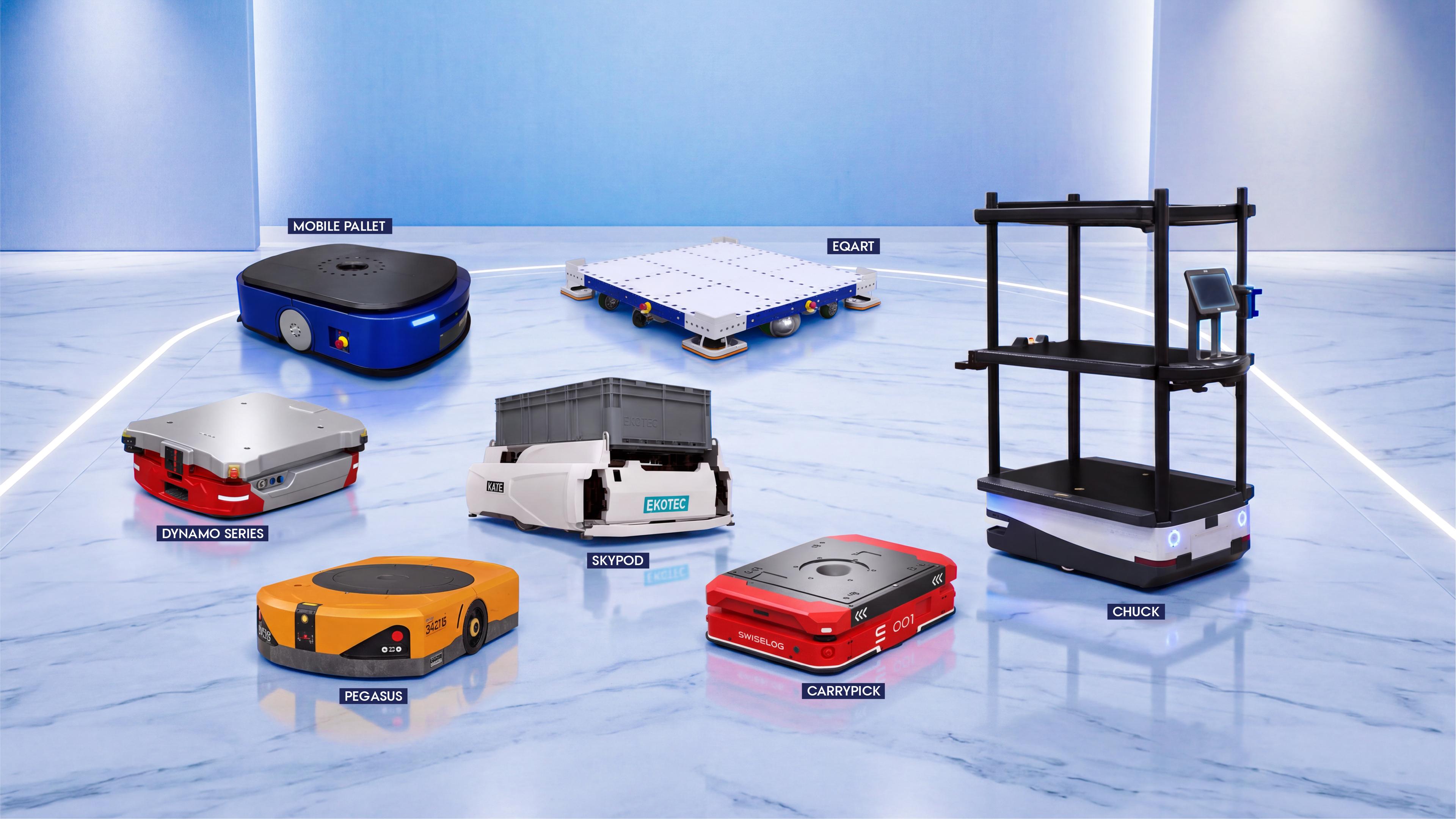
Platform builders sell complete automation stacks rather than single robot types. Denmark's Mobile Industrial Robots, founded in 2013 and now part of Teradyne, established the mobile-cobot category before extending into pallet-handling. Switzerland's Swisslog, with robotics roots tracing to 1900, builds CarryPick and IntraMove inside a wider systems-integration business. India's Addverb Technologies has built out its Dynamo series, and the UK's Ocado Intelligent Automation, established in 2023, supplies the Chuck and Hummingbird robots to outside customers.
Heavy-load specialists replace forklifts and tow tractors. Austria's AGILOX builds AGVs around what it calls swarm-intelligence navigation, designed to reroute without magnetic strips or rails. VisionNav Robotics builds autonomous forklifts; Malaysia's DF Automation & Robotics a broad AGV range; the US-Poland manufacturer AFORMIC underride robots that slot beneath pallet racks; Colorado's Prime Robotics the MobilePallet and RackBot lines. Spain's Robotnik Automation and Sweden's FlexQube, maker of the modular eQart carts, complete that group.
Compact AMR and dense-storage makers compete on maneuverability rather than payload. France's Exotec builds the Skypod, a cube-storage robot that climbs racking rather than travelling aisles, the design logic Norway's AutoStore popularised. Fellow French firm Sherpa Mobile Robotics and China's ForwardX Robotics, Hangzhou Lanxin Robotics and iBen Robot build multi-model tote-transport ranges. The US's Peer Robotics and Ultra Technologies, founded as recently as 2024, plus Denmark's Robotize and Japan's CuboRex, build smaller, lower-cost units. South Korea's Wonik Robotics supplies AMR chassis alongside its industrial arm business.
Two manufacturers mark the category's outer edges. Japan's NACHI-FUJIKOSHI, founded in 1928, added warehouse robots to a machine-tool and robotic-arm business. Sweden's Einride extends the same problem onto public roads with autonomous electric freight pods.
Where the two predictions stand
Both conditions Plus One's co-founders set have now been met at least once. Geekplus's own results announcement discloses the kind of proof of performance Nieves and Edwards said the market would start demanding, and the CMRA's count of eight acquisitions and investments in the first half of 2026 is a confirmed fact, not a prediction.
Whether that becomes the broader consolidation they forecast or stays limited to a handful of named deals and one profitable company is not yet settled.
The shakeout they called has produced its first confirmed cases in 2026, not yet its full scale.
More articles on this topic
103 articles ReportNoetix Robotics Reportedly Files for Hong Kong IPO
 ReportHumanoid Expands Nvidia Partnership for Onboard Robot AI
 ReportMitsubishi Electric Develops AI-Controlled Humanoid Machining System
 ReportEka Robotics Secures $150 Million to Advance Dexterous Automation
 ReportAgility Robotics Signs Deal to Pilot Digit at AGCO Factory
 ReportDream Labs Raises $90M, Offers Robot AI by the Hour
 ReportOpenAI Veteran Launches Factory Automation Startup With $232M
 ReportSchaeffler Opens China Factory Where Humanoids Build Robot Parts
 ReportPHYBOT Unveils Direct-Drive Robotic Hand With 23 Active Joints
 ReportOpenAI Expands Robotics Hiring to Develop Humanoid Hardware
 ReportRobots Can Do Physical Work, but Can Businesses Afford Them?
 ReportFAIRINO Targets Industrial Embodied AI With New Funding
BUSINESS NEWS WEEKLY LETTER
The Weekly Letter for Robotics Professionals, Summarizing the Most Important Industry Moves, Launches, Deals and Signals.