PUDU KettyBot vs. KEENON DINERBOT T8
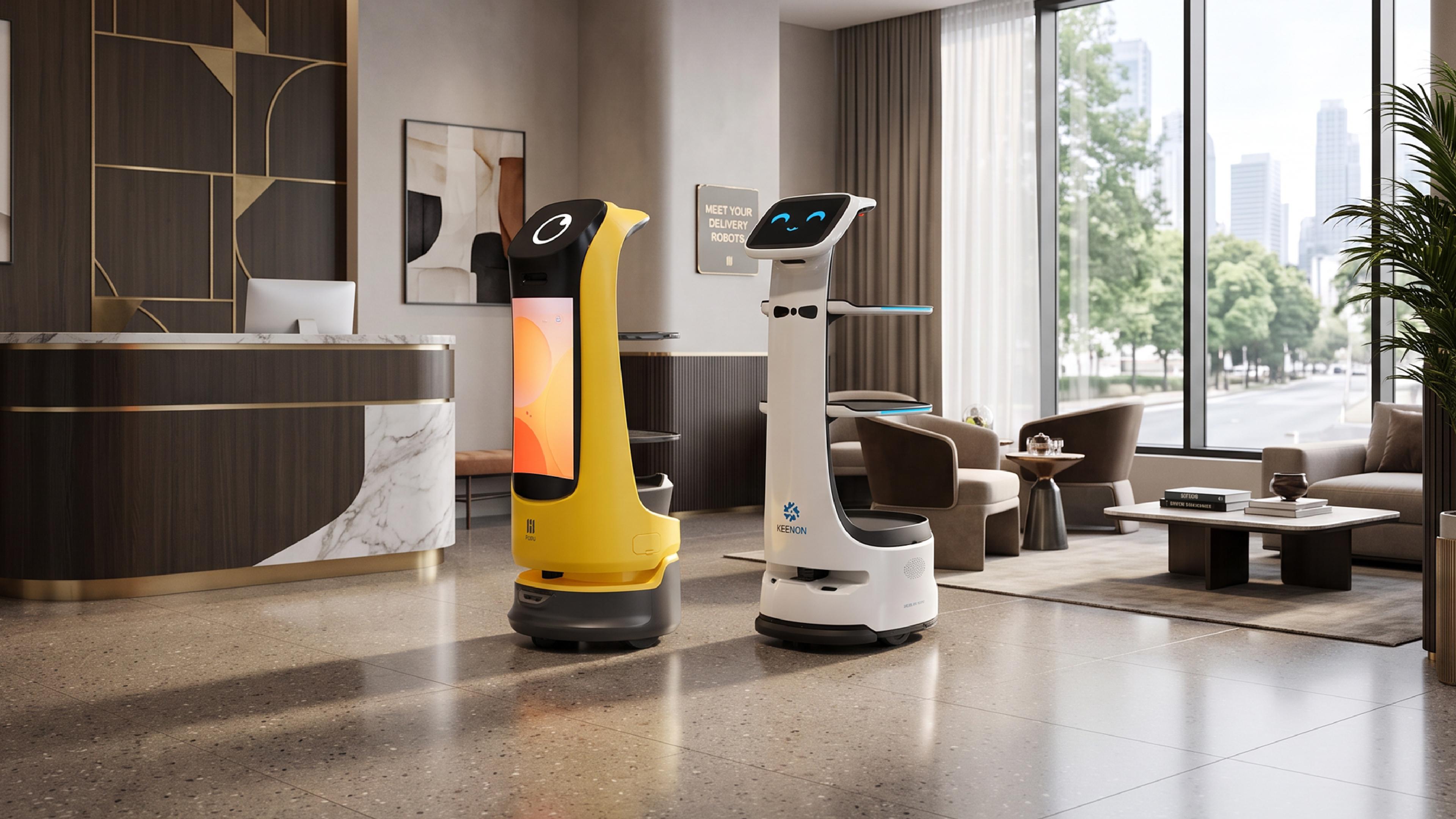
PUDU KettyBot and KEENON DINERBOT T8 are commercial service robots designed to support delivery and customer-facing operations. Both offer autonomous navigation, charging, human detection and multi-robot coordination. We compare their mobility, navigation systems, operating speeds, physical weight, connectivity and suitability for hospitality, healthcare and retail environments.

November 18, 2026 by Business Desk Team
Introduction
More and more restaurants, hotels, and other commercial premises adopt service robots which help with transportation of goods and customers-facing functions.
Such robots could help workers with carrying goods from one point to another, navigating indoors, and conducting regular servicing procedures. But not all commercial service robots are made for the same tasks.
While some robots are made for easy movement and interaction with clients, others are built specifically for efficient transportation of goods in an indoor space. KettyBot and DINERBOT T8 are two Chinese commercial service robots used in this context.
Both robots provide autonomy in terms of navigation, autonomous battery charging, human detection capability, Wi-Fi connection, and cooperation with several robots. They have similar recorded parameters regarding weight and battery charging needs.
But KettyBot and DINERBOT T8 differ in the descriptions of navigation systems, drive mechanisms, speed of movement, and weight of the robot.
This comparison is based on ROBOT24.com market research records, and analyses their mobility, navigation capabilities, operational needs, and applicability to different commercial service tasks.
At a Glance
| Autonomous Charging | Yes | Yes |
|---|---|---|
| Autonomous Navigation | Yes | Yes |
| Availability | Commercially Available | Commercially offered through KEENON regional channels and dealers; stock, installation and delivery by quotation. |
| Charging Time | 3.5–4.5 h | 4 h |
| Drive System | Autonomous Wheeled Base | Differential Drive |
| Human Detection | Yes | Yes |
| Maximum Speed | 1.2 m/s | 1.0 m/s |
| Mobility Type | Wheeled | Wheeled UGV |
| Multi-Robot Coordination | Yes | Supported |
| Nationality | Chinese | Chinese |
| Navigation | Dual SLAM | LiDAR SLAM |
| Weight | 38 kg | 34 kg |
| Wi-Fi | Yes | Yes |
| Typical use | Hospitality, Retail & Showroom Operations, Healthcare | Hospitality, Healthcare, Retail & Showroom Operations |
| Status | Commercial | Commercial |
How They Compare
Product positioning and intended applications
PUDU KettyBot and KEENON DINERBOT T8 are commercial robots which operate in hospitality, retail, showroom and health care industries. Both of them are intended for appropriate service workflows, but their configurations and customer-related features may vary.
KettyBot can be considered as a platform which supports delivery and service. DINERBOT T8 is related to commercial delivery and service activities. The robots' applications may involve movement of appropriate items between selected places.
But the specified specifications do not demonstrate identical carrying capabilities, tray configuration and customer interface. In order to estimate the exact capabilities of each robot, businesses should pay attention to the exact applications instead of application types.
Physical weight
Weight of PUDU KettyBot equals 38 kg. KEENON DINERBOT T8 is 34 kg heavy. Thus, it can be seen that the weight difference is 4 kg. This means that T8 is 10.5% lighter than KettyBot.
It can be easier to relocate the lighter robot if it is required. But the weight is not the only characteristic which influences on mobility and carrying capability. The dimensions, wheels configuration and structure of robots can be different.
No payload capabilities and sizes of robots are provided in the records. Thus, it is impossible to estimate carrying capability of robots based on weight only.
Autonomous navigation
Both KettyBot and DINERBOT T8 support autonomous navigation. This feature enables the robots to navigate suitable indoor routes without constant manual control.
Autonomous navigation may be helpful in places such as restaurants or hotels in which service routes are repeated throughout the day. Nevertheless, the fact that both robots feature autonomous navigation technology does not mean that their performances will be similar.
The efficiency of navigation depends on the sensor setup, the use of mapping software, route planning, and the ability to avoid obstacles. Only when both robots cover a certain route in comparable circumstances can a comparison be made.
Navigation technology
According to the provided specifications, KettyBot features dual-SLAM navigation technology. Meanwhile, DINERBOT T8 uses LiDAR SLAM. SLAM is an abbreviation for simultaneous localization and mapping.
The technology allows the robot to determine its location while creating a map of the surrounding area. In LiDAR SLAM, laser-based distance measurements are utilized for this purpose.
The use of term dual SLAM suggests that KettyBot supports dual navigation, but the provided specifications do not specify what sensor setups are used by KettyBot. These descriptions cannot be viewed as any proof of accuracy or reliability of the corresponding navigation system.
Drive system
KettyBot is stated to have an autonomous wheeled base. DINERBOT T8 features differential-drive mechanism. Usually, a differential drive system manages motion through controlling the speeds of wheels placed on either side of the robot.
This system allows turning and maneuvers in indoors. However, there is no specification of the particular drive system used in KettyBot's wheeled base. The two descriptions thus provide different technical detail level. A comparison of the turning radius and other factors of maneuverability and drive would need additional information.
Mobility type
Both robots have wheeled mobility. KettyBot is classified as a wheeled robot. DINERBOT T8 is classified as a wheeled unmanned ground vehicle (UGV). Basically, both are wheeled robots and do not use legs or tracks to move around indoors.
The wheeled mobility works well indoors for the cases when floor and trajectory are accessible. However, the performance may be affected by floor transitions, slops, thresholds, and available space for turning.
Neither record specifies the maximum climbing angle, maximum obstacle crossing height, and minimum passage width. Such information would be necessary for the facilities with narrow passages or uneven floors.
Maximum movement speed
KettyBot has a maximum speed equal to 1.2 m/s. T8 has a maximum speed of 1.0 m/s. Converted to the kilometers per hour, this means 4.32 km/h and 3.6 km/h, respectively.
From the information given, the maximum speed of KettyBot is 20% higher than that of T8. However, the maximum speed should not be equated to the delivery speed. The robot may slow down when delivering a cargo, maneuvering through crowded areas or approaching the point of delivery.
Route length, obstacle avoidance, and customer interaction could also affect the performance of the robot. An effective comparison would require the same delivery path to be completed by both robots.
Human detection
Human detection capabilities are supported both by KettyBot and DINERBOT T8. These capabilities are useful in robots that work in direct contact with customers. Many people move around in restaurants, hotels, and other similar establishments, and their locations and movements cannot be predicted.
Human detection may assist the robot in recognizing humans within the robot's field of operation. But the information provided does not mention any specific sensors or detection technologies used in either platform.
Also, the information does not show any equal human detection range, time of reaction or safety performance. It means that human detection should be reviewed as an integral part of the robot's navigation and obstacle avoidance system.
Autonomous charging
The robot in question supports the autonomous charging function. This feature helps to decrease the necessity of connecting the robot to a charger manually.
Under appropriate operating conditions, the robot can return to its charging station as part of the robot's charging process. But at the same time, the provided information does not tell anything about the process of charging for either robot.
The robot's autonomous charging does not imply that the robot will operate autonomously during the entire cycle of its operation. Some activities, such as performing services, inspecting and maintaining the robot should be performed manually.
Charging time
KettyBot has an established charging time of 3.5-4.5 hours. DINERBOT T8 has an established charging time of four hours. Thus, both of them have close charging times.
In addition, the charging time of the latter falls into the range of the former's established charging time. Therefore, the provided specifications do not allow us to distinguish a significant difference between the charging times of the two robots.
However, it is also necessary to take into consideration the running time of each of the robots.
Multi-robots coordination
Both of the robots allow coordination of several robots in one place. This factor can be important for organizations using several robots at once in the same building.
For instance, in restaurants, there may be a necessity to use several robots in different areas.In this case, coordination software can be useful in managing these compatible robots in a common environment.
However, the provided information does not indicate the maximum number of robots that can be coordinated through the corresponding software in each of the cases.
Wi-Fi connectivity
Both robots support Wi-Fi. Wireless connectivity can support compatible communication, configuration and management functions. For businesses operating multiple service robots, network reliability may be important.
However, Wi-Fi support alone does not establish identical remote-monitoring or cloud-management capabilities. The supplied records do not specify supported wireless standards, frequency bands or network requirements. Organizations should confirm compatibility with their existing infrastructure before deployment.
Restaurant service applications
Both KettyBot and DINERBOT T8 may be relevant to restaurant service workflows. Service robots can support staff by transporting suitable items between designated locations.
KettyBot's higher recorded maximum speed may be relevant to movement between service points. T8's lighter recorded weight may influence handling and deployment arrangements.
However, neither specification establishes superior restaurant performance. For restaurant operators, carrying capacity, tray accessibility, minimum passage width and handoff procedures are especially important. These details are not included in the supplied comparison. A practical evaluation should examine how each robot handles the same loaded route through a representative dining environment.
Hospitality applications
Both robots belong to the same category of application: hospitality. It could mean that hotels or other hospitality establishments could utilize these robots for transport and customer service activities.
Both navigation and charging abilities may prove useful for performing repeatable service activities. The ability to detect people is important in case there is the need to perform certain tasks amid the presence of customers in the same room.
Nevertheless, it is necessary to note that the suitability of these robots will depend on the tasks being performed. The supplied records do not mention anything about elevator access and delivery in closed containers as well as compatibility with some hotel management software. The ability of the robot to work in such ways should not be assumed without further proof.
Retail and showroom operations
Both robots belong to retail and showrooms applications. There mobile service robots could be used for performing some of the customer service and transport activities in those environments.
The navigation ability allows performing the movement along the indoor path. However, no information is provided regarding the display and interaction with customers or promotion features.
It is especially important for the establishments that will buy a robot to engage the customers. Such information should be provided by comparing the transport and interaction abilities of these robots.
Healthcare applications
The category of the healthcare is also mentioned when describing the applications of both robots. The mobile service robots may be used in health care for performing transport and operational tasks.
However, hospitals and clinics may have some additional requirements with respect to cleanliness, privacy, and safety. The supplied records do not mention anything about certification for using these robots in health care environment or their ability to perform some medical procedures or move medical materials.
Commercial availability
Both KettyBot and DINERBOT T8 have commercial status. KettyBot is listed as commercially available. DINERBOT T8 is commercially offered through KEENON's regional channels and dealers.
For T8, stock, installation and delivery arrangements are subject to quotation. Commercial availability does not necessarily mean that every configuration is immediately available in every market. Businesses should confirm regional purchasing arrangements, warranty coverage, installation services and spare-parts availability.
Maintenance and operational requirements
Commercial service robots require routine maintenance to support reliable operation. Maintenance may include cleaning sensors, inspecting wheels, checking charging contacts and monitoring battery condition.
For food-service applications, carrying surfaces and relevant hygiene procedures may also require attention. KettyBot and DINERBOT T8 may have different maintenance requirements depending on their configurations.
The supplied records do not include directly comparable maintenance intervals, service costs or replacement-part requirements. These factors should be considered alongside purchasing costs and operational performance.
Summary
PUDU KettyBot and KEENON DINERBOT T8 are wheeled service robots developed to perform hospitality, retail, showroom and healthcare duties. Both robots have the following features: autonomous navigation, autonomous charging, human detection, Wi-Fi capability and multi-robots control.
KettyBot has the weight of 38 kg, uses dual-SLAM technology and the maximum recorded speed is 1.2 m/s. DINERBOT T8 has the weight of 34 kg, uses LiDAR SLAM technology and the maximum recorded speed is 1.0 m/s. From these figures, it is possible to conclude that KettyBot has the highest speed and T8 is the lightest robot among them.
The charging time of both devices is quite comparable – KettyBot requires 3.5-4.5 hours, T8 requires approximately four hours to get charged. Nevertheless, the provided specifications do not define which robot is better in terms of performance.
The two robots could be applicable in similar commercial facilities, yet their applicability will depend on the carrying capacity, width of corridors, navigational abilities, operational durability and workflow process.
Some important specifications, such as runtime, carrying capacity, trays number and minimum corridor width, are missing from the provided comparison. They should be known in order to make a better estimation of their performance in restaurants and hospitality industry.
The comparison is performed according to ROBOT24.com market research data records and not the results of the performance test. The navigation capabilities, delivery efficiency, battery life and commercial availability should be checked in current manufacturer documentation.
More articles on this topic
163 articles ReportRichtech DUST-E S vs. Gausium Phantas
 ReportEngineAI SE01 vs. AGIBOT RAISE A1ReportRichtech DUST-E S vs. KEENON KLEENBOT C20
 ReportAGIBOT X2 vs. Unitree R1
 ReportPUDU CC1 vs. UniRing MAX
 ReportPUDU KettyBot Pro vs. KEENON DINERBOT T9 Pro
 ReportPUDU CC1 vs. KEENON KLEENBOT C55 vs. UniRing MAX
 ReportCleanfix S170 Navi vs. SoftBank Robotics Whiz vs. KEENON KLEENBOT C30
 Report1X Technologies NEO Gamma vs. AGIBOT A2 Max
 ReportAI² Robotics AlphaBot 2 vs. AGIBOT A2-W
 ReportAGIBOT D1 Pro vs. Unitree Go2 Edu Plus
 ReportAGIBOT G2 vs. Astribot S1
BUSINESS NEWS WEEKLY LETTER
The Weekly Letter for Robotics Professionals, Summarizing the Most Important Industry Moves, Launches, Deals and Signals.