AGIBOT X2 vs. Unitree R1
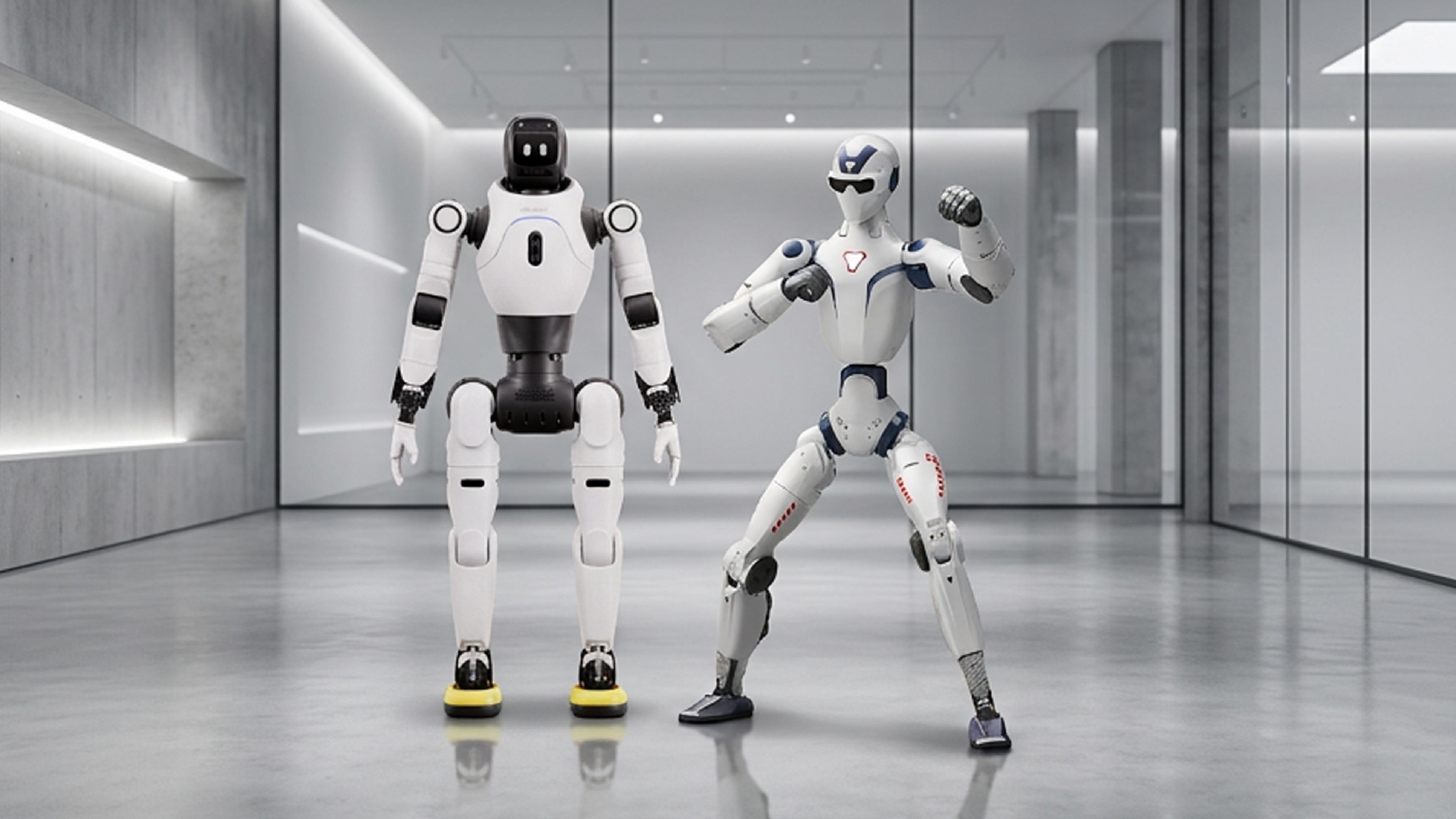
AGIBOT X2 and Unitree R1 are compact Chinese humanoid robots designed for research, development and interactive applications. We compare their mobility, speed, computing systems, degrees of freedom, battery configurations and commercial availability.

November 18, 2026 by Business Desk Team
Introduction
Small-scale humanoid robots are becoming more relevant to the research, education and interactive robotics. In contrast to large scale industrial humanoids, small-scale bipedal humanoids would allow developers a more convenient experimental environment for locomotion, perception and interaction with humans.
Nevertheless, compact humanoid robots could significantly vary in terms of their physical structure, computing system, joint structures and application area. AGIBOT X2 and Unitree R1 are two compact humanoid robots from China that belong to this type of platforms.
AGIBOT X2 is a robot platform developed for the purpose of interaction with people, education, research and services. The family of AGIBOT X2 products includes various joint structures, computing and sensing systems. Unitree R1 is a compact humanoid robot platform created for individual users, enthusiasts, educational establishments and laboratories conducting research. Both robots use bipedal locomotion and are equipped with wireless connectivity, making them suitable for embodiments of artificial intelligence. Nevertheless, according to the recorded specifications, there are some differences between physical characteristics, walking speed, weight, battery design and hardware design.
This comparison is based on ROBOT24.com market-research data.
At a Glance
| Height | 130 cm | 122 cm |
|---|---|---|
| Max speed | 5.4 km/h | 9 km/h |
| Runtime pr charge | ~2 hours at 0.5 m/s walking with 500 Wh battery hours | N/A hours |
| Strength | 3 kg | 10 kg |
| Walking Speed | 5.4 km/h | 9 km/h |
| Weight | 35–37 kg depending on variant kg | 25 kg |
| Availability | In production | Commercially Available |
| Battery | Integrated | Quick-Release Lithium Battery |
| Camera resolution | Interactive RGB camera; flagship model includes RGB-D camera + multi-line LiDAR + head-touch sensor | Stereo binocular camera (220 ° FOV on SV1‑25 module) |
| Color | Black, White | N/A |
| Connectivity | Bluetooth, Pro/Ultra optional 4G/5G module, Wi‑Fi | Bluetooth, Wi‑Fi |
| CPU/GPU | Base: RK3588 ×2; Ultra: RK3588 ×2 + optional NVIDIA Orin NX 157 TOPS | On‑board 8‑core CPU + GPU |
| Degrees of Freedom | Estimated 40+ | 20 (R1 Air), 26 (R1), 26–40 (R1 EDU) |
| Degrees of freedom, hands | 5 DOF per arm on base X2, 7 DOF per arm on Pro/Ultra | N/A |
| Degrees of freedom, overall | 27 to 31 DOF depending on version (base X2: 27 DOF; Pro/Ultra: 31 DOF) | 26 |
| Dexterous Hands | Yes | Optional (EDU) |
| Gear tech | N/A | Unitree has previously used quasi‑direct drives without harmonic reducers |
| Ingress protection | Not specified | Not specified |
| Latency glass to action | N/A | N/A |
| LLM integration | AI-driven decision making, uses a foundation model (GO-1) for general intelligence | multimodal large language model for speech & image recognition |
| Main market | Elderly-care, Entertainment, Home service, Light industrial assistance, Public interaction, Security | hobbyists, individual developer, research labs |
| Main structural material | flexible/impact-resistant materials for exterior | composite shell over alloy frame |
| Manufacturer | AgiBot | Unitree Robotics |
| Microphone Array | Yes | 4-Mic Array |
| Mobility Type | Bipedal Humanoid | Humanoid |
| Motor tech | Joint modules with peak joint torque 120 N·m. | Unitree in‑house smart actuators (same lineage as H1/G1); details pending |
| Nationality | China | Chinese |
| Number of fingers | 5 per hand | 10 |
| Operating system | Not publicly specified; likely optimized for real-time interaction given demo responsiveness (assumption) | Unitree typically ships a Linux‑based SDK |
| OTA Updates | Supported | Yes |
| Runtime | Not Publicly Disclosed | Approximately 1 Hour |
| Safe with humans | Yes — designed for human environments, with force limits and obstacle avoidance. | Not specified |
| Shipping Size | 131 cm × 46 cm × 21 cm | N/A |
| Terrain Adaptation | Yes | Yes |
| Website | https://www.agibot.com/products/X2 | https://www.unitree.com/ |
| Typical use | Hospitality, Education & Training, Research & Development | Education & Training, Research & Development, Development Platform |
| Status | Commercial | Commercial |
How They Compare
Product positioning and intended applications
AGIBOT X2 and Unitree R1 are both compact humanoid robots, but their recorded market positioning differs. AGIBOT X2 is associated with hospitality, education, research and public-facing applications.
Its listed markets also include entertainment, home service, elderly care, light industrial assistance and security. However, these categories describe potential applications and should not be interpreted as evidence of commercial deployment in every setting. Unitree R1 is positioned more directly toward hobbyists, individual developers, educational institutions and research laboratories. Its recorded applications emphasize robotics development, experimentation and training.
Both robots may be relevant to embodied AI research, but buyers should evaluate the hardware and software configurations available for their specific projects.
Height and physical dimensions
AGIBOT X2 measures 130 cm tall. Unitree R1 measures 122 cm.
X2 is therefore 8 cm taller. Both robots are smaller than many full-size industrial humanoids. Their compact dimensions may be relevant to educational environments, research laboratories and controlled indoor demonstrations. However, height alone does not establish reach, workspace or maneuverability. Arm length, joint range, body proportions and balance-control systems also influence the tasks a humanoid can perform. The supplied specifications do not include directly comparable reach measurements.
Weight and Physical Handling
AGIBOT X2 weighs about 35-37 kg, depending on the version. Unitree R1 weighs about 25 kg according to the provided records. Taking into account the aforementioned figures, one can state that R1 weighs approximately 10-12 kg less.
This may affect transportation and physical handling of the platforms in research environment. A lighter platform may be easier to move from one place to another to make several demonstrations or lab tests. However, lesser weight does not imply superiority in terms of locomotion, balancing and safety. Structures, actuator designs, control system of robots should also be taken into consideration.
Bipedal locomotion
Both robots have bipedal humanoid structure. AGIBOT X2 is referred to as bipedal humanoid. Unitree R1 is referred to as humanoid and uses two-legged design. Bipedal locomotion is related to research on balance, gait generation and movement in human-oriented environments.
However, walking ability cannot be based on the number of legs. Joint torque, control algorithms, feedback and the conditions of the terrain may play a role. The provided information lacks directly comparable indicators of balance recovery, step height and walking stability.
Maximum speed
AGIBOT X2 has the maximum speed of 5.4 km/h according to the records. Unitree R1 has the maximum speed of 9 km/h. According to these figures, R1 has greater maximum speed.
This maximum speed is approximately 67% higher than X2's. This may be relevant for researchers who study dynamic locomotion. However, the maximum speed does not define superiority of movement performance in any conditions.
A robot achieves maximum speed only under certain test conditions. There is no information about the equivalent conditions for X2 and R1. A comparison of their movements will be possible in similar conditions.
Walking speed
The supplied specifications also list walking speeds of 5.4 km/h for X2 and 9 km/h for R1. These match the figures recorded under maximum speed..
Terrain adaptation
Both AGIBOT X2 and Unitree R1 have terrain adaptation listed. Terrain adaptation can involve adjusting movement to accommodate changes in surface conditions. This capability is relevant to humanoid locomotion research.
However, the supplied records do not identify the exact terrain conditions supported by either robot. They also do not provide comparable maximum slope angles, obstacle-crossing heights or recovery capabilities. Therefore, the available data does not establish which robot performs better on uneven surfaces.
Degrees of Freedom
Degrees of Freedom or DOF define the number of independent movement possibilities in the robotic mechanism. The provided information includes various configurations of DOF of both platforms. AGIBOT X2 is specified as having 27–31 DOF in total depending on the configuration.
Accordingly, AGIBOT X2 is defined as having 27 DOF in its basic configuration, whereas Pro and Ultra versions are specified as having 31 DOF. There is, however, one more row estimating over 40 DOF of X2. The numbers appear inconsistent and need some explanation.
The Unitree R1 is estimated as having 20 DOF in its Air configuration and 26 DOF in its regular configuration, as well as 26–40 DOF in the R1 EDU. Regular R1 configuration is estimated as having 26 DOF in total.
Both platforms feature multiple configurations; therefore, any comparison between them should provide specific configurations used. More DOF does not necessarily mean better manipulation or locomotion capabilities. The location of joints, access to controls and actuators should be taken into account as well.
Articulation and manipulation of arms
AGIBOT X2 is provided as featuring arm configuration with 5 DOF of each arm in its base version and 7 DOF of each arm in Pro and Ultra versions. It means that AGIBOT X2 features different configurations of arm articulations.
The DOF for Unitree R1 arms are not provided in the supplied information. Overall, Unitree R1 DOF varies depending on configuration. In the context of manipulation research, arm articulation defines the possibility of reaching certain positions and orientations. However, only DOF numbers do not guarantee the ability to perform certain actions.
Hands dexterity
AGIBOT X2 has dexterous hands described in the provided specifications. The table describes five fingers per hand. Unitree R1 has optional dexterous hands attached to the EDU setup.
According to its number-of-fingers specification, the robot has ten fingers, but the precise hand configuration is not specified. Such details make a difference for researchers focusing on grasping and manipulation tasks.
Five-fingered hand does not mean the same as another five-fingered hand. Finger articulation, tactile perception, grip force, and control capabilities could be different. The provided specifications do not offer an equivalent set of hand DOF and tactile sensors descriptions for both robots.
Strength and load capacity
AGIBOT X2 has a strength specification of 3 kg. Unitree R1 has a strength specification of 10 kg. Given the specifications provided, R1 has a greater numerical value. However, the meaning of strength is ambiguous. It is unclear what parameter it represents - payload capacity, lift capacity, arm load or something else.
The two parameters should not be compared until their definitions become clear. For manipulation research, the load capacity should be evaluated with respect to reach capability, grip configuration and loading conditions.
Actuators and joint torque
AGIBOT X2 has joint modules with a maximum joint torque of 120 N·m. It is possible that the torque parameter will play some role in locomotion control of AGIBOT. Unitree R1 has in-house smart actuators, according to the table. They are linked to Unitree's overall experience in the humanoid actuator development, but there is no R1's specific actuator data available yet.
Furthermore, the table mentions Unitree's previous use of quasi-direct drive without harmonic reducers. Such historical data cannot be automatically considered as R1 drivetrain specification.
For a fair actuator comparison, joint specific torque, transmission and control data for both robots would be needed
Operating runtime
According to the provided X2 specifications, the estimated runtime of this unit while walking at a pace of 0.5 m/s is two hours and the battery capacity is 500 Wh. According to the provided information, the operating runtime of Unitree R1 is approximately one hour.
Connectivity
Both AGIBOT X2 and Unitree R1 support Bluetooth and Wi-Fi. In addition, Pro and Ultra configurations of X2 have an optional 4G/5G connectivity. This connectivity option can give additional opportunities for communication in some deployments.
Unitree R1 is not equipped with cellular connectivity; however, this fact does not prove that the third-party connectivity is impossible. For research purposes, the network capabilities should be considered along with developer access and data transfer options.
Software updates
According to the provided records, both robots support over-the-air software updates. This feature simplifies software updating and deployment of improvements.
However, the presence of the OTA update capabilities does not mean that the software update schedules and support are the same. Research institutions should clarify the update process, version management, and compatibility requirements.
Structural materials
AGIBOT X2 is equipped with flexible or impact-resistant exterior materials. At the same time, Unitree R1 has a composite shell on top of an alloy frame. These materials can affect the durability and weight.
Education and research applications
Education and research are the common application fields for both robots. AGIBOT X2 can be useful in human interaction, perception, and manipulation research. It has several configurations with different sensors, arm articulations, and computing hardware.
At the same time, Unitree R1 is positioned toward developers, research laboratories, and educational institutions. The product family of this robot includes robots with different DOF and manipulation capabilities.
For research institutions, the choice of the robot depends on the experiments performed. The institution that focuses on locomotion can pay attention to joint control, movement capabilities, and simulation support. At the same time, the institution that studies manipulation can emphasize arm articulation, dexterous hands, and sensing systems.
Commercial availability
AGIBOT X2 is listed as being in production. Unitree R1 is listed as commercially available. Both also have commercial status in the supplied table.
However, production status and commercial availability are not identical. A robot may be in production without every configuration being available for immediate delivery. Likewise, commercial availability can vary by region, configuration and supplier. Organizations should confirm ordering procedures, shipping timelines, software access and after-sales support before procurement.
Summary
AGIBOT X2 and Unitree R1 are compact Chinese humanoid robots designed for research, education and other interactive applications. AGIBOT X2 measures 130 cm tall and weighs approximately 35–37 kg, depending on the variant.
It has a recorded maximum speed of 5.4 km/h and offers configurations with different arm articulation, sensing hardware and computing capabilities. Its listed applications include hospitality, public interaction, education and research.
Unitree R1 measures 122 cm tall and weighs 25 kg. It has a recorded maximum speed of 9 km/h and is positioned toward developers, hobbyists, educational institutions and research laboratories. Based on the supplied figures, R1 is lighter and has a higher stated maximum movement speed.
X2 offers documented configurations with additional sensing and manipulation hardware, although the exact capabilities depend on the variant. Both robots support wireless connectivity, OTA updates and terrain adaptation.
However, their recorded degrees of freedom, runtime and strength figures require further verification before they can be compared directly. These differences do not establish an overall performance winner.
AGIBOT X2 may be relevant to organizations prioritizing interactive applications, perception and manipulation research. Unitree R1 may be relevant to developers and research teams prioritizing a lighter humanoid platform and dynamic locomotion.
The appropriate choice depends on the exact model configuration, developer access, manipulation requirements, operating endurance and intended application.
This comparison is based on ROBOT24.com market-research data records rather than controlled performance testing. Technical specifications, software capabilities, commercial availability and performance claims should be verified against current manufacturer documentation before drawing conclusions about overall performance.
More articles on this topic
163 articles ReportRichtech DUST-E S vs. Gausium Phantas
 ReportEngineAI SE01 vs. AGIBOT RAISE A1ReportRichtech DUST-E S vs. KEENON KLEENBOT C20
 ReportPUDU CC1 vs. UniRing MAX
 ReportPUDU KettyBot vs. KEENON DINERBOT T8
 ReportPUDU KettyBot Pro vs. KEENON DINERBOT T9 Pro
 ReportPUDU CC1 vs. KEENON KLEENBOT C55 vs. UniRing MAX
 ReportCleanfix S170 Navi vs. SoftBank Robotics Whiz vs. KEENON KLEENBOT C30
 Report1X Technologies NEO Gamma vs. AGIBOT A2 Max
 ReportAI² Robotics AlphaBot 2 vs. AGIBOT A2-W
 ReportAGIBOT D1 Pro vs. Unitree Go2 Edu Plus
 ReportAGIBOT G2 vs. Astribot S1
BUSINESS NEWS WEEKLY LETTER
The Weekly Letter for Robotics Professionals, Summarizing the Most Important Industry Moves, Launches, Deals and Signals.