Intel and SAP Bring Physical AI Closer to Factory Operations
The companies connect enterprise software with autonomous robots, allowing business systems to assign physical tasks and track their completion.

October 30, 2026 by Artem
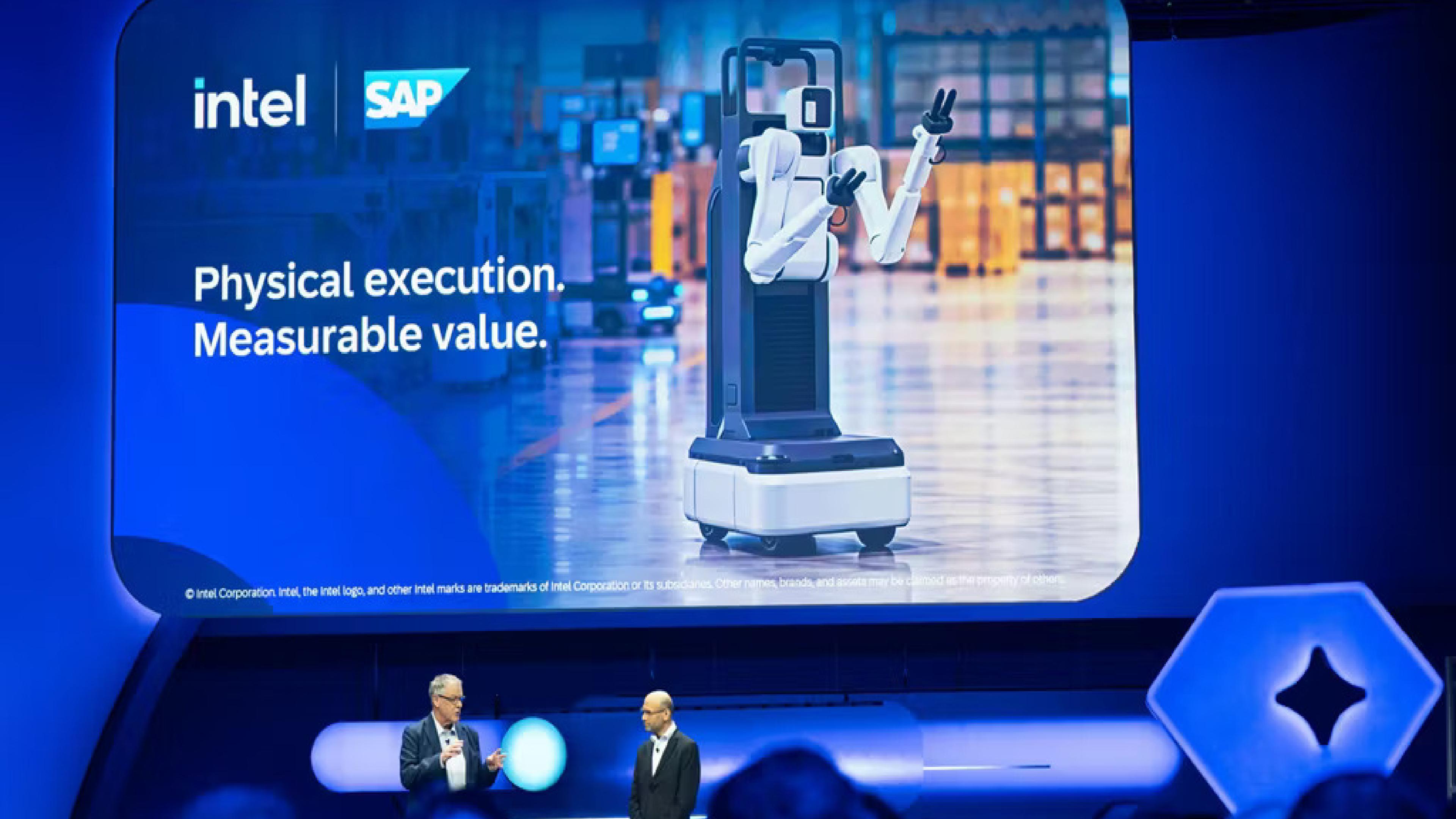
SANTA CLARA, Calif. -- Intel and SAP have been collaborating to bridge the gap between physical AI and the software that controls manufacturing processes, so that the autonomous robots receive their tasks straight from the enterprise system and then report the outcome.
The U.S. chipmaker and German software giant demonstrated the technology at SAP's TechEd event in late October, illustrating how the warehouse management software instructs the autonomous material handling robots without the need for any separate task assignments.
This project tackles one of the issues that manufacturers face - integration of robots doing physical work and business systems responsible for managing inventory, production plans and operations.
The companies have created a proof of concept solution using SAP Extended Warehouse Management (SAP EWM) software combined with Intel's edge AI hardware and robotics software solution at the Intel manufacturing plant in Chengdu, China.
In case SAP EWM needs to transport some materials, the system creates a mission for the autonomous robot to do that. The robot handles the material, and reports task progress and completion back to SAP EWM system.
Intel claims the system decreased the distance of material transport and repetitive manual handling, but hasn't revealed the productivity numbers, the number of robots used or comparisons with existing automation systems.
Connecting IT, Physical Work
The partnership involves more than simply controlling the robots. SAP handles the workflow, priorities and processes, while Intel provides the computing capabilities for robots to recognize and act on their environment.
Intel’s solution involves central, graphics and neural processing units combined with software for robotics, namely OpenVINO Physical AI and Robotics AI Suite.
The companies have developed an architecture that is supposed to work for robots of various manufacturers, operating systems and AI models. This way, factories will be able to incorporate different equipment without relying on any particular robotics vendor.
However, Chengdu has not proved how easy it is to duplicate the solution in other factories or fleets of robots.
SAP works on integration of a similar kind in other industries. At Arçelik-LG, which makes air conditioners, there is a storage humanoid robot keeping track of what it does in SAP warehouse management software. The company reports that the solution solves problems associated with wrong storage and claims to save millions of euros.
Building materials producer Holcim has implemented physical AI capabilities for equipment inspections, according to SAP. Quadruped robots check the conveyor, while drones examine difficult-to-reach equipment.
Maintenance plans generated in SAP initiate the inspections, and notifications are returned to the enterprise system after the tasks are completed.
SAP also identifies electronics manufacturer Foxconn as a collaborator connecting warehouse tasks with humanoid robots and autonomous transport systems.
Challenge Beyond Demonstration
For manufacturers, connecting robots to enterprise software means new requirements in addition to navigation and object manipulation.
Robots should perform actions based on corporate priorities, inform about failures, and provide information usable by other systems used in manufacturing processes. Enterprise software must cope with exceptions if the physical job cannot be performed according to instructions.
According to Intel and SAP, the approach they developed is intended to bridge these processes and allow their customers to select whatever platform for robots they want.
Neither costs nor performance indicators and timeframes of deployment were provided by Intel and SAP to assess the approach's industrial feasibility.
As of now, the Chengdu project of Intel is only a prototype, and the next step is to test whether the same system will work in routine manufacturing without extensive customization.
More articles on this topic
115 articles ReportMaximo Claims New Robot System Boosts Installation Productivity 2.5 Times
 ReportFoundry Robotics Raises $100M to Expand AI-Powered Assembly
 ReportAgiBot Unveils Hardware as First-Half Revenue Nears 2 Bln Yuan
 ReportChina's AI Stock Rout Puts Humanoid Robot Boom to the Test
 ReportANYbotics Starts Deliveries of Explosion-Protected Quadrupeds
 ReportOtto Group Plans Up to 25 Sereact Robots for Returns Processing
 ReportUnitree Reports 17% Profit Drop in First Earnings Since IPO
 ReportRockwell's AI Ambitions Test the Limits of Factory Automation
 ReportMachenta Raises $40M to Develop Robots That Learn From One Demo
 ReportQiyuan Claims 20-Fold Daily Robot Production Jump in One Month
 ReportMaxinsights Updates $30M Robot Training Funding Release
 ReportChina's Humanoid Supply Chain Moves Toward Industrial Production
BUSINESS NEWS WEEKLY LETTER
The Weekly Letter for Robotics Professionals, Summarizing the Most Important Industry Moves, Launches, Deals and Signals.