DEEPRobotics Lynx M20 vs. Unitree B2-W
Two wheel-legged industrial quadrupeds compared on payload, speed, endurance, terrain mobility and autonomous navigation.

October 2, 2026 by Business Desk Team
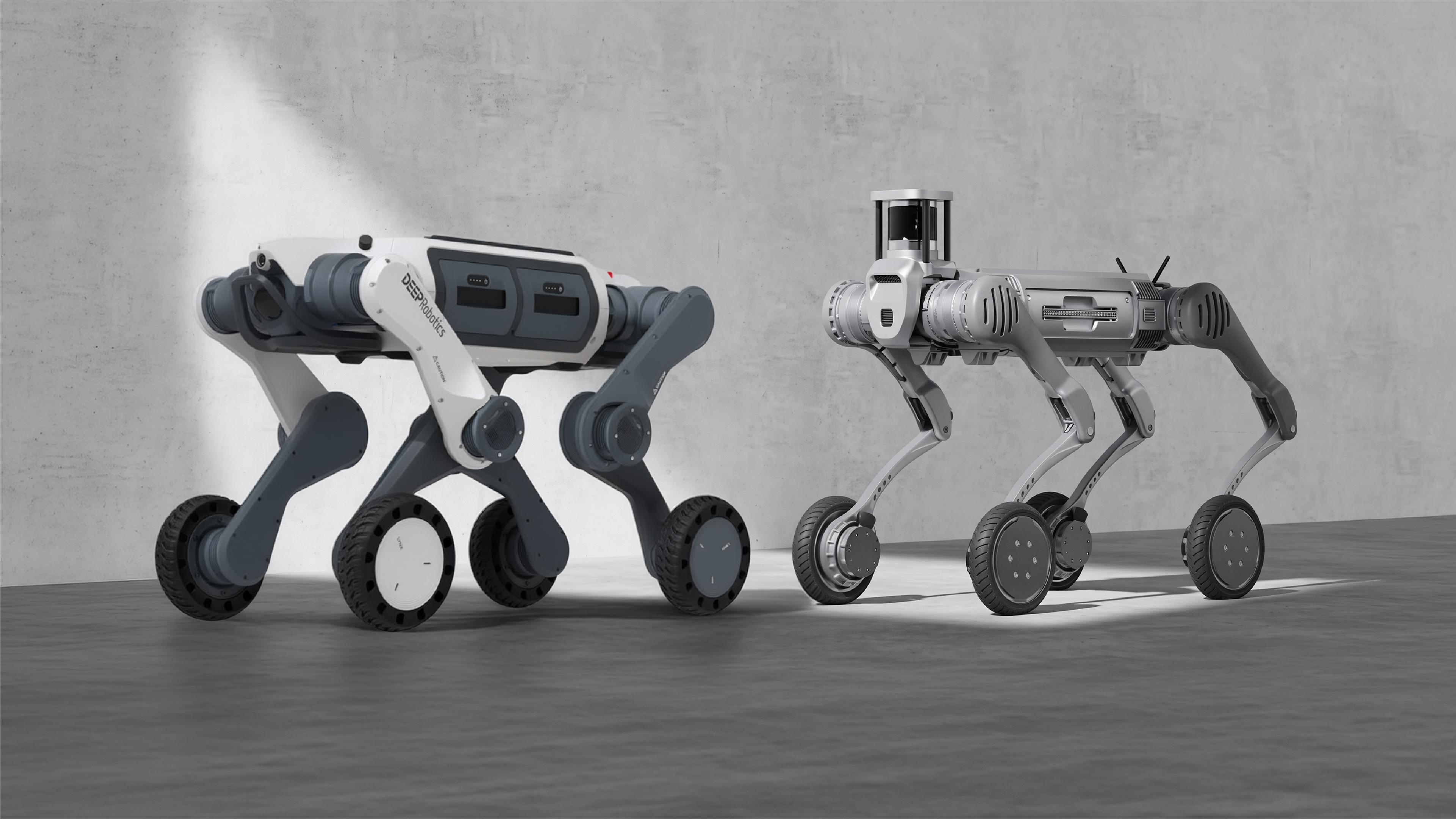
Introduction
DEEPRobotics Lynx M20 and Unitree B2-W are wheel-legged quadruped robots designed for demanding industrial environments.
According to ROBOT24.com market-data records, the Lynx M20 is designed for industrial inspection, utilities, infrastructure, security, emergency response and research. The Unitree B2-W targets similar applications, including industrial inspection, energy infrastructure, mining, logistics, security and emergency response.
The comparison highlights their differences in size, payload, speed, endurance, mobility and autonomous navigation.
At a Glance
| Metric | DEEPRobotics Lynx M20 | Unitree B2-W |
|---|---|---|
| Robot type | Wheel-legged quadruped | Wheel-legged industrial quadruped |
| Use cases | Industrial inspection; utilities; infrastructure; security; emergency response; research | Industrial inspection; energy infrastructure; mining; logistics ; emergency response; security; research |
| Dimensions | 820 x 430 x 570 mm | 1098 x 550 x 758 mm standing |
| Weight | 33 kg | ~85 kg including battery |
| Payload | 15 kg effective; 50 kg maximum | >40 kg walking; 120 kg standing |
| Maximum speed | 5 m/s max; 2 m/s operational | 15 km /h (~4.2 m/s) |
| Runtime | 3 hours no load; 2.5 hours with 15 kg | Not separately recorded |
| Range / endurance | 15 km no load; 12 km with 15 kg | 30 km unloaded; 25 km with 40 kg payload |
| Navigation | Autonomous wheel-legged locomotion; terrain recognition; point-cloud mapping | Autonomous navigation; 3D LiDAR + vision |
| Sensors | Dual 96-line LiDAR; dual wide-angle cameras; IMU | 3D LiDAR; 2 depth cameras; 2 RGB cameras; IMU |
| Protection rating | IP66 | IP67 |
| Special capability | 25 cm continuous stair height; 80 cm single step | Wheel-leg hybrid mobility; 20- 25 cm stairs; >45 deg slope |
| Availability | Commercially available | Commercially available |
| Price | USD $49,000-74,500+ | Approx. USD $95,000-100,000 |
How They Compare
The two robots have significant overlap in industrial inspection, security and emergency-response applications, but differ considerably in size and carrying capacity.
The Lynx M20 weighs 33 kg, compared with around 85 kg for the B2-W. The Lynx M20 has a maximum speed of 5 m/s, while the B2-W is listed at 15 km/h, or around 4.2 m/s.
Payload is another major difference. The Lynx M20 has a 15 kg effective payload and a 50 kg maximum, while the B2-W can carry more than 40 kg while walking and support up to 120 kg while standing.
The Lynx M20 offers up to three hours of runtime without a load and a 15 km range. ROBOT24.com market-data records do not list a separate runtime figure for the B2-W, but record a range of up to 30 km unloaded and 25 km with a 40 kg payload.
Both use LiDAR, cameras and IMUs for autonomous navigation. The Lynx M20 also uses terrain recognition and point-cloud mapping, while the B2-W combines 3D LiDAR with vision-based localization.
Summary
DEEPRobotics Lynx M20 and Unitree B2-W are built for many of the same industrial applications but differ in size, payload, range and mobility. This comparison is based on specifications currently recorded in ROBOT24.com market-data records.
More articles on this topic
68 articles ReportRichtech DUST-E S vs. Gausium Phantas
 ReportEngineAI SE01 vs. AGIBOT RAISE A1ReportRichtech DUST-E S vs. KEENON KLEENBOT C20
 ReportRobint Rhino vs. OrionStar CleaniBot S55 Pro
 ReportGausium Phantas vs. OrionStar CleaniBot K1
 ReportBear Robotics Servi Plus vs. UBTECH CADEBOT L100
 ReportStarship Delivery Robot vs. Cartken Courier
 ReportOrionStar CleaniBot S55 Pro vs. KEENON KLEENBOT C55
 ReportBear Robotics Servi Plus vs. Pudu BellaBot
 ReportRobint Foodie vs. UBTECH CADEBOT L100
 ReportBear Robotics Servi Plus vs. KEENON DINERBOT T9 Pro
 ReportPNDbotics Adam U vs. WL Robotics Titan O1
BUSINESS NEWS WEEKLY LETTER
The Weekly Letter for Robotics Professionals, Summarizing the Most Important Industry Moves, Launches, Deals and Signals.