Cartken Courier vs. Kiwibot
Two autonomous delivery robots compared on how Cartken Courier’s indoor-outdoor mobility, higher payload and enterprise integration differ from Kiwibot’s campus-focused sidewalk delivery model and remotely supervised operations.

September 30, 2026 by Business Desk Team
Introduction
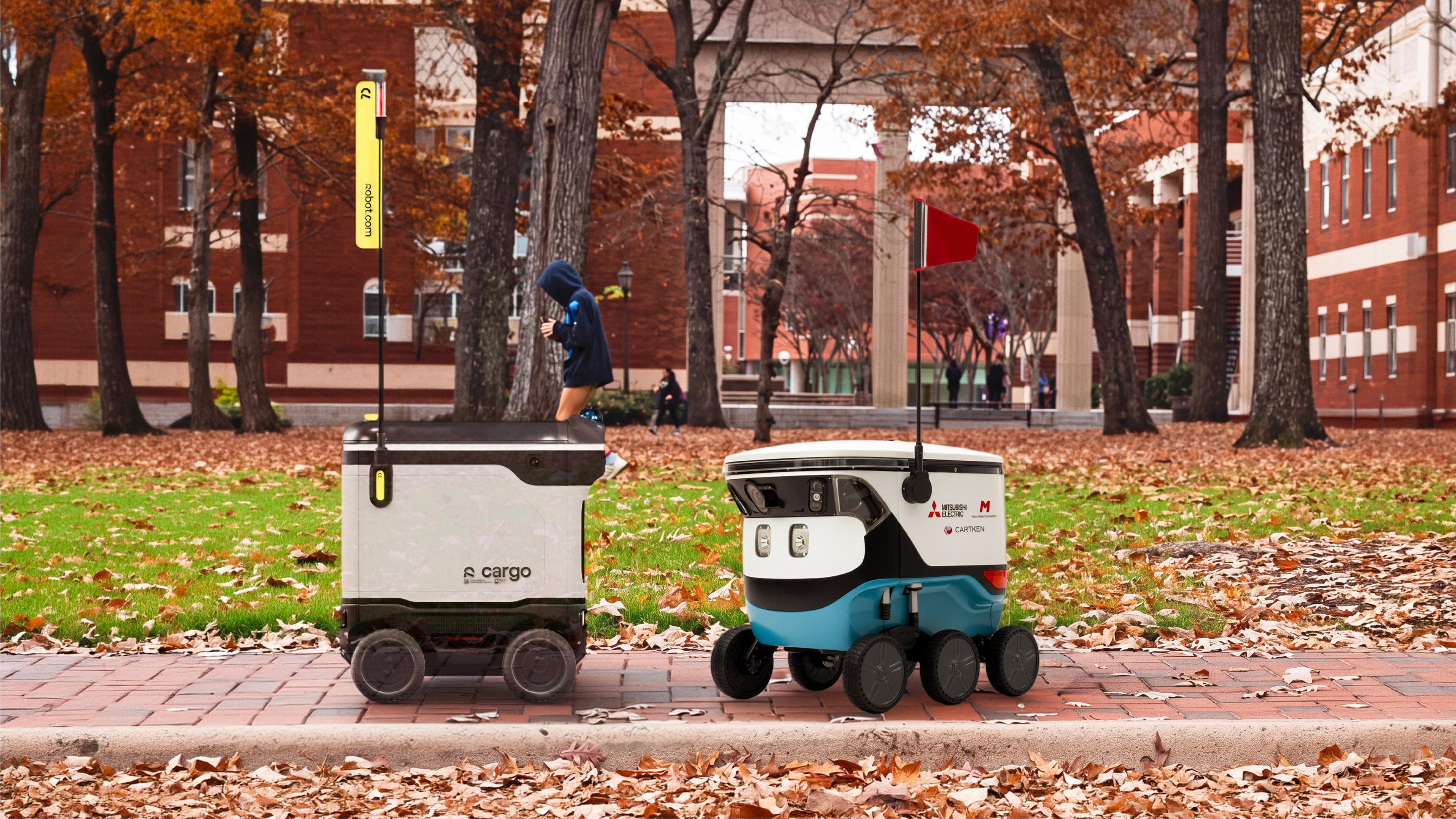
Cartken Courier and Kiwibot are both delivery robots and are compared here using the specifications and use cases recorded in the supplemental ROBOT24.com market-data record comparison material.
Cartken Courier (outdoor-indoor) autonomous mobile robot for light transport use case includes industrial sites; campus and facility delivery; small parts; samples and lightweight goods Kiwibot (outdoor/indoor) autonomous sidewalk delivery robot use case includes campus food delivery; urban sidewalk delivery; small parcels.
Key differences are mainly in dimensions, specifications, way of operating, endurance, capacity, sensing, and technical specifications data available for each model.
At a Glance
| Metric | Cartken Courier | Kiwibot |
|---|---|---|
| Robot type | Outdoor-indoor autonomous mobile robot for light transport | Autonomous sidewalk delivery robot |
| Use cases | Industrial sites; campus and facility delivery; small parts, samples and lightweight goods | Campus food delivery; urban sidewalk delivery; small parcels |
| Dimensions | Compact footprint; exact dimensions not publicly stated in event listing | Approx. 58 x 48 x 50 cm reported for Kiwibot 4.0 |
| Weight | Not publicly specified | Approx. 27 kg reported; some sources vary by generation |
| Payload / capacity | Up to 20 kg / 44 lb | Approx. 20 L capacity; small food/package delivery |
| Maximum speed | Up to 9.7 km/h / 6 mph | Approx. 3 km/h reported for Kiwibot 4.0 |
| Runtime | 13+ hours; autonomous charging | Public sources vary; around 10-12 hours reported for some versions |
| Charging time | Not publicly specified | Detachable battery / charging varies by version |
| Navigation | AI navigation with cameras; indoor-outdoor navigation across mixed environments | Level 4 or semi-autonomous operation in mapped/geofenced areas with remote supervision |
| Sensors | Camera-based AI navigation; detailed sensor suite not publicly specified in listing | LiDAR, cameras, proximity/cliff sensors, GPS/4G/LTE depending on version |
| Special capability | Can integrate with doors, gates, elevators and enterprise systems | Campus-focused delivery model; human fleet supervision for exceptions |
| Availability | Commercially offered | Commercially deployed on campuses/urban pilots |
| Price | Quote-based / not publicly disclosed | Service/RaaS model; not generally public |
How They Compare
Cartken Courier and Kiwibot are both autonomous delivery robots, but they target slightly different jobs. Cartken Courier is designed for indoor and outdoor transport across industrial sites, campuses and facilities, while Kiwibot is mainly used for food and small-package deliveries on campuses and urban sidewalks.
Summary
More articles on this topic
52 articles ReportPUDU BellaBot vs. UBTECH CADEBOT L100
 ReportFourier GR-3 vs. EngineAI SE01
 ReportPudu CC1 vs. KEENON KLEENBOT C30
 ReportDEEPRobotics Lynx M20 vs. Unitree B2-W
 ReportDEEPRobotics X30 Pro vs. Unitree B2
 ReportServe Robotics Delivery Robot vs. Cartken Courier
 ReportElliQ vs. LOVOT
 ReportLOVOT vs. PARO
 ReportKEENON BUTLERBOT W3 vs. Relay+
 ReportPUDU FlashBot vs. Relay+
 ReportPARO vs. Joy for All Companion Pet Cat
 ReportServe Robotics Delivery Robot vs. Starship Delivery Robot
BUSINESS NEWS WEEKLY LETTER
The Weekly Letter for Robotics Professionals, Summarizing the Most Important Industry Moves, Launches, Deals and Signals.