Amazon Unit Connects Nvidia Simulation With Robot Training and Deployment
The reference architecture combines Nvidia simulation tools, AWS model-training services and edge computing to help developers build and refine AI-powered robots.

October 9, 2026 by Artem
Amazon Unit Connects Nvidia Simulation With Robot Training and Deployment
The reference architecture combines Nvidia simulation tools, AWS model-training services and edge computing to help developers build and refine AI-powered robots.
SEATTLE — Amazon Web Services (AWS) offers robotics developers a framework to link virtual robot training and real-world sensor data and on-device AI, addressing one of the practical difficulties in developing autonomous industrial machines.
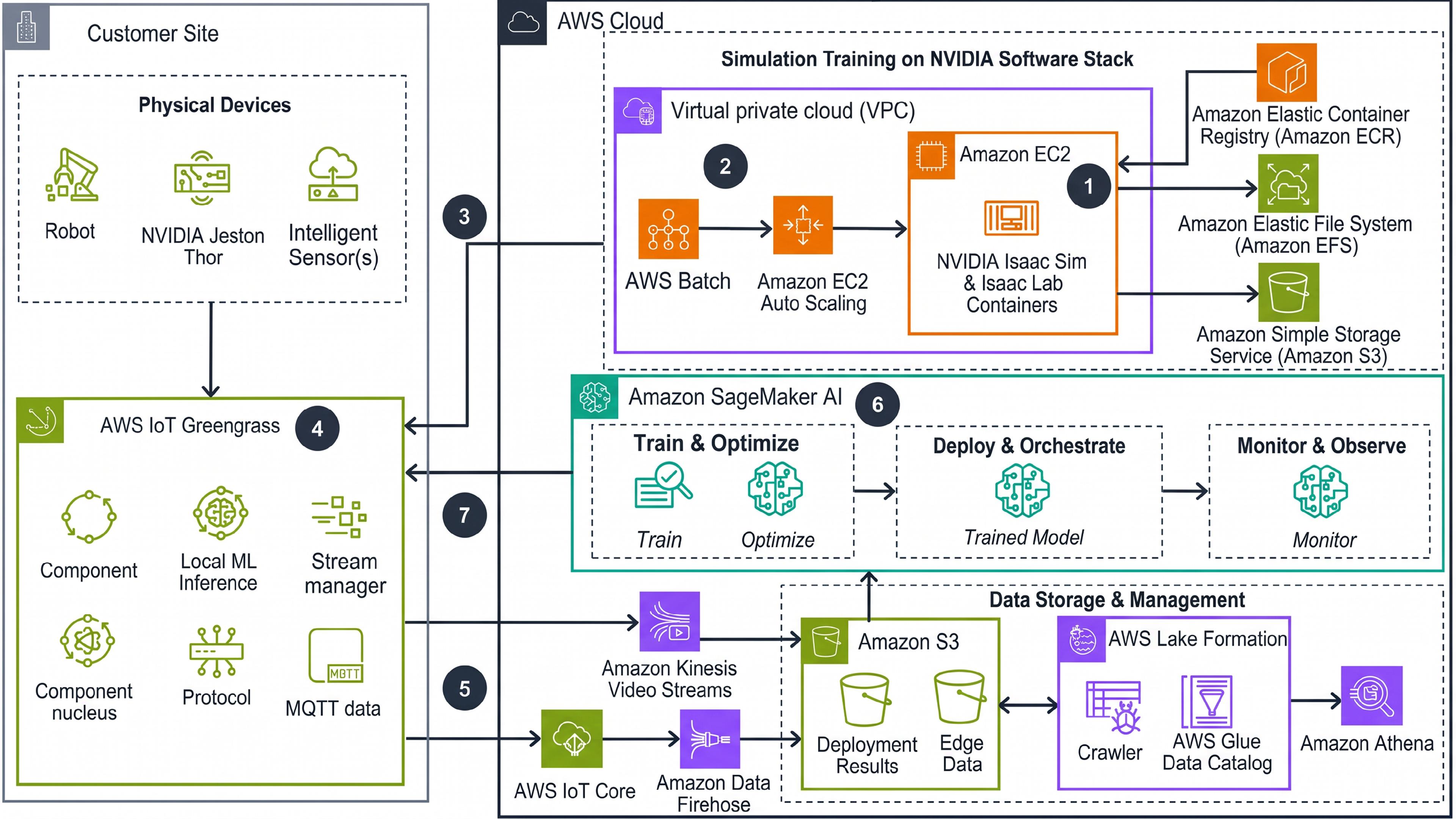
The company's Guidance for Physical AI for Robotics describes how developers can create and optimize Nvidia's robotics simulation software with AWS cloud services to train, test and update robot control models.
Rather than introducing a new robot or proprietary foundation model, AWS provides an implementation framework for connecting existing technologies. The architecture includes simulation, machine learning, and data collection, plus deployment to edge computers working in concert with physical robots.
AWS says the approach targets robotics manufacturers and industrial users who build systems that adapt to changing environments. It supports both simulation-based training and learning from physical sensor data.
AWS offers guidance in the AWS Solutions Library but hasn't provided independent verification that the architecture improves performance or cuts commercial deployment costs.
Two Paths for Training Robots
The framework addresses a familiar problem in robotics development: a robot that performs reliably in simulation may behave differently when exposed to actual factory conditions.
Virtual environments can recreate robot actions and their interactions with objects, letting developers rerun the same tests without risking costly equipment.
But simulated physics cannot perfectly reproduce friction, soft materials, dynamic lighting, and nearby workers' actions.
AWS proposes two complementary training paths.
The first uses Nvidia Isaac Sim to create virtual environments and generate synthetic training data. Nvidia Isaac Lab supports reinforcement learning, allowing robot control policies to improve through repeated simulated interactions. Developers run these workloads on AWS to run numerous training scenarios.
Real‑world sensor data serves as the basis for a second approach. Robots gather interaction data from cameras, force sensors and joint encoders
Developers can process that information using Amazon SageMaker AI, AWS's managed machine-learning service, to train or update models.
The two approaches can be combined. First, a robot might initially learn a manipulation task in simulation, then undergo testing on physical hardware and collect more data for training.
AWS describes this as a way to close the gap between simulation and reality. However, the architecture does not eliminate the need for physical testing or establish that a model trained in simulation will operate safely on actual equipment.
Linking Cloud Training to Robot Hardware
The guidance also addresses how trained AI models reach robots.
AWS IoT Greengrass provides software platform for deploying applications on edge devices and managing their connections with cloud services.
In the proposed architecture, robot control models can execute locally while sensor data is collected for further analysis, and enhance the model's performance.
That distinction matters for industrial robotics. Many control functions must operate with predictable timing and cannot depend on a continuous cloud connection.
Cloud infrastructure handles complex training and data processing, while onboard systems execute control policies using local sensor inputs.
AWS presents the framework applies to robotic arms, mobile robots and humanoids performing manufacturing or logistics tasks.
AWS has also released technical information that outlines how its services can support robot model development. An April 15 technical article explains the combination of Nvidia Isaac simulation, cloud-based training and feedback from physical systems.
The guidance did not disclose a consolidated implementation price. AWS failed to identify a customer deployment that utilized the entire reference architecture, nor it shared comparative benchmarks.
More articles on this topic
159 articles ReportRobots vs Humans: Who’s Winning the Sports Showdown?
 ReportUBTECH, FAW-Volkswagen Expand Humanoid Robot Work Into Logistics
 ReportMecka Raises $60 Million as Demand for Robot Training Data Grows
 ReportMinerva Humanoids Raises $10 Million for Robots Built for Dangerous Jobs
 ReportAsmech Starts Selling $6,999 Elephant Robotics Cobot in Japan
 ReportKUKA Taps TD SYNNEX to Expand Mobile Robot Sales in Europe
 ReportBoston Dynamics Puts Former Amazon Executive at Helm for Physical AI Push
 ReportHumansX launches Wuji dexterous hand and data glove in Japan
 ReportDoosan Gets $51M in State Support for Physical AI
 ReportThe Rise of Delivery Robots: How They Work and Where They’re Headed
 ReportTeradyne Invests in Bright Machines to Link Robots and Factory Data
 ReportPanasonic Targets Humanoid Robot Production by 2029
BUSINESS NEWS WEEKLY LETTER
The Weekly Letter for Robotics Professionals, Summarizing the Most Important Industry Moves, Launches, Deals and Signals.