UBTECH CADEBOT L100 vs. PUDU PuduBot 2
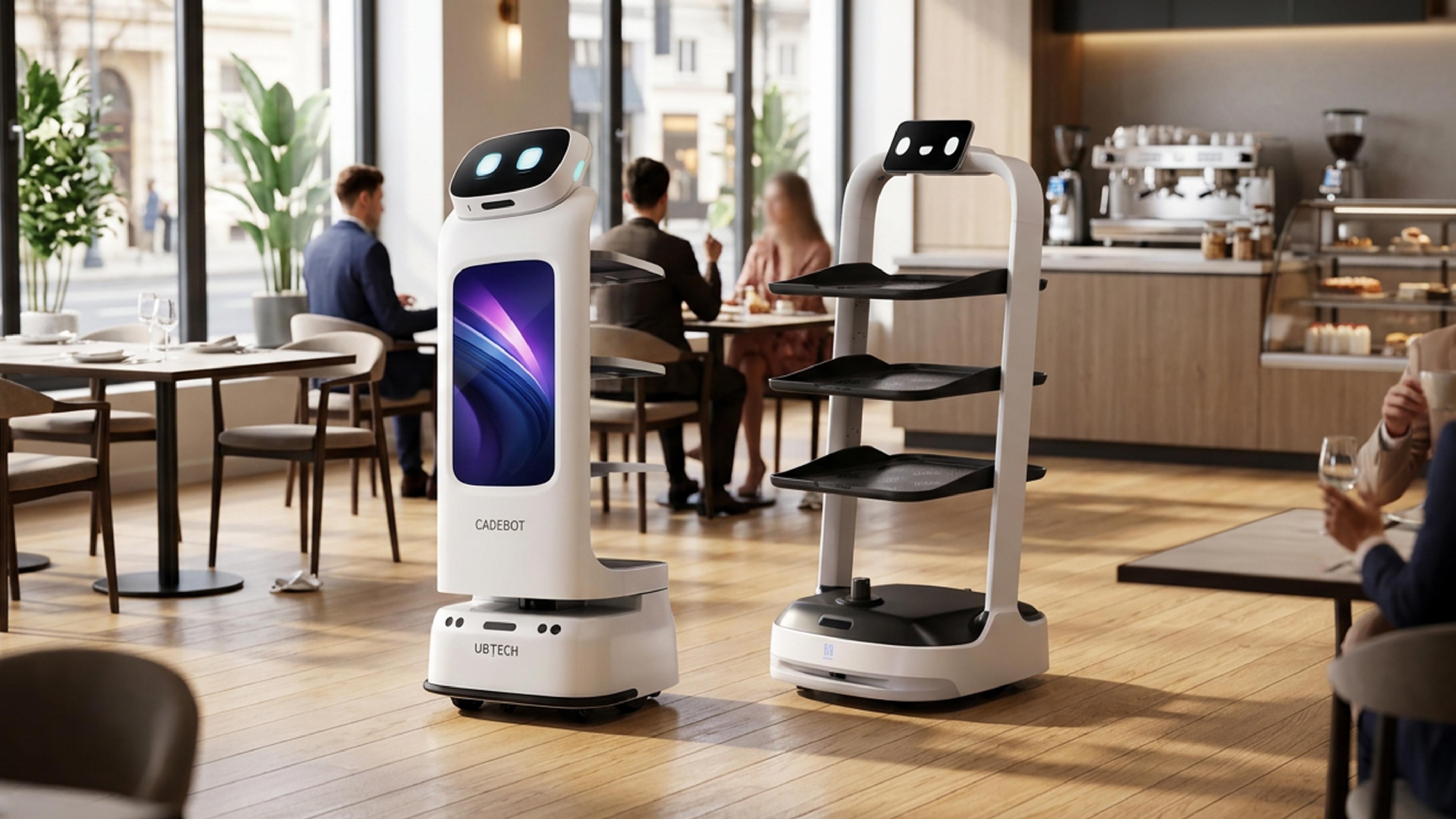
UBTECH CADEBOT L100 and PUDU PuduBot 2 are autonomous delivery robots designed to transport food, beverages and other items in commercial environments. We compare their payload capacities, tray configurations, navigation clearance, operating endurance and charging capabilities to examine their suitability for restaurants, hotels and hospitality operations.

November 3, 2026 by Business Desk Team
Introduction
At a Glance
| Metric | UBTECH CADEBOT L100 | PUDU PuduBot 2 |
|---|---|---|
| Robot type | Autonomous commercial delivery and advertising robot | Autonomous commercial delivery robot |
| Best-fit use cases | Restaurant and hospitality delivery with promotional displays | Restaurant, hospitality and multi-tray delivery operations |
| Maximum payload | 40 kg | 40 kg |
| Tray configuration | 4 trays | 3 standard trays; supports up to 7 |
| Load per tray | 10 kg | Not specified in supplied records |
| Minimum passage width | 650 mm | 800 mm |
| Operating runtime | Up to 8 hours | 12 hours unloaded; 15 hours fully loaded; up to 24 hours maximum — figures require verification |
| Charging time | Approximately 4 hours | Approximately 4 hours |
| Charging method | Automatic docking or charging adapter | Wired and autonomous charging |
| Travel speed | Adjustable, 0–0.8 m/s | 0.5–1.2 m/s cruising speed |
| Robot weight | Not specified in supplied records | Approximately 39 kg |
| Front touchscreen | 10.1 inches | Not specified in comparable record |
| Advertising display | 21.5-inch Full HD display | Not specified in comparable record |
| Fleet management | Not established in supplied records | PUDU fleet integration |
| Recorded price | US$8,280–$10,000 | US$12,000–$20,000 |
| Key limitations | Shorter stated runtime and lower maximum speed; fixed four-tray configuration | Wider minimum passage requirement; inconsistent runtime figures require verification |
How They Compare
Commercial delivery/operating role
UBTECH CADEBOT L100 and PUDU Bot 2 are built to make tedious delivery tasks easier in the commercial space.
The robots are capable of carrying food, drinks and other items to further minimise staff trips to and from service points.
The CADEBOT L100 merges a delivery robot with a visual advertising display making it suitable for sites wanting to display ads whilst delivering.
Deliverability: Pudu Bot 2 emphasizes configurable capacity, with customized tray options and fleet management.
While they may offer the same delivery functionality, two different robotics configurations might be better suited to different restaurant layout, operating hours and front of house needs.
Payload capacity and tray setup
The declared payload of CADEBOT L100 and Pudu Bot 2 both reach 40 kg.
Therefore neither robot exceeds the other in total rated carrying capacity.
However, their tray arrangements differ.
CADEBOT L100 trays have a rated capacity of 10 kg for each of its four trays.
Pudu Bot 2 comes as standard with three trays, but can accommodate up to seven.
The other tray options could be useful if you're carrying several smaller parcels, or making a few different deliveries that day.
Nevertheless, the trays do not determine the number of meals a robot can deliver per hour.
The actual number of trays that can be delivered is determined by the size of the tray, how the load is spread throughout the delivery, the length of the route, and the time required for staff to load and unload.
Operators must determine whether they are able to load the intended loads safely into the application tray.
Room clearance and restaurant traversing
The minimum passage width is one of the main differences between the two robots.
UBTECH CADEBOT L100 has been measured at 650 mm.
PUDU Bot 2 needs a minimum passage width of 800 mm.
Therefore, CADEBOT L100 is provided with a stated passage requirement that is 150 mm less than.
This difference may be significant when restaurant spaces are less spacious, tables are packed closely together, or access routes are narrow.
However, the minimum passage width should not be thought of as assuring the ability of any robot to pass through any route of that width.
Direction of travel, roll away, customer movement, and loaded size of robot can all have an impact on navigation.
A demonstration on site must identify the tightest sections and locations of most frequent service availability prior to application.
Operating endurance
CADEBOT L100 has an alleged operating time of as long as eight hours.
Pudu Bot 2 has a handful of moments of operation are collected, including 12 hours without load, 15 hours at full load and 24 hours, or a maximum of.
The figures listed here need to be checked again, as the full load life is given at a higher level than the unloaded life, which is highly unusual without further information of test conditions.
The records thus suggest that Pudu Bot 2 may enable longer operation durations; but they are not enough to provide a direct like-for-like endurance comparison.
The actual battery life is affected by payload, trip length, average speed, operating environments and the number of stops.
Restaurants will need to assess if the schedule of service will be able to be achieved without too many time-consuming charging breaks.
Charging and operational continuity
Both robots have a recorded charging time of approximately four hours.
CADEBOT L100 supports automatic docking or charging through an adapter.
PuduBot 2 supports wired charging and autonomous charging.
Automatic charging may be useful in restaurants and hotels operating across extended service periods, as it can reduce the need for staff to manually connect the robot to a charger.
However, charging functionality alone does not establish uninterrupted operation.
Facilities should confirm docking requirements, charging-station placement and how each robot handles incomplete delivery tasks when its battery becomes low.
Speed of Travel and Performance during Delivery
CADEBOT L100 adjustable speed 0-0.8 m/s.
Pudu Bot 2's cruising-speed range is noted as 0.5-1.2 m/sec.
Pudu Bot 2 also claims a higher published upper speed figure.
This could matter to venues with extended delivery corridors, although maximum speed isn't explicitly linked to the total production for delivery.
In busy restaurants, robots are likely to need to stop and start often in order to avoid running into customers, staff and tables.
To be effective, delivery also has to encompass route planning, tray loading, pickup strategy, and time spent waiting.
Operators should rely on actual trip completion times for normal service conditions.
Customer interaction and advertising
CADEBOT L100 has a 10.1" Front touch screen and a separate 21.5" Full HD advertising screen.
The bigger screen may enable restaurants, hotels and other commercial establishments to share messages to customers as the robot is on the job.
Has a possible secondary application for customer service, over and above moving items.
However, Pudu Bot 2 is mostly focused on autonomous delivery so the supplied comparator record does not offer an advertising display comparable.
Not that Pudu Bot 2 doesn't have sales-related features. It's just the limited information we have seen no direct match up between stores.
If you would like to advertise with us, the screen requirements are simple, visibility, content control and whether the advertising feature is included within the package purchased.
Fleet management and deployment
Pudu Bot 2 is compatible for integration to PUDU's fleet-management system.
This could be applicable to operators using a team of robots in restaurants, hotels or other commercial locations.
Autonomy features might assist with the management of fleet tasks and the scheduling of robot activities, but particular services supported should be verified for the deployment you have in mind.
CADEBOT L100 is built for autonomous commercial delivery, but the pack provided does not yield a vehicle-to-vehicle fleet-management specification that is directly comparable.
Ensure one of the robots has the ability to perform the scheduling, dispatching, tracking and software integration functions.
They should also check the local technical back up, maintenance and replacement parts.
Costs and ownership issues
The supplied records list CADEBOT L100 at approximately US$8,280–$10,000.
PuduBot 2 has a recorded price range of approximately US$12,000–$20,000.
These figures suggest different recorded acquisition-price ranges, but they should not be interpreted as verified current quotations.
Pricing may vary according to region, distributor, tray configuration, software packages and service agreements.
Businesses should also account for installation, maintenance, charging equipment, training and ongoing technical support when evaluating total ownership costs.
A lower purchase price does not necessarily establish a lower long-term operating cost
More articles on this topic
111 articles ReportRichtech DUST-E S vs. Gausium Phantas
 ReportEngineAI SE01 vs. AGIBOT RAISE A1ReportRichtech DUST-E S vs. KEENON KLEENBOT C20
 ReportRobint Rhino vs. OrionStar CleaniBot S55 Pro
 ReportECOVACS DEEBOT X8 PRO OMNI vs. MOVA V50 Ultra Complete
 ReportDreame X50 Ultra vs. Narwal Flow
 ReportRoborock Saros 10R vs ECOVACS DEEBOT X8 PRO OMNI
 ReportRoborock Saros 10R vs. Dreame X50 Ultra
 ReportMOVA V50 Ultra Complete vs. Narwal Flow
 ReportPUDU BellaBot Pro vs. UBTECH CADEBOT L100
 ReportDreame L10s Ultra Gen 2 vs. eufy Omni C20
 ReportOrionStar GreetingBot Mini vs. PadBot X1
BUSINESS NEWS WEEKLY LETTER
The Weekly Letter for Robotics Professionals, Summarizing the Most Important Industry Moves, Launches, Deals and Signals.