PUDU BellaBot Pro vs. UBTECH CADEBOT L100
PUDU BellaBot Pro and UBTECH CADEBOT L100 are autonomous delivery robots designed for restaurants, hotels and other commercial environments. We compare their payload capacities, tray configurations, operating endurance, navigation clearance and customer-facing features to examine their suitability for food delivery and hospitality service.

November 3, 2026 by Business Desk Team
Introduction
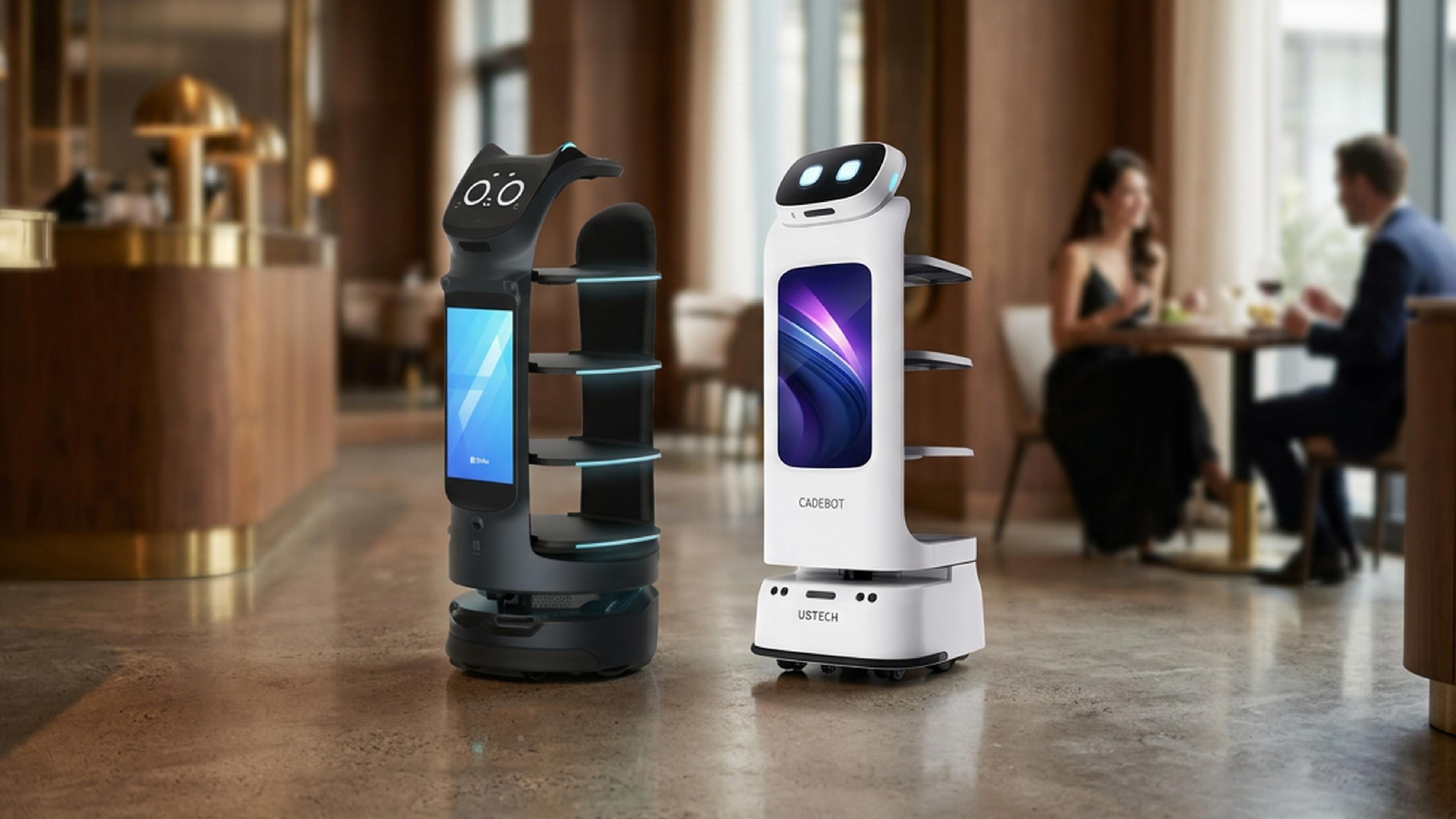
CADEBOT L100 integrates delivery services with an advertising display and a reduced listed minimum passage requirement.
At a Glance
| Metric | PUDU BellaBot Pro | UBTECH CADEBOT L100 |
|---|---|---|
| Robot type | Autonomous delivery and customer-interaction robot | Autonomous delivery and advertising robot |
| Best-fit use cases | Restaurant meal delivery and interactive hospitality service | Restaurant and hospitality delivery with promotional displays |
| Maximum payload | 40 kg total | 40 kg total |
| Tray configuration | 4 adjustable trays | 4 trays |
| Maximum load per tray | 10 kg | 10 kg |
| Minimum passage width | 700 mm | 650 mm |
| Operating runtime | Up to 20 hours | Up to 8 hours |
| Charging time | Approximately 4.5 hours | Approximately 4 hours |
| Charging method | Autonomous charging recorded; configuration requires confirmation | Automatic docking or charging adapter |
| Maximum speed | 1.2 m/s | 0.8 m/s, adjustable |
| Customer interface | Interactive cat-face display, touchscreen and voice notifications | 10.1-inch front touchscreen |
| Advertising display | No directly comparable specification in supplied records | 21.5-inch Full HD display |
| Elevator integration | Recorded capability; implementation requires confirmation | Not established in supplied records |
| Recorded price | US$15,000–$25,000 | US$8,280–$10,000 |
| Key limitations | Wider passage requirement; runtime and integration capabilities require verification | Shorter advertised runtime and lower maximum speed |
How They Compare
Commercial delivery and operational role
PUDU BellaBot Pro and UBTECH CADEBOT L100 are designed to automate repetitive delivery tasks in restaurants, hotels and other commercial environments.
Both robots can transport meals, beverages and supplies, potentially reducing the number of trips staff need to make between kitchens, service stations and customer areas.
BellaBot Pro places particular emphasis on customer-facing service. Its interactive cat-face display and voice notifications are intended to make the robot more engaging during deliveries.
CADEBOT L100 combines autonomous transport with a dedicated advertising display, allowing businesses to present promotional content while the robot moves through a venue.
Both robots perform similar delivery functions, but their additional features may appeal to different hospitality requirements.
Payload capacity and tray configuration
Both BellaBot Pro and CADEBOT L100 have a recorded maximum payload of 40 kg.
Each robot also supports four trays, with a stated maximum load of 10 kg per tray.
This gives them the same published total carrying capacity and individual tray load limit.
However, BellaBot Pro has adjustable trays, which may provide additional flexibility when transporting items of different sizes.
CADEBOT L100's four-tray arrangement is designed for commercial delivery, although the supplied records do not establish equivalent tray-adjustment capabilities.
The identical payload ratings do not necessarily mean the robots can transport the same number of meals or complete deliveries at the same rate.
Tray dimensions, item height, load distribution and staff loading procedures can all influence practical carrying capacity.
Restaurants should assess whether the tray configuration accommodates their plates, serving containers and beverages before deployment.
Passage clearance and restaurant navigation
One of the clearest differences between the two robots is their minimum passage-width requirement.
BellaBot Pro has a recorded minimum passage width of 700 mm.
CADEBOT L100 has a stated minimum passage width of 650 mm.
This gives CADEBOT L100 a 50 mm narrower published clearance requirement.
The difference may be relevant in restaurants with closely spaced tables, narrow service corridors or limited space around furniture.
However, minimum passage width is not the same as the space required for comfortable operation in a busy restaurant.
Robots may need additional clearance to turn, avoid customers or navigate around temporary obstacles.
A site demonstration should assess the narrowest routes, turning areas and expected pedestrian traffic before either robot is introduced into daily service.
Operating endurance
BellaBot Pro has an advertised operating runtime of up to 20 hours.
CADEBOT L100 has a stated runtime of up to eight hours.
Based on these published figures, BellaBot Pro has the longer advertised maximum operating duration.
This may be relevant to restaurants and hospitality venues operating across extended service periods.
However, the two runtime figures should not be treated as directly comparable without knowing the manufacturers' test conditions.
Battery endurance can vary depending on payload, travel distance, speed, frequency of stops and interaction features.
The 20-hour figure for BellaBot Pro is a recorded claim rather than a verified result from a controlled comparison.
Operators should confirm whether the robot can complete their intended service schedule under realistic loaded conditions.
Charging and operational continuity
BellaBot Pro has a recorded charging time of approximately 4.5 hours.
CADEBOT L100 has a stated charging time of approximately four hours.
The difference is relatively small, although actual charging duration may vary depending on battery condition and charging arrangements.
BellaBot Pro has autonomous charging recorded among its capabilities, but the exact implementation should be confirmed for the selected configuration.
CADEBOT L100 supports automatic docking or charging through an adapter.
Automatic charging can reduce the need for staff to manually connect robots to chargers between service periods.
However, businesses should also consider charging-station placement, available floor space and how each robot handles interrupted delivery tasks.
Travel speed and delivery efficiency
BellaBot Pro has a recorded maximum speed of 1.2 m/s.
CADEBOT L100 has an adjustable speed range of 0–0.8 m/s.
BellaBot Pro therefore has the higher published maximum speed.
This may be relevant to venues with longer delivery routes, although higher maximum speed does not necessarily result in faster service.
In crowded restaurants, robots often need to slow down or stop to navigate safely around customers, staff and furniture.
Overall delivery efficiency also depends on route planning, tray loading, destination handover and the time spent waiting for items to be collected.
Neither robot's maximum speed should be interpreted as a direct measure of meals delivered per hour.
Customer interaction and service experience
BellaBot Pro incorporates an interactive cat-face display, touchscreen interface and voice notifications.
These features are designed to support customer-facing interactions during delivery.
The robot's distinctive appearance and interactive functions may be relevant to restaurants seeking to make robotic service part of the customer experience.
CADEBOT L100 offers a different approach through its 10.1-inch front touchscreen and 21.5-inch Full HD advertising display.
The larger display can support promotional messaging alongside delivery operations.
This may be useful for venues that want to advertise menu items, offers or other content while the robot travels through customer areas.
The distinction is primarily one of intended function: BellaBot Pro emphasizes interactive service, while CADEBOT L100 includes dedicated advertising hardware.
The effectiveness of either approach depends on customer expectations, venue layout and how the features are used.
Elevator integration and multi-floor operations
BellaBot Pro has elevator integration recorded among its capabilities.
This may be relevant to hotels or other multi-floor environments where delivery robots need to move between levels.
However, the supplied records do not establish whether elevator integration is included as standard or requires additional hardware, software or building-system compatibility.
CADEBOT L100's elevator integration capabilities are not established in the supplied comparison data.
This does not necessarily mean the robot cannot support multi-floor operations.
For either robot, businesses planning deliveries between floors should confirm elevator compatibility, access permissions, connectivity and any additional integration costs.
Pricing and ownership considerations
The supplied records list BellaBot Pro at approximately US$15,000–$25,000, depending on region and configuration.
CADEBOT L100 has a recorded price range of approximately US$8,280–$10,000.
These figures suggest different acquisition-price ranges, with CADEBOT L100 carrying the lower recorded price.
However, the figures are not verified current quotations and may reflect different markets, configurations or commercial packages.
Businesses should also consider maintenance, software subscriptions, charging equipment, technical support and replacement parts.
The purchase price alone does not establish which robot will have lower long-term operating costs.
Deployment and operational considerations
Both robots are intended to support commercial delivery workflows, but successful deployment depends on how well they fit the physical environment and service process.
BellaBot Pro's interactive features, adjustable trays and recorded elevator integration may be relevant to customer-facing hospitality operations.
CADEBOT L100's narrower stated passage requirement and advertising display may appeal to restaurants where space efficiency and promotional messaging are priorities.
Before purchasing either robot, operators should confirm tray dimensions, loaded navigation performance, charging arrangements and local technical support.
They should also evaluate staff handover procedures, customer interaction and the robot's ability to operate safely during busy service periods.
Summary
PUDU BellaBot Pro and UBTECH CADEBOT L100 are autonomous commercial delivery robots with identical recorded maximum payloads of 40 kg and four-tray configurations, but they differ in operating endurance, navigation clearance and customer-facing features.
BellaBot Pro is worth considering for restaurants and hospitality venues prioritizing interactive service and extended operating periods. Its adjustable trays, cat-face display, voice notifications and advertised runtime of up to 20 hours may support customer-facing delivery operations, subject to verification under actual working conditions.
CADEBOT L100 may suit businesses looking to combine autonomous delivery with promotional displays and a narrower stated passage requirement. Its 650 mm minimum passage width, 10.1-inch touchscreen and 21.5-inch advertising display offer a different combination of delivery and customer-facing functionality.
The choice depends on restaurant layout, operating hours, customer interaction requirements, tray dimensions, charging arrangements and the role of promotional content in the service environment.
This comparison is based on ROBOT24.com market-research data records rather than controlled performance testing. Runtime, navigation clearance, elevator integration, pricing and actual delivery productivity should be verified through manufacturer documentation and site-specific trials before drawing conclusions about overall performance.
More articles on this topic
111 articles ReportRichtech DUST-E S vs. Gausium Phantas
 ReportEngineAI SE01 vs. AGIBOT RAISE A1ReportRichtech DUST-E S vs. KEENON KLEENBOT C20
 ReportRobint Rhino vs. OrionStar CleaniBot S55 Pro
 ReportECOVACS DEEBOT X8 PRO OMNI vs. MOVA V50 Ultra Complete
 ReportDreame X50 Ultra vs. Narwal Flow
 ReportRoborock Saros 10R vs ECOVACS DEEBOT X8 PRO OMNI
 ReportRoborock Saros 10R vs. Dreame X50 Ultra
 ReportMOVA V50 Ultra Complete vs. Narwal Flow
 ReportUBTECH CADEBOT L100 vs. PUDU PuduBot 2
 ReportDreame L10s Ultra Gen 2 vs. eufy Omni C20
 ReportOrionStar GreetingBot Mini vs. PadBot X1
BUSINESS NEWS WEEKLY LETTER
The Weekly Letter for Robotics Professionals, Summarizing the Most Important Industry Moves, Launches, Deals and Signals.