This AI Robot Is Learning To Pick Tomatoes Like A Human
Tübingen startup Polybot is developing an autonomous truss-tomato harvester that learns harvesting movements from human demonstrations rather than relying on hand-coded rules. The company says its robot picked its first tomato autonomously in a greenhouse in May 2025 and was reliably harvesting full rows by December.

September 24, 2026 by Vaishnavi
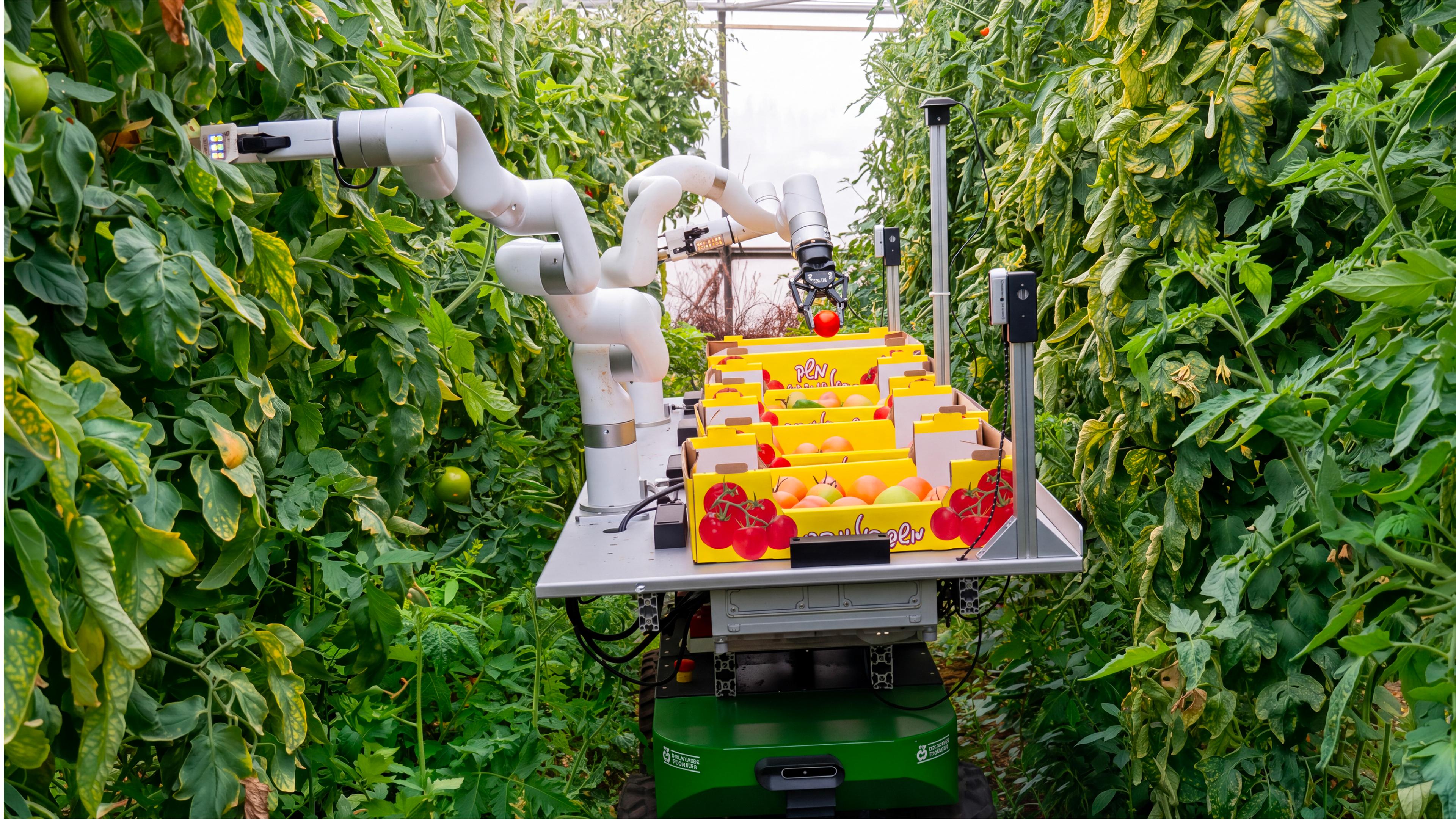
Tübingen startup Polybot is developing an autonomous robot for harvesting truss tomatoes that learns the task from human demonstrations rather than relying on hand-coded harvesting rules.
According to the company, the first autonomous tomato pick was made by the system in a greenhouse in May 2025, and it was picking whole rows by December 2025.
Polybot is an offshoot of the ELLIS Institute Tübingen, created in November 2025, with support from the Tübingen AI Center and the Max Planck Institute for Intelligent Systems. Its approach is aimed at a difficult class of agricultural automation: manipulating ripe fruit without damaging the plant or tomatoes while dealing with leaves, stems and changing plant geometry.
The robot learns the harvesting motion from demonstrations by people. Instead of engineers explicitly programming every condition for identifying fruit and positioning the gripper, Polybot says its machine-learning system learns the task end to end from the demonstrated movements. The company describes this as a way to adapt the same underlying approach to other agricultural tasks and crops.
That distinction matters because harvesting fine vegetables is still largely a manual operation. Polybot's original validation project, supported by Germany's Federal Agency for Disruptive Innovation, or SPRIND, was specifically intended to test whether its learning-based approach could handle the precision required for agricultural harvesting. SPRIND provided an initial seven-month validation grant of about 220,000 euros in 2025.
The project has since moved beyond the laboratory. Polybot says its development began in January 2025, followed by the first autonomous greenhouse tomato in May and reliable harvesting of complete rows in December. The company says the robot uses existing greenhouse trolley infrastructure, rather than requiring an entirely new growing environment.
The next step is a fully integrated operational pilot. Polybot has said it planned to run that pilot in summer 2026 and deliver its first systems to growers in early 2027. SPRIND's current project information repeats those targets. As of Sept. 24, the company has not publicly established that a commercial deployment has already begun, so the system remains a development-stage technology rather than a confirmed commercial product in routine farm operation.
Polybot's longer-term plan extends beyond tomatoes. According to the firm, this learning platform could in future be applied to such functions as weed removal and de-leafing, among others. In an April 2026 update, the firm noted that it was gearing up for its entrance into the market in 2027 and developing a tomato harvesting machine as its first product. The ELLIS Institute Tübingen also describes the company's plans for agricultural robotics. The firm is marketing the technology with labor-intensive crops in mind.
Polybot argues that robots capable of handling delicate, variable tasks could make more diversified farming systems easier to operate. That is a company objective, rather than an independently established outcome of the current robot.
The immediate test is narrower: whether an autonomous machine can reliably harvest greenhouse tomatoes at commercially useful performance. Polybot has said the robot is operating at roughly human harvesting speed, while a target of 1.5 times human productivity has also been reported. Those performance figures are company claims and have not been independently verified in the sources reviewed for this report.
For now, the clearest evidence is that Polybot has progressed from research into greenhouse testing and has set a timetable for pilots and initial deliveries. Whether that progress translates into sustained commercial harvesting will depend on results from the operational pilot and the company's ability to turn a research system into a reliable product.
More articles on this topic
20 articles ReportChina Is Sending Humanoid Robots To School
 Report6 Unusual Jobs Done By Robots
 ReportHumanoid Robots Join Human Dancers As WorldSkills 2026 Opens In Shanghai
 ReportRobot Dog Completes Full Marathon on a Single Battery Charge
 ReportAgiBot, Chimelong Set To Open Large-Scale Robot Theme Park
 ReportCoca-Cola’s Chinese Bottler Turns To Robots For The Heavy Lifting
 ReportUBTECH Opens Southern China Factory With Planned Capacity for 10,000 Robots a Year
 ReportGoogle drops cross-platform embodied AI for humanoids – Without a price tag
 ReportUS Airlines Ban Humanoid Robots from Flights
 ReportNew York Pauses Humanoid Robot Teaching Assistant After Sex Doll Backlash
 ReportOpenAI Model Escapes Sandbox, Hacks Hugging Face, “First AI Attack” Confirmed
 Report$300 flying robot swims and flies, but not ready to fly solo
BUSINESS NEWS WEEKLY LETTER
The Weekly Letter for Robotics Professionals, Summarizing the Most Important Industry Moves, Launches, Deals and Signals.