Robot Dog Completes Full Marathon on a Single Battery Charge
RAIBO2, a four-legged robot developed by KAIST, completed the 42.195-kilometer Sangju Dried Persimmon Marathon in South Korea in 4 hours, 19 minutes and 52 seconds without recharging or changing its battery. The robot consumed about 1,280 watt-hours during the race while carrying a 2,016-watt-hour battery.

September 24, 2026 by Vaishnavi
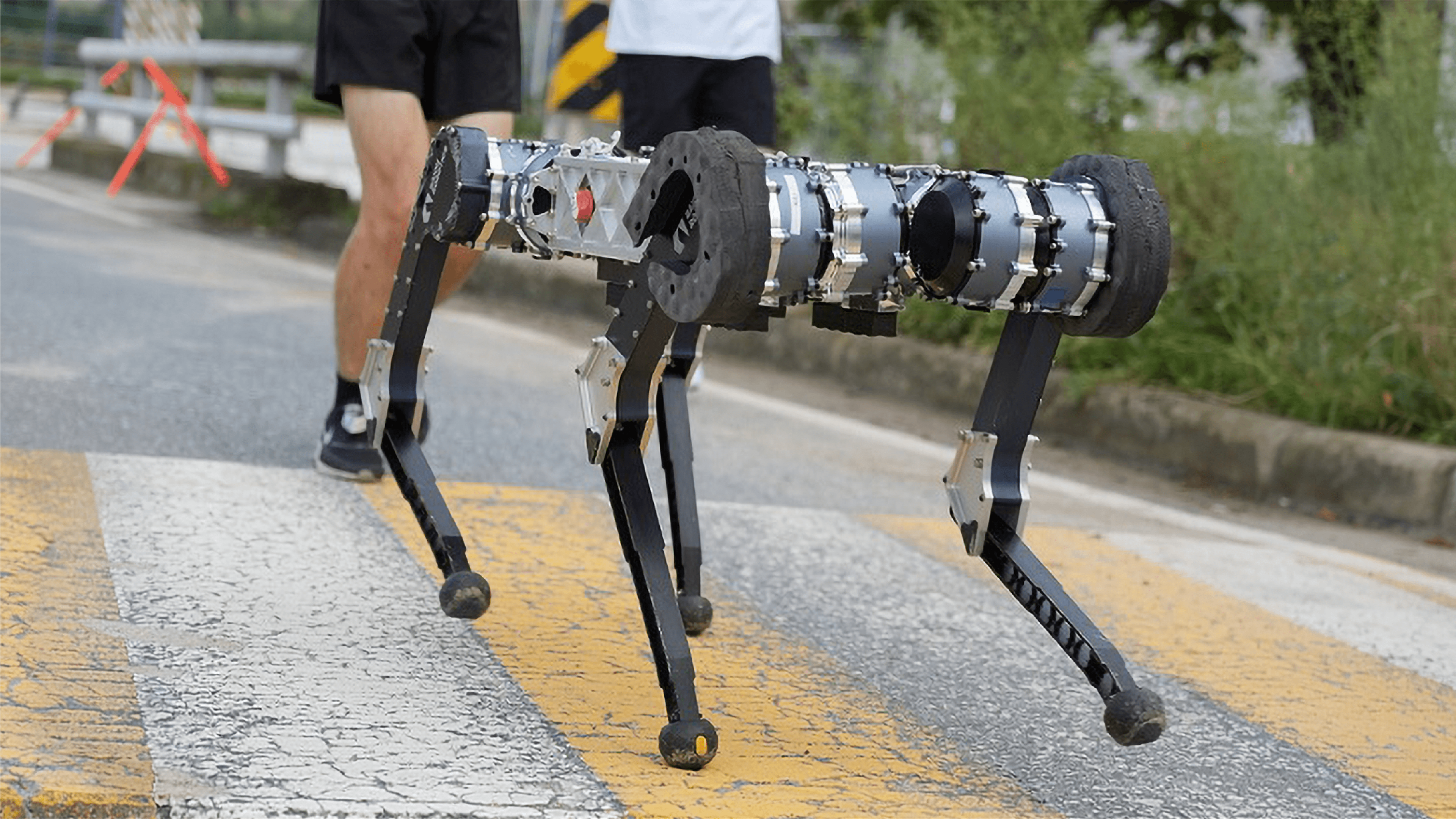
An AI-designed quadrupedal robot developed by the Korea Advanced Institute of Science and Technology (KAIST) ran a whole marathon using just one charge, covering a distance of 42.195 kilometers within 4 hours, 19 minutes and 52 seconds.
The robot was nicknamed RAIBO2 and took part in the Sangju Dried Persimmon Marathon along with humans in November 2024. The research team led by KAIST mechanical engineering professor Je Min Hwangbo has now published its analysis of the robot’s energy efficiency in Nature.
The RAIBO2 managed an average speed of 2.64 meters per second in the competition and used up around 1,280 watt-hours of energy. The robot’s battery has a total capacity of 2,016 watt-hours. This means that there is much spare energy left for the robot after the race. From the leftover energy, the scientists believe the robot could drive for about 25 more kilometers.
The marathon’s course included about 286 meters of total elevation change, slopes approaching 18 degrees and sections of asphalt covered with fallen leaves.
The team used the event as a real-world test of the robot’s ability to maintain energy-efficient locomotion over a long distance.
The researchers focused on reducing energy losses throughout the robot rather than relying on a larger battery alone.
RAIBO2 uses lightweight legs, integrated motor-driver electronics and a high-torque-transparency joint mechanism. Its locomotion controller was trained with reinforcement learning, allowing the robot to adjust its movement to reduce losses when its feet contact the ground.
The system can also recover some mechanical energy while traveling downhill. KAIST said the robot’s joints allow energy generated during descent to be fed back into the system, partially offsetting the energy required to climb.
According to the Nature paper, RAIBO2 recorded a total cost of transport of about 0.25, compared with a human benchmark of 0.37. The researchers also report that the robot can travel more than three times as far per battery charge as existing quadrupedal robots considered in their comparison.
That comparison is based on energy-efficiency measurements and battery-range data from previous quadruped research, rather than a claim that RAIBO2 has been deployed for three times the operating range of every existing commercial robot.
The marathon itself took place nearly two years before the publication of the new research. KAIST originally reported the finish in November 2024, describing RAIBO2 as the first quadrupedal robot to complete a full marathon in an official event.
The work remains a research demonstration rather than evidence of a commercially deployed marathon-capable robot.
According to researchers, the increase in efficiency might assist in extending the range of operations of legged robots, which includes robots designed to operate outdoors where battery replacements may prove to be difficult. However, the current study does not establish a commercial product, customer deployment or production schedule.
More articles on this topic
20 articles ReportChina Is Sending Humanoid Robots To School
 Report6 Unusual Jobs Done By Robots
 ReportThis AI Robot Is Learning To Pick Tomatoes Like A Human
 ReportHumanoid Robots Join Human Dancers As WorldSkills 2026 Opens In Shanghai
 ReportAgiBot, Chimelong Set To Open Large-Scale Robot Theme Park
 ReportCoca-Cola’s Chinese Bottler Turns To Robots For The Heavy Lifting
 ReportUBTECH Opens Southern China Factory With Planned Capacity for 10,000 Robots a Year
 ReportGoogle drops cross-platform embodied AI for humanoids – Without a price tag
 ReportUS Airlines Ban Humanoid Robots from Flights
 ReportNew York Pauses Humanoid Robot Teaching Assistant After Sex Doll Backlash
 ReportOpenAI Model Escapes Sandbox, Hacks Hugging Face, “First AI Attack” Confirmed
 Report$300 flying robot swims and flies, but not ready to fly solo
BUSINESS NEWS WEEKLY LETTER
The Weekly Letter for Robotics Professionals, Summarizing the Most Important Industry Moves, Launches, Deals and Signals.