Best Humanoid Robots for Warehouses 2026
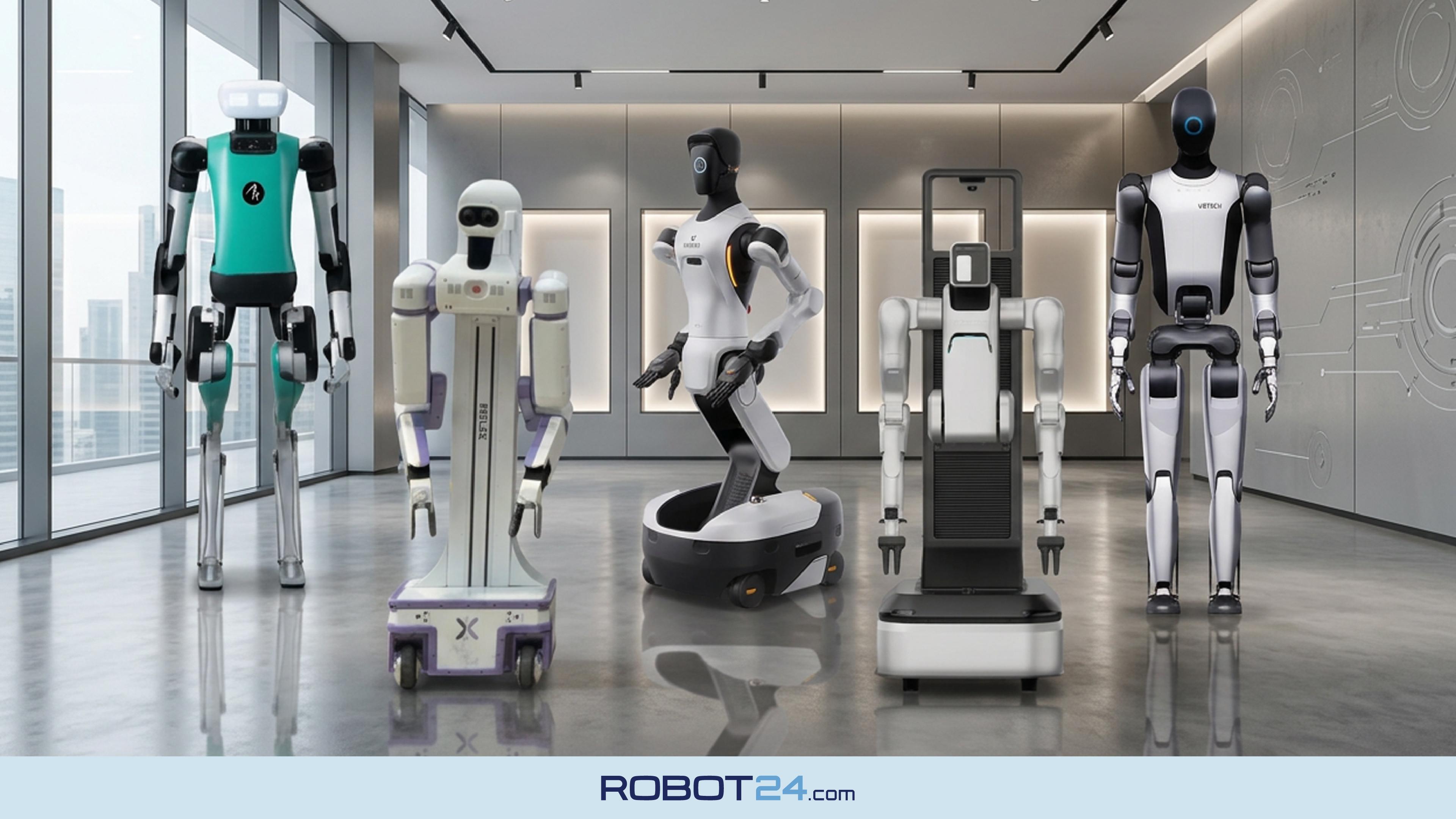
From tote handling to round-the-clock material movement, we compare five commercially available humanoid robots built for warehouses on task performance, autonomy, mobility, endurance and operational support.

November 18, 2026 by Business Desk Team
Introduction
Humanoids in warehouses and factories are expected to perform repetitive handling tasks in environments tailored for humans without any changes to the existing racks, conveyors or workstations. Their effectiveness will depend on their ability to carry weight, ability to perform their functions without a human supervisor and how long they can operate per shift.
Below is a ranking of Agility Robotics’ Digit, UBTECH’s Walker S2, AGIBOT’s A2-W and G2 and Reflex Robotics’ Reflex Humanoid. The rankings are based on ROBOT24.com's in Market Research Database as commercially available and designed for warehouses or logistics; prototypes and robots that have not been deployed yet have been ruled out.
The assessment of each model has been made based on Robot24.com’s Market Research Database along five parameters: task performance; autonomy & reliability; mobility & environment; operational endurance and deployment & integration.
At a Glance
| Rank | Robot | Overall score | Robot24 price | Standout specification | Best suited to |
|---|---|---|---|---|---|
| 1 | Agility Robotics Digit | 81/100 | Around US$250,000 | Up to 8 hours runtime with swappable batteries, 16 kg payload | Tote movement in distribution and fulfilment centres |
| 2 | Reflex Robotics Reflex Humanoid | 77/100 | Approx. US$50,000 | 16+ hours runtime in a footprint under 2 × 2 ft | Picking and shelf replenishment in tight aisles |
| 3 | AGIBOT G2 | 76/100 | US$138,000–200,000 | Dual 3D LiDAR with autonomous docking for 24/7 operation | Mixed handling and sorting on busy floors |
| 4 | AGIBOT A2-W | 76/100 | US$80,000–120,000 | 2 kWh hot-swappable battery, up to 5 hours | Loading, unloading and pick-and-place at fixed stations |
| 5 | UBTECH Walker S2 | 75/100 | US$90,000 | Autonomous battery swapping, 52 DOF | Factory-linked warehouses and production-line supply |
The Robots Behind the Rankings
1. Agility Robotics Digit: Built for the warehouse shift
Overall score: 81/100
Digit ranks number one since it was developed to address the repetitive transportation of goods in warehouses and distribution centers. It features both tote transportation capability and eight hours runtime, thus making it ideal for fulfillment applications that require a robot to be on the floor throughout the entire shift.
The key differentiator is its runtime due to the swappable battery feature. For operations staff, it translates into no downtime while charging and higher predictability of robot presence. It has LiDAR sensor, depth detection and route planning capabilities, which enable it to move autonomously among people and objects, as well as transport loads up to 16 kg.
Digit falls under commercially deployed robots, having such features as fleet management, cloud connectivity, and OTA updates. Nonetheless, the cost of around US$250,000 makes it the most expensive robot in this list. Moreover, it is unknown how many degrees of freedom Digit has.
2. Reflex Robotics Reflex Humanoid: Long hours in tight aisles
Overall score: 77/100
The Reflex Humanoid is well justified for narrow-aisle and tightly packed warehouse shelving units. The robot takes second position in this group based on its runtime and affordability. However, supervised autonomy makes it fall behind the leader in terms of capability and flexibility.
In terms of runtime, it is able to work for more than 16 hours which is highly pertinent to multi-shift operations. This, coupled with a footprint less than 2 x 2 ft, zero turn steering and telescopic spine, makes order picking, tote transfer, and shelf replenishing possible. The payload capability is more than 22 kilograms, and the gripper types are interchangeable even for suction capability.
The major factor of this robot lies in its autonomy capability that combines autonomous navigation with remote teleoperating capabilities. The robot is classified as a commercial pilot and deployment stage with an estimated price tag of US$50,000.
3. AGIBOT G2: The most advanced navigator
Overall score: 76/100
The G2 stands out for its perception and autonomy. This makes it an option for warehouses that need a robot to move safely through busy, changing floor space.
With dual 3D LiDAR, RGB-D cameras, ultrasonic sensors and NVIDIA Jetson Thor compute rated at around 200 TOPS, it can navigate autonomously with dynamic obstacle avoidance and human detection. Its autonomous docking and charging add to its usefulness for 24/7 operation, and its omnidirectional base reaches 7 km/h. Robot24 lists it as commercially available with fleet deployment support and an IP42 protection rating.
It ranks third because of its light payload of 5 kg per arm, the lowest in this ranking. Robot24 also does not record its runtime per charge, and its US$138,000–200,000 price places it among the most expensive options.
4. AGIBOT A2-W: The station-based workhorse
Overall score: 76/100
The A2-W offers long, stable shifts for fixed-station work such as loading, unloading and pick-and-place. Its appeal lies in its 2 kWh hot-swappable battery, rated for up to five hours, supported by a four-wheel-drive omnidirectional base with zero-radius turning.
The robot’s 360° LiDAR, 3D SLAM navigation and 275 TOPS of AI compute help it handle material transport between stations. Dual 7-DOF arms with six-axis force feedback carry 10–12 kg.
Its fourth-place position reflects its build: at 230 kg with an IP20 rating, it suits clean, flat indoor floors rather than mixed environments. Robot24 also lists it at the limited production and pilot deployment stage. For facilities prioritising runtime and stable handling at workstations, it may still be a suitable choice.
5. UBTECH Walker S2: Best suited for supply to production lines
Overall rating: 75/100
Walker S2 can replace its batteries independently. This is helpful when working in a warehouse supplying components to production lines, since replacing batteries interrupts the cycle of movement. The database has information about sorting and assembly operations and mentions a payload of up to 15 kg.
The Best Fit Depends on the Warehouse
Start with Digit for repetitive tote transfers or Reflex for picking in tight aisles. Consider G2 for lighter loads on shared routes, A2-W for workstation handling and Walker S2 for production-line supply where battery changes could interrupt work.
Run a pilot with the actual load and route. Count completed transfers per shift, staff interventions and time lost to charging or battery changes.
Ranking Explained
| Parameter | What we assess | Weight |
|---|---|---|
| Task performance | Payload, manipulation (arms, hands, grippers, reach) and documented warehouse tasks such as tote handling, picking, sorting and loading. | 25% |
| Autonomy and reliability | Autonomous navigation, obstacle avoidance, human detection, perception sensors and reliance on teleoperation or human supervision. | 25% |
| Mobility and environmental suitability | Safe movement through aisles, around racks and across warehouse floors, including footprint, turning, speed and protection rating. | 20% |
| Working endurance | Runtime per charge, battery capacity, charging downtime and automatic docking or battery swapping. | 15% |
| Integration, deployment and support | Fleet management, remote monitoring, warehouse and industrial integration, commercial deployment status, maintenance and warranty. | 15% |
Each criterion receives a score out of 10, converted into a weighted total out of 100. Scores use ROBOT24.com market-research data and distinguish included features from optional extras. Price is shown for reference but is not scored. The shortlist includes commercial and pilot-stage platforms. Confirm availability for the exact configuration with the vendor.
Score Breakdown
| Robot | Task performance | Autonomy and reliability | Mobility | Endurance | Integration and support | Total |
|---|---|---|---|---|---|---|
| Agility Robotics Digit | 8 | 8 | 7 | 9 | 9 | 81 |
| Reflex Robotics Reflex Humanoid | 8 | 6 | 8 | 10 | 7 | 77 |
| AGIBOT G2 | 6 | 9 | 8 | 7 | 8 | 76 |
| AGIBOT A2-W | 7 | 8 | 7 | 9 | 7 | 76 |
| UBTECH Walker S2 | 8 | 8 | 7 | 8 | 6 | 75 |
More articles on this topic
59 articles ReportBest Humanoid Robots You Can Actually Buy 2026
 ReportThe Most Deployment-Ready Humanoid Robots 2026
 ReportBest Humanoid Robots 2026
 ReportThe Best Robots for Interactive Art Galleries and Museum Exhibits 2026
 ReportThe Best Delivery Robots for Serving Several Tables in One Trip 2026
 ReportBest Robots for Serving Drinks at Events
 ReportBest Robots for Answering Product Questions in Showrooms 2026
 ReportBest Robots for Multilingual Reception Desks 2026
 ReportBest Full-Size Humanoids for Live Brand Launches and Events 2026
 ReportThe Best Robots for In-Store Promotions 2026
 ReportThe Best Robots for Sweeping Covered Loading Bays 2026
 ReportBest Compact Humanoids for Staffed Live Demonstrations
BUSINESS NEWS WEEKLY LETTER
The Weekly Letter for Robotics Professionals, Summarizing the Most Important Industry Moves, Launches, Deals and Signals.