Best Compact Humanoids for Staffed Live Demonstrations
From trade-show stands to brand activations, we compare two compact humanoids on demonstration features, operator setup, transportability, battery logistics, and purchase and support.

November 11, 2026 by Business Desk Team
Introduction
A humanoid robot attracts more visitors than most other exhibits. But the live demo is not the test scenario of a lab. The robot must be unpacked, set up and ready to run within a set time frame, typically several times a day, with a modest group of staff available to operate and interact with visitors. A robot that makes its mark in a showroom video clip may underwhelm if it takes too much time to set up, is difficult to transfer from venue to venue or runs out of battery mid-demonstration.
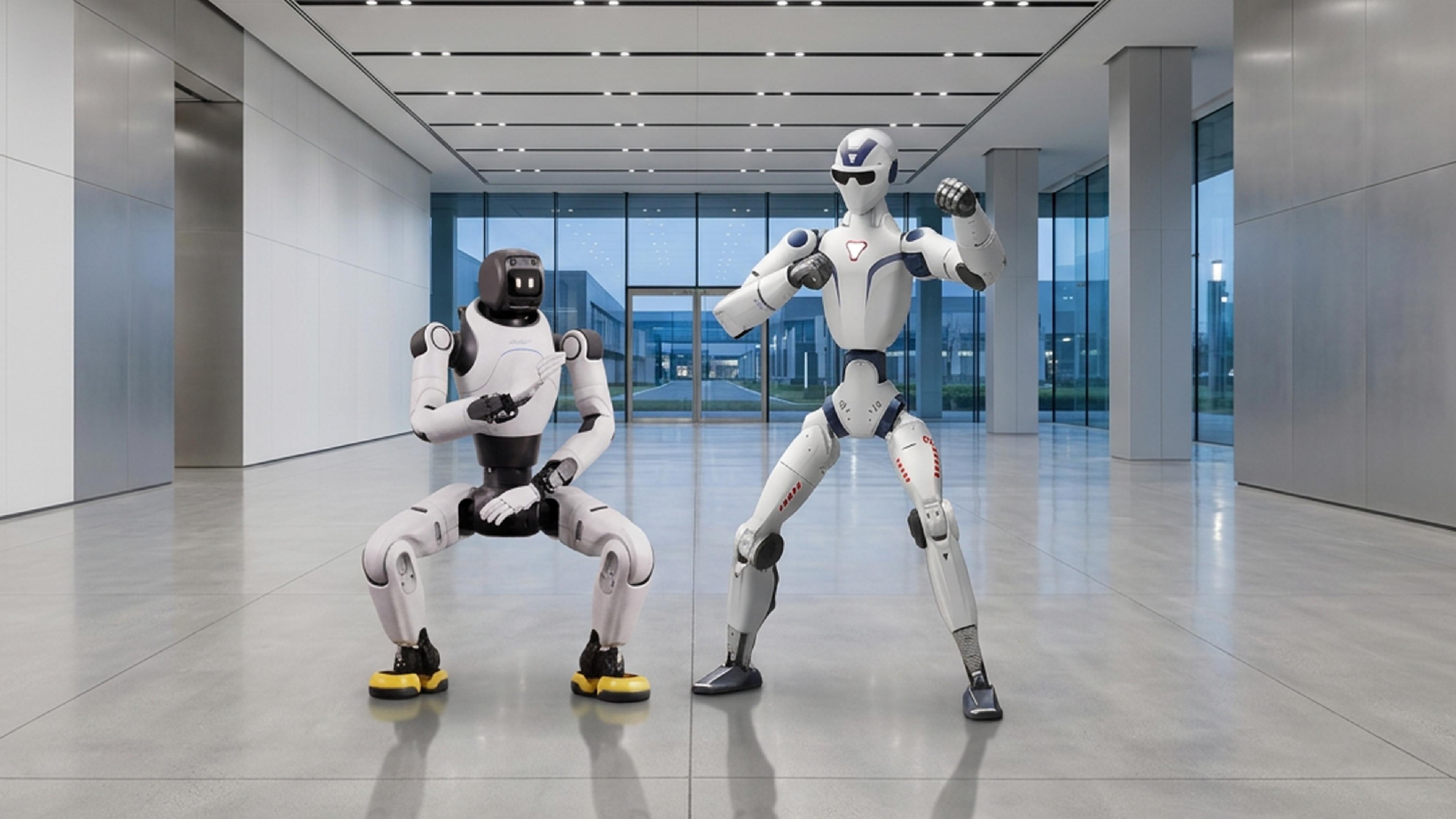
This ranking evaluates AGIBOT X2 Neo and Unitree R1 for the job: staffed live demonstrations at events, exhibitions, and showrooms. They come within half a point of each other in their own ways—one emphasizing performance attributes; the other being light and easy to transport.
Both robots are graded out of 10 across five criteria, each with a weighting: demonstration features, setup by operators, transportability, battery logistics, and purchase and support considerations. Total scores out of 100 and ranking order are determined according to ROBOT24. com market data records. This ranking reflects capability and editorial judgment and not the result of comparative testing at a live event.
AT A GLANCE
|
Rank |
Robot |
Overall score |
Standout specification |
Best suited to |
|---|---|---|---|---|
|
1 |
AGIBOT X2 Neo |
84.0/100 |
Head display with 30+ expressions, wireless microphone and speaker; about 2 h runtime |
Stage shows and staffed performances at events and showrooms |
|
2 |
Unitree R1 |
83.5/100 |
About 29 kg; quick-release swappable battery |
Touring demos that move between venues often |
The Robots Behind the Rankings
AGIBOT X2 Neo: Built to perform
Overall score: 84.0/100
The AGIBOT X2 Neo takes first place by half a point. AGIBOT sells it as a compact humanoid for performances and interaction, and its screen, audio and performance features make it a strong event candidate. It scores 9/10 for both demonstration features and operator setup.
Its interactive head display shows more than 30 expressions, and it can also show QR codes and lighting effects, so visitors can scan through to more information. AGIBOT lists a microphone array, a wireless microphone and a speaker, and a dance or song can be started by voice command. Staff can shape its persona, voice and knowledge in AGIBOT’s LinkSoul tool without code, and LinkCraft turns a video of a movement into a routine for the robot. An optional UWB group-control kit lets several X2 robots perform together.
Setup is helped by what comes in the box: the robot, a charger, a remote control, a microphone and a quick-start guide, with a mobile app and over-the-air updates. AGIBOT lists about 2 hours of runtime while walking, a charge of 1.5 hours or less, and a replaceable battery, which supports its 8/10 for battery logistics. At about 35 kg and 1.31 m tall, it also scores 8/10 for transportability.
Its lowest score is 7/10 for purchase and support. AGIBOT lists the X2 Neo at US$25,600 with an 8-month warranty, against 18 months for the X2 Ultra. AGIBOT also notes that the Neo does not support autonomous navigation or secondary development, so demonstrations are staff-led rather than robot-led. For one-off events, AGIBOT’s AGIRAAS rental service is an alternative to buying.
The X2 Neo suits brands and event teams who want a robot that performs, speaks and engages visitors on a staffed stand.
2. Unitree R1: The lightweight touring option
Overall score: 83.5/100
The Unitree R1 finishes half a point behind and earns the only perfect score in this comparison: 10/10 for transportability. At about 29 kg in the standard configuration and 1.23 m tall, it is roughly 6 kg lighter than the X2 Neo, which matters when a robot has to be lifted in and out of vehicles, carried into venues and set up on stands.
It matches the X2 Neo on demonstration features, at 9/10. Unitree has built a reputation for dynamic movement, and sellers describe the R1 walking, running and balancing dynamically, with a binocular depth camera, a 4-microphone array, stereo speakers and onboard speech-and-vision AI. It ships with a remote controller and a support-stand kit, and scores 8/10 for operator setup.
Its weak point is battery logistics, at 6/10. Sellers list about 1 hour of runtime, around half the X2 Neo’s, so a full day of demonstrations needs spare batteries and a charging plan. The quick-release, tool-free battery makes swaps fast, but each spare adds cost.
It scores 8/10 for purchase and support. Unitree lists the R1 from US$4,900, and it is widely available through international distributors, although prices vary considerably by configuration and region.The R1 suits teams that move a demonstration robot between venues often and can manage battery swaps through the day.
Head-to-head: test the routine before breaking the tie
With half a point between them, the two robots are effectively tied, and they suit different kinds of event. The AGIBOT X2 Neo is the performance-led choice, with its expressive screen, audio and longer runtime. The Unitree R1 is the lighter, easier robot to move between venues, at about 29 kg against about 35 kg, but it needs more battery swaps across a day.
Specifications will not settle a tie this close. Event teams should test both robots on the two things that decide a live demonstration. First, setup time: from opening the transport case to the robot standing and ready for its first routine, timed with the staff who will run it. Second, the same staffed routine: run an identical demonstration on each robot, with the same script, music, staff and stand space, and repeat it as many times as a typical event day would require.
That trial will show how each robot performs in practice, how much the battery strategy matters over a full day, and which one the team can run most confidently in front of an audience.
RANKING EXPLAINED
|
Parameter |
What we assess |
Weight |
|---|---|---|
|
Demonstration features |
Movement, expressions, screen, audio and routines that hold an audience’s attention. |
35% |
|
Operator setup |
How quickly and easily staff can unpack, start, control and customise the robot. |
20% |
|
Transportability |
Weight, size and how easily the robot moves between vehicles, venues and stands. |
15% |
|
Battery logistics |
Runtime, charging time and how easily batteries can be swapped during an event day. |
15% |
|
Purchase and support |
Price, warranty, availability, rental options and after-sales support. |
15% |
Each criterion is scored out of 10, and the weighted scores combine into an overall score out of 100. Demonstration features carry the most weight because a live demonstration succeeds or fails on what the audience sees.
SCORING DETAIL
|
Robot |
C1: Demonstration features |
C2: Operator setup |
C3: Transportability |
C4: Battery logistics |
C5: Purchase and support |
Overall score |
|---|---|---|---|---|---|---|
|
AGIBOT X2 Neo |
9 |
9 |
8 |
8 |
7 |
84.0/100 |
|
Unitree R1 |
9 |
8 |
10 |
6 |
These scores are editorial assessments based on documented information and the staffed live-demonstration use case. They are not the result of matched-condition independent testing at a live event.
More articles on this topic
47 articles ReportBest Robotic Mowers for Large Commercial Lawns 2026
 ReportBest Robots for Routine Dry Vacuuming on Commercial Hard Floors 2026
 ReportBest Robots for Routine Inspection in Hazardous Process Plants 2026
 ReportBest Warehouse Inventory Drones for Counting High-Rack Pallets 2026
 ReportBest Scrubbing Robots for Shopping Centre Concourses
 ReportBest Portable Robots for Cleaning Ground-Mounted Solar Panels 2026
 ReportBest Window-Cleaning Robots for Large Home Windows 2026
 ReportBest Robots for Spot Cleaning Retail Hard Floors
 ReportBest Wire-Free Robot Mowers for Hotel and Campus Lawns 2026
 ReportBest Compact Robot Scrubbers for Offices with Tight Layouts 2026
 ReportThe Best Wet-Cleaning Robots for Small Shops 2026
 ReportBest Robots for Retrieving Totes From Tall Warehouse Racks 2026
BUSINESS NEWS WEEKLY LETTER
The Weekly Letter for Robotics Professionals, Summarizing the Most Important Industry Moves, Launches, Deals and Signals.