TUM Develops Self-Reflective Robot AI That Recognizes When It Cannot Complete a Task
Researchers at the Technical University of Munich created a self-reflective vision-language-action system enabling robots to detect task uncertainty, pause to request human assistance, and acquire new manipulation skills.

November 25, 2026 by Dr Maulik Vyas
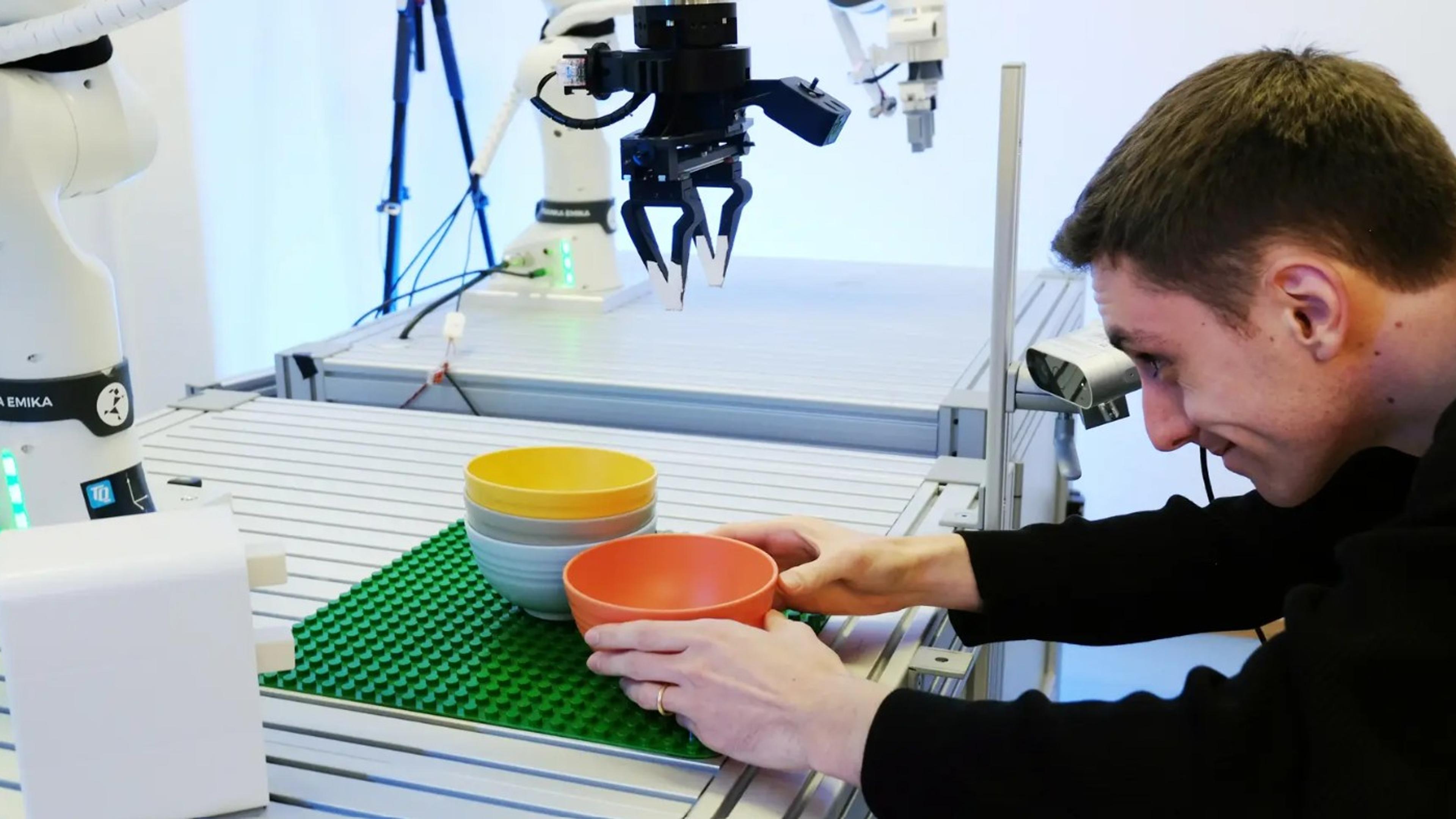
For applications outside of fixed factory cells, current robotic control systems frequently fail to deal with unknown or foreign objects, changing light conditions and other previously unscheduled physical constraints. Instead of attempting to execute a movement that might fail in a critical way, such a system now stops in time and asks for human assistance where necessary.
The core component for such a system is a so-called self-reflective vision-language-action (VLA) system that allows a robot to assess its own capabilities during execution. With this framework that has been developed by doctoral researcher Ralf Römer and Professor Angela Schoellig from the Chair of Safety, Performance and Reliability of Learning Systems at Technical University of Munich (TUM), new manipulation skills can be learned by a robot without it losing previously learned tasks.
Existing VLA models can be extended by incorporating additional data such as proprioception, and allow for the execution of tasks given corresponding language input and a view of the world by a robot’s cameras. So far, however, standard VLA architectures lack sufficient generalization to execute a task safely given only a difference in the data used for learning (off-line) and execution (on-line). To address this issue, we develop within the framework of the uncertainty-quantification of actions generated by the VLA an on-line quantification of action uncertainties during execution, allowing for a stopping of execution of actions in uncertain situations and for a call for human assistance if required.
The knowledge base of the VLA system is updated when a human has demonstrated the appropriate behavior to solve a task. For this purpose, the architecture Continual Learning for Vision-Language-Action Models via Autonomous Adapter Routing and Expansion (CLARE) was implemented. Here, a pre-trained VLA model is left frozen and only very lightweight, modular adapters are trained on top of the corresponding layers for encoding the observation in feature space.
The autoencoder-based routing mechanism introduced in the architecture is able to choose the best-suited adapter-module within milliseconds to process new incoming features of the current task. Experiments are presented for 40 simulated tasks as well as for five physical manipulation-tasks. The resulting architecture increases by only about 2% in the number of its model parameters per newly learned skill, while performance on already learned tasks remains completely unchanged.
More articles on this topic
286 articles ReportWhat it Really Costs to Own a Personal Assistant Robot at Home
 ReportBrightMaster T100 Robot Targets Exterior Painting on High-Rise Buildings
 ReportKG Steel Tests ALICE M2 Humanoid on Steel Coil Packaging Tasks
 ReportX Square Robot Releases WALL-OSS-1.0 Vision-Language-Action Model
 ReportTürkiye Launches State Grant Program Covering 50% of Industrial Humanoid Robot Development Budgets
 ReportAGIBOT Deploys Dozens of G2 Robots on Lens Technology's Smartphone Testing Lines
 ReportInlif Secures More Than $10 Million in Agreements for Its New Six-Axis Industrial Robots
 ReportSingapore's Botsync Raises $11 Million to Expand Its Factory Robotics Platform
 ReportHumyn Labs Raises $47 Million to Build Real-World Training Data for Robotics
 ReportBoston Dynamics Selects GlobalFoundries as First Semiconductor Customer for Atlas Humanoid Trials
 ReportGenesis AI Raises $500 Million at a $3.5 Billion Valuation to Scale General-Purpose Robots
 ReportMultiway Robotics Showcases Intralogistics Solutions and Wheeled Humanoid at CeMAT ASIA
BUSINESS NEWS WEEKLY LETTER
The Weekly Letter for Robotics Professionals, Summarizing the Most Important Industry Moves, Launches, Deals and Signals.