Robotic Insects Reveal New Possibilities for Tiny Flying Machines
Harvard's RoboBee flew without a power cord under halogen lamps, while an MIT robot driven by soft artificial muscles hovered for 1,000 seconds and recovered from in-flight collisions.

October 30, 2026 by Dr Maulik Vyas
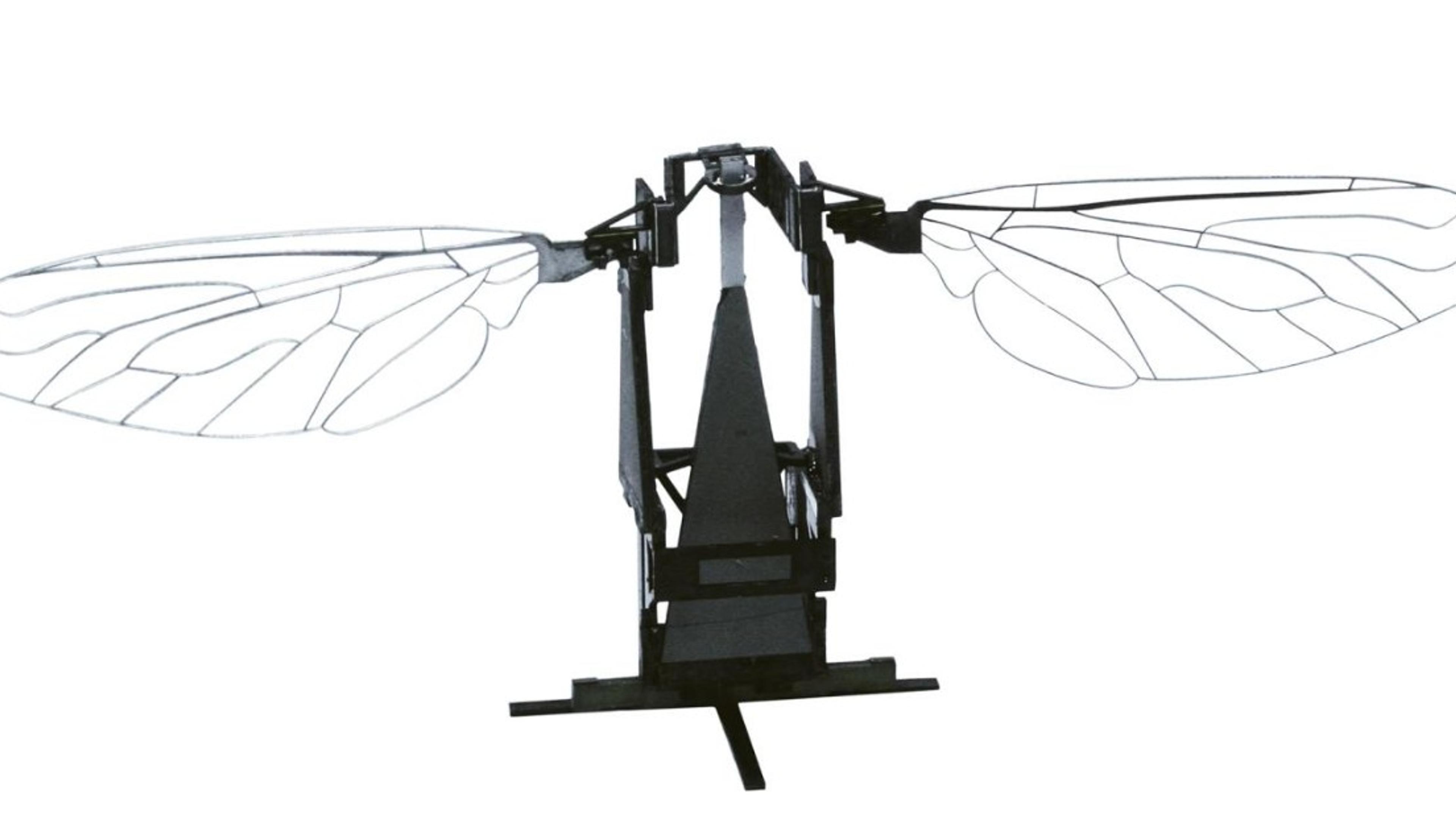
Some flying robots weigh far less than a paperclip and flap their wings the way a bee does. Two university labs in the United States have pushed these machines further than most people expected, each by solving a different problem. The first one came from Harvard.
Harvard RoboBee and its first flight
Robert Wood led the RoboBee project at Harvard's Microrobotics Lab. They worked hard for nearly ten years. The team got a RoboBee into controlled flight in 2012, which was the first for any insect-scale robot. It weighed 80 milligrams and spanned 3 centimeters and had a carbon fiber frame.
But there was a catch.
Power and control signals came down a thin tether; hence, the bee could hover and slide sideways but couldn't drift or wander away! Any flapping wings are harder to control than a quadrotor's spinning blades. While larger machines like Festo's BionicOpter dragonfly can move each wing separately to steer, this robot with too light weight gets shoved around by tiny air currents. Hence, the RoboBee had no such luxury. Staying airborne was one thing, though, and the team soon went after a way to stop for a rest.
RoboBee perching on surfaces
In April 2016, the Harvard team presented work in Science showing that a RoboBee can perch in mid-flight. It uses an electrostatic patch to stick to a surface, much like bats, birds or butterflies landing to save energy.
The numbers are striking. Perching takes about 1,000 times less power than hovering. For a robot that can't carry a proper battery, that's a huge difference, since it can sit, watch and save its flight time for when it counts. Saving power helped, but the bigger prize was cutting the cord altogether, and that came in 2019.
RoboBee X-Wing flying without a cable
In August 2019, a new version nicknamed X-Wing became the lightest vehicle ever to fly untethered for a sustained time. It added a second pair of wings, plus changes to the actuators and transmission, so it could lift solar cells and a small electronics panel.
The vehicle weighs about 90 milligrams and carries 170 milligrams of electronics and solar cells. Even the smallest commercial batteries weigh more than the robot itself, which is why solar power was the route. Its thrust for the weight of its muscle matched that of real bees.
The first solo flight was tense. With no onboard steering, the robot veered toward the lights until a Kevlar safety harness caught it. X-Wing needs about three suns' worth of light, so for now it flies under halogen lamps in the lab. Harvard used rigid, high-power actuators. Down the road at MIT, another team took a softer approach.
MIT soft-muscle flying robot
Kevin Chen leads the Soft and Micro Robotics Laboratory at MIT, where his team built the first heavier-than-air aerial robot powered by soft artificial muscles. It hovered for 1,000 seconds, which comes to about 17 minutes in the air.
Soft muscles do something rigid ones can't. They soak up bumps. Chen's robot can recover from an in-flight collision and perform a somersault within 0.10 seconds. Real insects crash into things all day and keep going, and this design copies that toughness. The lab has also worked on adding onboard sensors, electronics and batteries. Put these machines together and a list of possible jobs starts to form.
Possible jobs for tiny flyers
Researchers behind these projects point to environmental monitoring, structural repair, search and rescue, and archaeological studies. Harvard's team also describes aerial microrobots as a way to place sensors across large, hard-to-reach or dangerous areas.
- Environmental monitoring across wide areas
- Search and rescue in tight spots
- Structural checks and repair
- Archaeological studies
These robots still work inside labs, so field jobs are goals, not products. Even so, every milestone from a tethered hover to a 17-minute soft-muscle flight has made the idea more believable.
ROBOT24.com will keep covering real robots like these, from insect-sized flyers to machines you can see across a room. Check back for the next story, and share this one with someone who still thinks robots have to be big.
More articles on this topic
238 articles ReportWhat it Really Costs to Own a Personal Assistant Robot at Home
 ReportETH Zurich Engineers Create Tiny Robots Powered by Mouse Muscle
 ReportRobots that Explore the Great Pyramid's Narrow Shafts
 ReportA Little Company, Courtesy of a Robot
 ReportA Humanoid Walks into a New York Park
 ReportRailway Inspection Robots Search for Defects in Tracks
 ReportChina's Humanoid Supply Chain Moves Toward Industrial Production
 ReportCompanionship now comes with a Charging Cable
 ReportCould a Robotic Guide Help Blind Travelers Navigate Public Spaces?
 ReportThis Robot Finds Cracks and Fixes Them
 ReportXPENG's IRON Humanoid Adapts to Changing Human Gestures in Real Time
 ReportRobots Are Learning to Sort Clothes for Textile Recycling
BUSINESS NEWS WEEKLY LETTER
The Weekly Letter for Robotics Professionals, Summarizing the Most Important Industry Moves, Launches, Deals and Signals.