The Best Small Humanoids for Robotics Teaching Labs 2026
From beginner-friendly lessons to advanced robotics experiments, discover four small humanoid robots bringing hands-on learning to teaching labs. UBTECH Yanshee, ROBOTIS OP3, NAO 6, and Leju AELOS Pro3 are compared on programming flexibility, learning resources, motion control, classroom usability, and technical support to help educators find the right fit for their students and goals.

October 27, 2026 by Business Desk Team
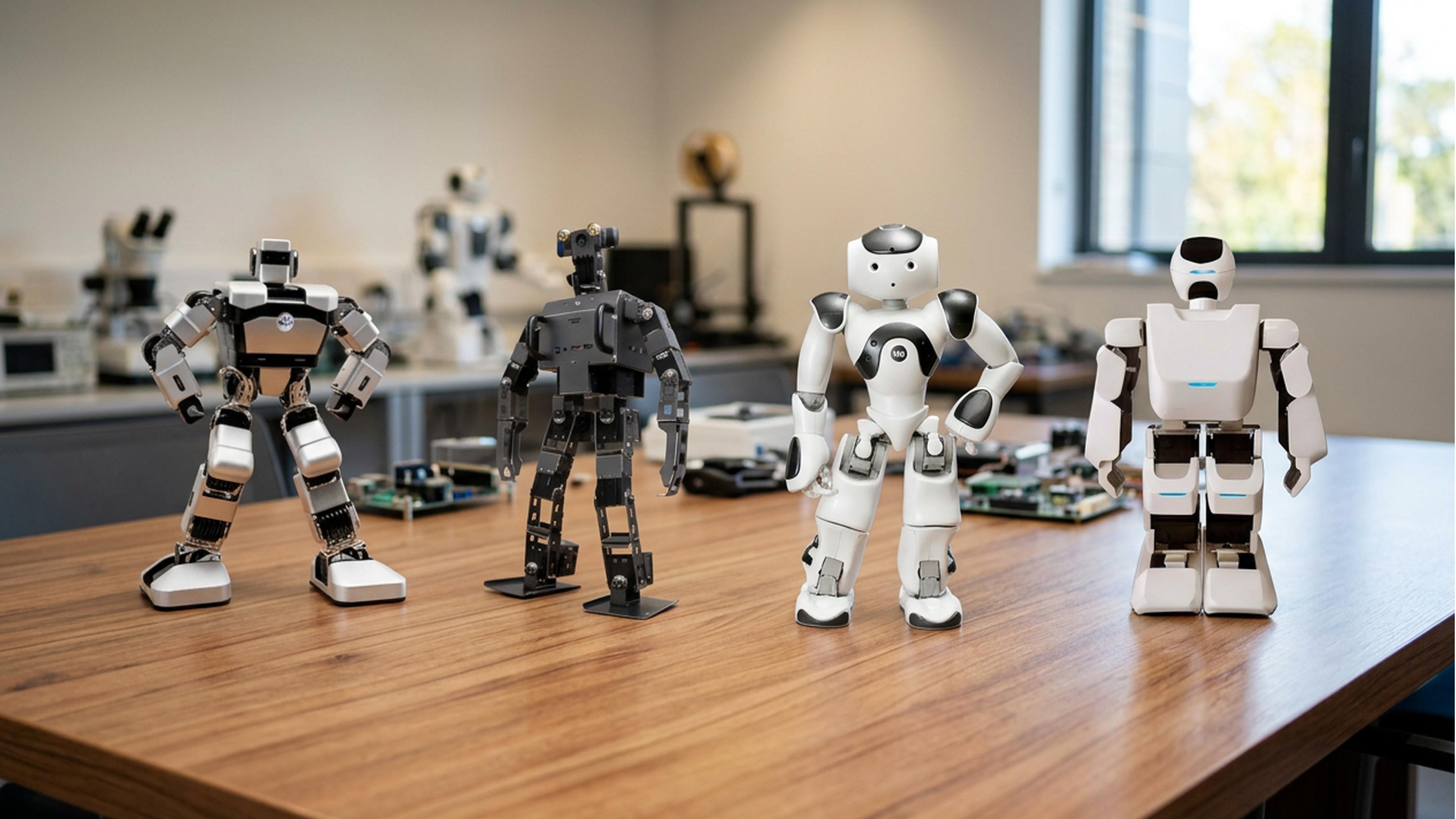
Small humanoid robots can make programming, motion control and robotics development accessible to students. The impact small humanoid robots have in teaching labs depends on how readily students can get to the software they are using, explore what the robot can do and move from exercises to open-ended projects.
This comparison evaluates three advanced humanoid robots in the appropriate hosting for the manual & school, in the basic knowledge of the programming, the practical application of the new book and the more advanced development. Total ranking: UBTECH Yanshee, Leju AELOS Pro3, ROBOTIS OP3, NAO 6.
We evaluate each robot with Robot24.com's Market Research Database, the manufacturer-provided manufacturer material, and our editorial judgement on five metrics: programmer accessibility and programmability; curriculum, documentation and learning resources; sensor accessibility, locomotion programming and experimentation; classroom deployment and setup; and cost of purchase, maintenance and tech support. We have made an educated estimate of each using the methodology that is shown below.
AT A GLANCE
| Rank | Robot | Overall score | Standout specification or feature | Best suited to |
|---|---|---|---|---|
| 1 | UBTECH Yanshee | 84/100 | Raspberry Pi-based platform, Python/C++ access and a documented 60-hour curriculum | Teaching labs seeking structured programming exercises and hands-on development |
| 2 | ROBOTIS OP3 | 84/100 | Linux/ROS-oriented development platform and extensive online manuals | Advanced robotics programming and experimentation |
| 3 | NAO 6 | 80/100 | Established classroom familiarity and teaching resources | Education settings prioritising learning materials and classroom use |
| 4 | Leju AELOS Pro3 | 76/100 | Compact humanoid with motion-programming capabilities | Labs exploring humanoid movement and programming |
This ranking is based on the provided editorial review. UBTECH Yanshee and ROBOTIS OP3 are the best rated with 84/100. Check for the specific model and configuration for accuracy and support plans.
The Robots Behind the Rankings
1. UBTECH Yanshee: Organized Learning and Developer Program
Overall score: 84/100
The UBTECH Yanshee ranks at the top of this list, offering a programmable platform paired with instructional materials. With its Raspberry Pi-based reported architecture, Python/C++ access and detailed 60-hour curriculum, it's a possibility for any teaching lab interested in blending guided instruction with hands-on robotics development.
Coding access makes more sense if you're teaching. Pupils can experiment with supported development tools to look at the principles of software, then see how they can be used in working projects; a planned curriculum enables teachers to plan lessons.
The evaluation provided with the product gives Yanshee high scores for programmability and curriculum. Laboratories need to ensure curriculum for the unit is available prior to purchasing, check the language the curriculum is available in, check for software compatibility, and ensure that any additional curriculum and consumables are available.
2. ROBOTIS OP3: Advanced Robotics Development
Overall score: 84/100
The ROBOTIS OP3 effectively makes a case for in-school teaching laboratories that would focus on software development and on robotics systems. The developer platform based on Linux/ROS and online manuals are the strongest points in the other provided assessment.
For advanced student users, developer resources create an environment in which students can explore software architecture, motion programming and robotics experimentation. The included scorecard also helps OP3 earn top scores for programmability and sensor access and motion programming and experimentation.
Its primary focus is also the learning curve. If a platform offers more 'advanced' technical access, the instructor may need more prep time and a stronger programming background than a curriculum-led teaching solution. Labs need to consider upfront setup, software requirements, maintenance plans and ongoing technical support when choosing one.
3. NAO 6: Classroom Familiarity and Learning Resources
Overall score: 80/100
NAO 6 has a familiar feel and an extensive list of teaching resources. It might be appropriate to those learning environments where teachers prefer a humanoid robot along with established lesson plans and classroom exercises.
Resources for teachers support teachers in delivering lessons, introduce ideas of robotics and support students with exercises. The provided assessment scores highly on curriculum, documentation and learning resources and usability for classrooms is the bot's strength.
The purchase price, current supply, supply arrangements and support lifecycle should be considered prior to a lab finalizing the decision to deploy. These elements will impact on total cost of ownership as well as ensuring coverage of a stable teaching environment.
4. Leju AELOS Pro3: Compact Humanoid Motion Programming
Overall score: 76/100
Leju AELOS Pro3 is a small humanoid platform for teaching labs with interest in motion programming and hands on experiments. It is attractive because a physical platform will be offered for students to experience how programmed motions work to make a robot move.
The assessment also provides a useful and consistent way of giving the Pro3 similar marks in experimentation, classroom usability and technical support to the humanoid labs. However, the robot's overall score is somewhat lower than that of the other robots under consideration.
One important aspect to consider is whether an English language curriculum and support that can be independently verified are available. Teachers should be able to check the documentation, programming environment, teaching support and maintenance arrangements in their area before purchasing.
The Best Fit Depends on the Teaching Lab
Although UBTECH Yanshee dominates the supplied grade and ROBOTIS OP3 has the overall score, the two robots are likely teaching different subjects.
For a lab that plans to use a set curriculum of exercises for students to learn programming, Yanshee might provide the curriculum and developer access it offers. For a university or advanced robotics lab using a Linux and ROS based development environment, OP3 might be the best choice. NAO 6 is a good choice for a classroom full of lessons resources, and AELOS Pro3 may be an option for humanoid motion-programming training activities.
The ultimate choice is based on prior skills of the students, objectives of the course, experience of the instructor, software demands, cost and whether tech support is needed. When considering buying, look at overall ownership costs, confirm what is supplied in the package and ask to be shown a sample lesson.
RANKING EXPLAINED
The criteria are used equally. We give each robot a mark out of 10 for each criterion, and then those five marks are added together to give a total score out of 100.
| Parameter | What we assess | Weight |
|---|---|---|
| Programmability and developer access | Supported programming languages, development interfaces, software access and opportunities for custom development | 20% |
| Curriculum, documentation and learning resources | Structured lessons, manuals, tutorials and materials suitable for instructors and students | 20% |
| Sensor access, motion programming and experimentation | Access to supported sensors, movement controls and practical robotics development capabilities | 20% |
| Classroom usability, setup and practical operation | Initial setup, ease of operation, suitability for teaching activities and instructor workload | 20% |
| Purchase cost, maintenance and technical support | Purchase price, ongoing maintenance, replacement parts, software arrangements and technical support |
All the criteria are scored between 0 and 10, and all hold an equal weighting. The total is the total of the ten marks. All five marks are added then multiplied by two. Unclear, incomplete or manufacturer-only information is not considered to have been independently supported.
| Rank / robot | C1: 20% | C2: 20% | C3: 20% | C4: 20% | C5: 20% | Total |
|---|---|---|---|---|---|---|
| 1. UBTECH Yanshee | 9 | 9 | 8 | 8 | 8 | 84/100 |
| 2. ROBOTIS OP3 | 10 | 9 | 10 | 7 | 6 | 84/100 |
| 3. NAO 6 | 8 | 10 | 8 | 9 | 5 | 80/100 |
| 4. Leju AELOS Pro3 | 7 | 7 | 8 | 8 | 8 | 76/100 |
C1-C5 are the five criteria in the methodology, in order. The marks reproduce the preliminary scorecard provided to the technology provider. No independent matched condition benchmark testing was conducted, and the scores should be read in conjunction with the evidence and open issues on exact-model documentation.
More articles on this topic
15 articles ReportThe Best Delivery Robots for Small Restaurants and Cafés 2026
 ReportThe Best Mobile Telepresence Robots 2026
 ReportThe Best Robot Vacuum-and-Mop Systems for Home 2026
 ReportThe Best Robot Mowers for Small Gardens 2026
 ReportThe Best Small Companion Robots for Home 2026
 ReportThe Best Mobile Robot Companions for Home 2026
 ReportThe Best Industrial Inspection Quadrupeds 2026
 ReportThe Best Robotic Pets for Seniors 2026
 ReportThe Best Hotel Delivery Robots 2026
 ReportThe Best Outdoor Security Patrol Robots 2026
 ReportThe Best Commercial Cleaning Robots 2026
 ReportThe Best Humanoids for Education & Embodied-AI Development 2026
BUSINESS NEWS WEEKLY LETTER
The Weekly Letter for Robotics Professionals, Summarizing the Most Important Industry Moves, Launches, Deals and Signals.