The Best Robots for Delivering Meals and Running In-Store Promotions 2026
From table delivery to on-floor advertising, we compare two service robots on promotional display, delivery workflow, narrow-route access, charging and staff controls.

November 10, 2026 by Business Desk Team
Introduction
For many restaurants and retail food venues, a service robot now has two jobs. It has to carry orders reliably to the table, and in the quieter moments between runs it can promote specials, new items or in-store offers to the people it passes. A robot that does one job well and the other badly only covers half the business case.
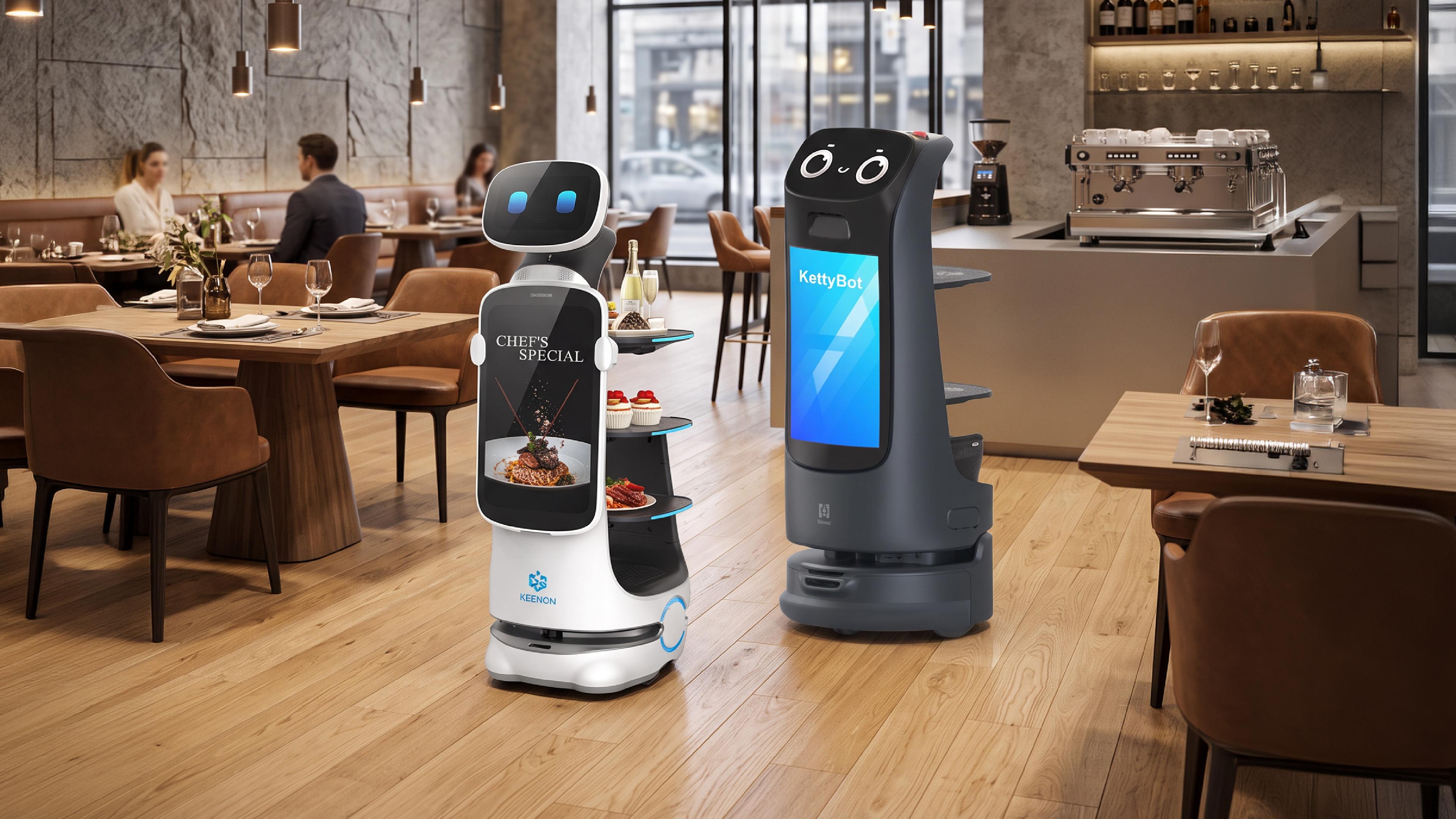
This ranking compares the KEENON DINERBOT T10 and the PUDU KettyBot Pro, two robots that combine meal delivery with on-board promotional screens. They arrive at almost the same overall score by different routes: one leans towards display, the other towards access in tight spaces.
Each robot is scored out of 10 on five weighted criteria: promotional display, delivery workflow, narrow-route access, charging and staff controls. Overall scores out of 100 and the ranking order follow ROBOT24’s desk review. The ranking reflects documented capability and editorial assessment, not matched-condition testing in a live venue. The methodology appears below.
AT A GLANCE
|
Rank |
Robot |
Overall score |
Standout specification |
Best suited to |
|---|---|---|---|---|
|
1 |
KEENON DINERBOT T10 |
81.0/100 |
23.8-inch screen with movable heads; 40 kg total load |
Venues where on-floor promotion is a priority alongside delivery |
|
2 |
PUDU KettyBot Pro |
80.5/100 |
52 cm minimum aisle width; 18.5-inch advertising screen |
Narrower venues where tight routes would rule out larger robots |
The Robots Behind the Rankings
1. KEENON DINERBOT T10: The display-focused contender Overall score: 81.0/100
The KEENON DINERBOT T10 achieves first position through the slimmest margin which separates it from the runners-up. The marketing robot from KEENON earns its highest score in promotional display with 9 out of 10 which represents the best single display rating in this evaluation. The hardware backs that up. The product from KEENON features a 23.8-inch display together with heads which move based on user touch and movement detection and users can operate the product through its interactive buttons.
The system supports delivery operations through its ability to carry 40 kg total weight while offering touch controls and AI-based tray detection and users can place remote calls and track their tasks through an app-based system. The delivery workflow received a score of 8 out of 10 together with staff control system evaluation results. Its trade-off is access.
The KEENON robot requires a minimum passage width of 59 cm and the T10 robot achieved an 8 out of 10 rating for narrow-route access which places it one point below the KettyBot Pro. The charging process received a rating of 7 out of 10; KEENON states their batteries operate between 9 and 12.5 hours and they need 5.5 hours to reach full charge starting from 15% battery level so businesses with extended operating hours should schedule their charging periods. The DINERBOT T10 operates best in restaurants and food courts and retail food stores which use screens as essential business tools and provide enough space for robot movement.
2. PUDU KettyBot Pro: The pick for narrower venues
Overall score: 80.5/100
The PUDU KettyBot Pro finishes half a point behind, and its case rests on access. The device achieved a 9 out of 10 rating for narrow-route access because it needs only 52 centimeters of aisle space which makes it the best choice for restricted spaces. The promotional robot performs as an actual marketing device. The product includes an 18.5-inch advertising display which serves delivery and reception functions according to retailer listings while achieving an 8 out of 10 rating for promotional display effectiveness.
Delivery workflow and staff controls both score 8/10, matching the T10. System administrators support users through different allocation systems which distribute available capacity. Operators who handle heavy loads need to check their complete transportation capacity because each tray in published listings shows 10 kg instead of providing a complete load capacity.
The T10 achieves a 7/10 rating which matches the performance of the other system. The device returns to its docking station automatically when the battery reaches its lowest level according to product descriptions but different retailers provide varying information about its operational duration which customers should verify through PUDU or their local distributor.
The KettyBot Pro works best for cafés and small restaurants and retail stores because it can operate in spaces where most robots would fail to navigate through tight corridors.
The best fit depends on the venue
With half a point between them, the two robots are effectively tied. They score the same on delivery workflow, charging and staff controls, so the decision comes down to one trade-off: display or access.
The DINERBOT T10 is the display-focused contender, with the larger screen and the higher promotional score. The KettyBot Pro gives up a point on display but gains one on narrow-route access, and its 52 cm aisle width gives it a clear reason to be shortlisted for tighter venues.
Ultimately, the choice should rest on the venue itself: the narrowest point on the delivery route, how much weight a typical order run carries, and how much value the business expects from on-floor advertising. Operators should measure their tightest aisle and test both robots on a real service route before deciding.
RANKING EXPLAINED
|
Parameter |
What we assess |
Weight |
|---|---|---|
|
Promotional display |
Screen size and placement, content options and how well the robot draws attention to promotions. |
25% |
|
Delivery workflow |
Load handling, tray layout, pickup prompts and how smoothly the robot completes a delivery. |
25% |
|
Narrow-route access |
Minimum passage width and ability to move through tight aisles and busy areas. |
20% |
|
Charging |
Run time, charging time and how easily the robot returns to service. |
15% |
|
Staff controls |
How easily staff can send, call, redirect and monitor the robot during service. |
15% |
Each criterion is scored out of 10, and the weighted scores combine into an overall score out of 100. Display and delivery carry the most weight because together they define the dual role these robots are bought for.
|
Robot |
C1: Promotional display |
C2: Delivery workflow |
C3: Narrow-route access |
C4: Charging |
C5: Staff controls |
Overall score |
|---|---|---|---|---|---|---|
|
KEENON DINERBOT T10 |
9 |
8 |
8 |
7 |
8 |
81.0/100 |
|
PUDU KettyBot Pro |
8 |
8 |
9 |
7 |
8 |
80.5/100 |
These scores are editorial assessments based on ROBOT24.com's market- data records. They are not the result of matched-condition independent testing. Real-world performance will vary with venue layout, aisle widths, load, screen content, configuration and how staff use the robot. Specifications, optional features and support terms should be confirmed with the manufacturer or supplier before purchase.
More articles on this topic
47 articles ReportBest Compact Humanoids for Staffed Live Demonstrations
 ReportBest Robotic Mowers for Large Commercial Lawns 2026
 ReportBest Robots for Routine Dry Vacuuming on Commercial Hard Floors 2026
 ReportBest Robots for Routine Inspection in Hazardous Process Plants 2026
 ReportBest Warehouse Inventory Drones for Counting High-Rack Pallets 2026
 ReportBest Scrubbing Robots for Shopping Centre Concourses
 ReportBest Portable Robots for Cleaning Ground-Mounted Solar Panels 2026
 ReportBest Window-Cleaning Robots for Large Home Windows 2026
 ReportBest Robots for Spot Cleaning Retail Hard Floors
 ReportBest Wire-Free Robot Mowers for Hotel and Campus Lawns 2026
 ReportBest Compact Robot Scrubbers for Offices with Tight Layouts 2026
 ReportThe Best Wet-Cleaning Robots for Small Shops 2026
BUSINESS NEWS WEEKLY LETTER
The Weekly Letter for Robotics Professionals, Summarizing the Most Important Industry Moves, Launches, Deals and Signals.