The Best Enclosed Delivery Robots for Multi-Floor Offices 2026
From the mailroom to the right desk on the right floor, we compare three enclosed delivery robots on enclosed handoff, elevator workflow, corridor access, shift continuity and building integration.

November 10, 2026 by Business Desk Team
Introduction
In a multi-floor office, internal deliveries quietly use up a lot of staff time. Parcels, documents, IT equipment and lunch orders all have to move from the ground floor or mailroom to individual teams, often several floors up. A delivery robot helps only if it can keep items secure, ride the lifts on its own and hand each delivery to the right person.
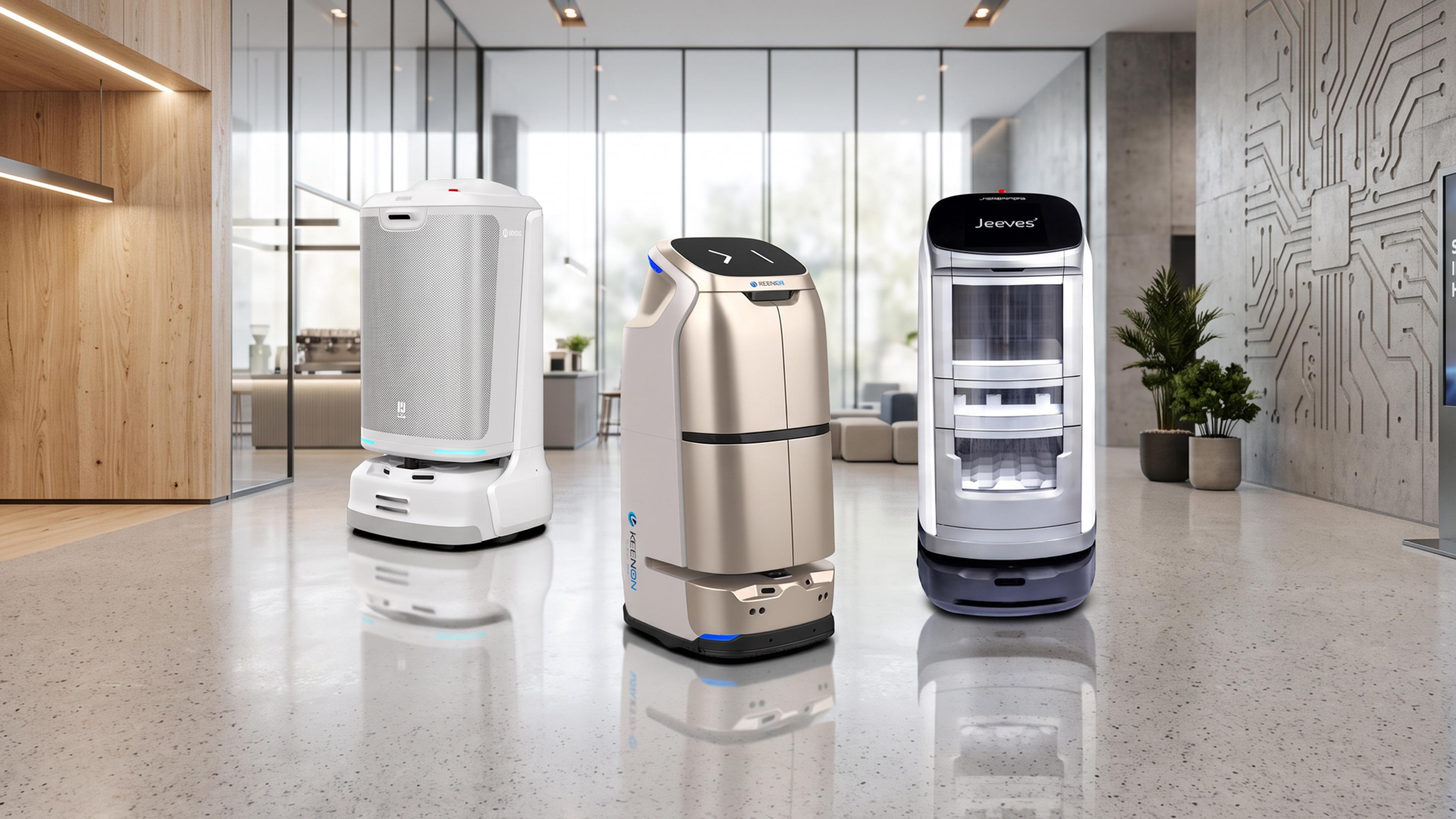
This ranking compares the PUDU FlashBot, Robotise JEEVES and KEENON BUTLERBOT W3 on that job. All three carry items in closed compartments rather than on open trays, and all three are aimed at multi-floor buildings. The top two finish level on points, and the third is only 1.5 points behind.
Each robot is scored out of 10 on five weighted criteria: enclosed handoff, elevator workflow, corridor access, shift continuity and building integration. Overall scores out of 100 and the ranking order follow ROBOT24’s desk review. The ranking reflects documented capability and editorial assessment, not matched-condition testing in a live building. The methodology appears below.
AT A GLANCE
|
Rank |
Robot |
Overall score |
Standout specification |
Best suited to |
|---|---|---|---|---|
|
1 |
PUDU FlashBot |
82.5/100 |
IoT elevator and automatic-door integration; password, phone or NFC pickup |
Buildings where lifts and doors can be connected to the robot |
|
2 |
Robotise JEEVES |
82.5/100 |
Modular drawers; cloud lift control used with major lift brands |
Offices that need a defined parcel and messenger service |
|
3 |
KEENON BUTLERBOT W3 |
81.0/100 |
Up to four independently accessible compartments with automatic doors |
Multiple drop-offs per trip across several floors |
The Robots Behind the Rankings
1. PUDU FlashBot: The building-integration specialist
Overall score: 82.5/100
The PUDU FlashBot shares the top score and leads this ranking on building integration, where it earns 9/10, the highest in the group. Its documented elevator integration is the main reason. Sellers describe IoT integration with lifts and automatic doors, and PUDU also offers its own hardware elevator-control solution for buildings where cloud control is not an option.
It matches the other two on enclosed handoff at 9/10. Items travel in enclosed, lockable compartments, adjustable from two to four, and recipients collect them using a password, phone number or NFC verification. It scores 8/10 for elevator workflow and corridor access.
Its weaker area is shift continuity, at 7/10. Published run-time figures vary between sellers, from about 8 to 12 hours, with a charge of around 4 hours and automatic return to the dock. Offices with long or overlapping shifts should confirm real-world endurance.
The FlashBot suits buildings where the lifts, doors and turnstiles can be connected to the robot, and where that connection is the deciding factor.
2. Robotise JEEVES: The office messenger
Overall score: 82.5/100
The Robotise JEEVES is level on points with the FlashBot and has the more even profile: 9/10 for enclosed handoff and 8/10 on every other criterion. Its strongest point for offices is an explicit parcel and messenger workflow, rather than a hotel room-service model adapted for office use.
JEEVES carries items in modular drawers mounted on a motorised base, and the container setup can be tailored to the building. In an office, that means it can run supplies such as printer paper and stationery, or carry parcels and documents between the mailroom and individual teams.
Its lift integration runs through the Robotise Operations Center, a cloud service that calls the elevator and allows 24/7 remote fleet monitoring. JEEVES has been deployed with lift systems from brands including KONE and Schindler, and it uses an on-board motion sensor to confirm which floor it is on. Compared with the FlashBot, it scores one point lower for building integration but one point higher for shift continuity.
JEEVES suits offices that want a defined internal mail and messenger service across several floors.
3. KEENON BUTLERBOT W3: Four drop-offs per trip
Overall score: 81.0/100
The KEENON BUTLERBOT W3 finishes just 1.5 points behind the leaders. KEENON markets it as an IoT elevator rider, and it shares the top enclosed-handoff score of 9/10.
Its compartment design is its strongest practical feature. It can be set up with up to four independently accessible compartments with automatic doors, so one dispatch can serve up to four locations. Sellers list a 20 kg total load, up to 12 hours of battery life and a 70 cm minimum passage width. It scores 8/10 for elevator workflow, corridor access and shift continuity.
Its lowest score is 7/10 for building integration. Lift riding is documented, but the reviewed material says less about door, turnstile or access-control integration than it does for the FlashBot. It also needs about 6.5 hours to charge, which should be planned around the office day.
The BUTLERBOT W3 suits offices where one trip regularly needs to serve several desks or floors.
The tie-breaker is the building itself
The PUDU FlashBot and Robotise JEEVES finish level on 82.5 points, and the KEENON BUTLERBOT W3 is only 1.5 points behind. All three score 9/10 for enclosed handoff, so the decision comes down to how each robot fits the building.
The FlashBot has the strongest documented building integration, including lifts and automatic doors. JEEVES has the clearest office parcel and messenger workflow and slightly better shift continuity. The W3 stands out for serving up to four locations in one trip.
The building’s lift and access-control compatibility should break the tie. Before choosing, offices should check which lift brands and control systems are installed, whether cloud or hardware lift integration is supported, how the robot will pass security doors or turnstiles, and who on the facilities side will own the integration. A robot that cannot ride a particular lift is effectively a single-floor robot in that building.
RANKING EXPLAINED
|
Parameter |
What we assess |
Weight |
|---|---|---|
|
Enclosed handoff |
Closed, lockable compartments and secure recipient pickup, such as PIN, phone or NFC verification. |
25% |
|
Elevator workflow |
How reliably the robot calls, boards and leaves lifts and confirms the right floor. |
25% |
|
Corridor access |
Minimum passage width and ability to move through office corridors, doors and shared areas. |
20% |
|
Shift continuity |
Run time, charging time and automatic return to the dock across the working day. |
15% |
|
Building integration |
Documented integration with lifts, automatic doors, turnstiles and access control. |
15% |
Each criterion is scored out of 10, and the weighted scores combine into an overall score out of 100. Enclosed handoff and the elevator workflow carry the most weight because secure, multi-floor delivery is the job these robots are bought for.
SCORING DETAIL
| Robot | C1: Enclosed handoff | C2: Elevator workflow | C3: Corridor access | C4: Shift continuity | C5: Building integration | Overall score |
|---|---|---|---|---|---|---|
| PUDU FlashBot | 9 | 8 | 8 | 7 | 9 | 82.5/100 |
| Robotise JEEVES | 9 | 8 | 8 | 8 | 8 | 82.5/100 |
| KEENON BUTLERBOT W3 | 9 | 8 | 8 | 8 | 7 | 81.0/100 |
These scores are editorial assessments based on documented information and the multi-floor office delivery use case. They are not the result of matched-condition independent testing. Real-world performance will vary with lift brand and control system, access-control setup, corridor layout, configuration and the integration work carried out on site. Lift compatibility, optional features and support terms should be confirmed with the manufacturer, integrator or building owner before purchase.
More articles on this topic
47 articles ReportBest Compact Humanoids for Staffed Live Demonstrations
 ReportBest Robotic Mowers for Large Commercial Lawns 2026
 ReportBest Robots for Routine Dry Vacuuming on Commercial Hard Floors 2026
 ReportBest Robots for Routine Inspection in Hazardous Process Plants 2026
 ReportBest Warehouse Inventory Drones for Counting High-Rack Pallets 2026
 ReportBest Scrubbing Robots for Shopping Centre Concourses
 ReportBest Portable Robots for Cleaning Ground-Mounted Solar Panels 2026
 ReportBest Window-Cleaning Robots for Large Home Windows 2026
 ReportBest Robots for Spot Cleaning Retail Hard Floors
 ReportBest Wire-Free Robot Mowers for Hotel and Campus Lawns 2026
 ReportBest Compact Robot Scrubbers for Offices with Tight Layouts 2026
 ReportThe Best Wet-Cleaning Robots for Small Shops 2026
BUSINESS NEWS WEEKLY LETTER
The Weekly Letter for Robotics Professionals, Summarizing the Most Important Industry Moves, Launches, Deals and Signals.