Best Robots for Returning Dirty Dishes to the Kitchen 2026
From cleared tables to the dish return, we compare three restaurant robots on collection capacity, collection workflow, route access, continuity between pickups, and dispatch and cleaning.

November 10, 2026 by Business Desk Team
Introduction
For a restaurant staff, clearing tables is one of the most tedious and repetieve tasks requiring them to work at the same location continuously. The process of bringing dishes back to the return station takes servers away from their guests while slow table clearing operations create delays for restaurant table availability.
Robots can become useful only when they can carry out full dish loads and perform safe transportation while returning to the following pickup station.
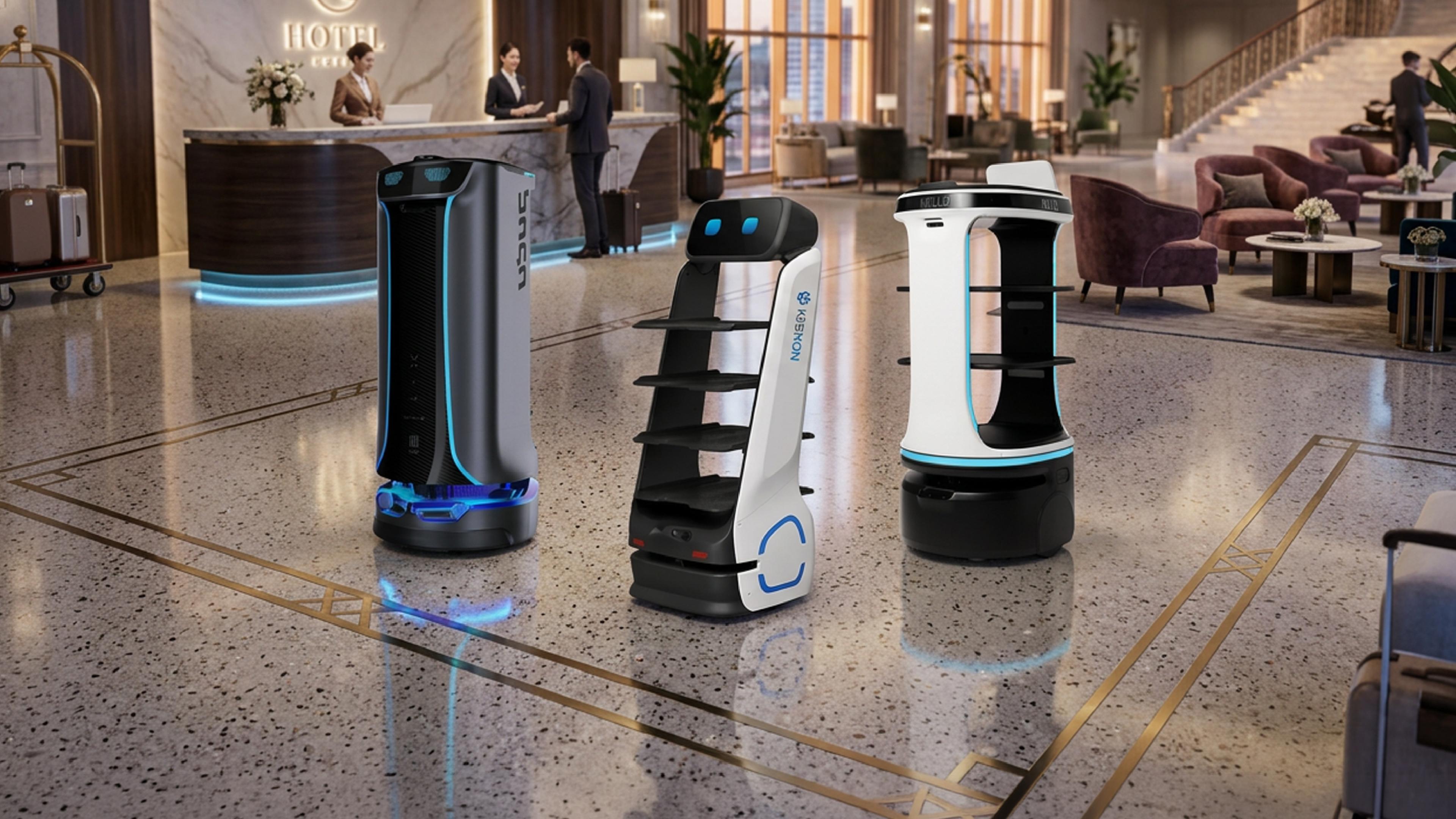
The ranking examoines PUDU HolaBot alongside Bear Robotics Servi Plus and KEENON DINERBOT T9 for their performance in specific tasks. The three roboots operate differently. While one focuses on collecting large amounts of items the other functions as a delivery robot which also serves as a dedicated bussing system and the third system operates as a basic tray-return system.
The evaluation based on ROBOT24.com market- data record rates robots through five established standards which include collection capacity and collection workflow and route access and continuity between pickups and dispatch and cleaning. The evaluation process produces scores out of 100 which determine the ranking order during their desk review.
The ranking shows capabilities from official records and editorial evaluations instead of performance testing with matched conditions at an operating restaurant. The methodology appears below.
AT A GLANCE
|
Rank |
Robot |
Overall score |
Standout specification |
Best suited to |
|---|---|---|---|---|
|
1 |
PUDU HolaBot |
83.5/100 |
60 kg payload and 120 L enclosed compartment |
High-volume clearing in buffets, banquets and large dining rooms |
|
2 |
Bear Robotics Servi Plus |
80.0/100 |
Dedicated bussing mode; carries up to 4 standard bus tubs |
Restaurants that want one robot for both food running and bussing |
|
3 |
KEENON DINERBOT T9 |
68.5/100 |
40 kg across four adjustable open trays |
Basic tray-return duty where a dedicated bussing setup is not needed |
The Robots Behind the Rankings
1. PUDU HolaBot: The capacity contender
Overall score: 83.5/100
The PUDU HolaBot takes first place and earns the only perfect score in this comparison: 10/10 for collection capacity. PUDU positions it as a collection robot, and its specifications explain why. Published listings give a 60 kg payload, a 120 L compartment and four trays rated at up to 15 kg each.
That compartment is built for dirty dishes. Listings describe an IPX5 waterproof inner cabin that resists liquid splashes, and one supplier describes the container as removable and washable. A pager function lets staff call the robot to a table for clearing. It scores 8/10 for collection workflow, route access, and dispatch and cleaning.
Its lowest score is 7/10 for continuity between pickups. Published run-time figures vary by source and battery setup, so operators should confirm how long it can keep collecting through a full service and how charging fits around peak periods.
The HolaBot suits buffets, banquet halls and large dining rooms where the volume of used dishes is the main bottleneck.
2. Bear Robotics Servi Plus: The balanced food-runner and busser
Overall score: 80.0/100
The Bear Robotics Servi Plus finishes second with a perfectly even profile, scoring 8/10 on all five criteria. Its strongest point for this ranking is its documented bussing mode, which makes dish collection a supported job rather than a workaround.
Bear Robotics lists a 40 kg payload, a capacity of more than 16 dishes and the ability to carry four XL trays or four standard bus tubs. The tray layout can be adjusted, so the same robot can switch between running food and clearing tables.
It does not match the HolaBot on raw capacity, scoring 8/10 rather than 10/10. Where it pulls ahead is continuity between pickups, scoring 8/10 to the HolaBot’s 7/10.
The Servi Plus suits restaurants that want one robot to cover both food running and bussing, rather than a dedicated collection unit.
3. KEENON DINERBOT T9: A basic tray-return option
Overall score: 68.5/100
The KEENON DINERBOT T9 completes the ranking, some way behind the top two. It is a capable delivery robot, but in this comparison it is best treated as a basic tray-return option rather than a dedicated bussing robot.
KEENON lists a 40 kg total load across four adjustable trays, with 10 kg per layer. Those are open delivery trays, and the reviewed documentation does not describe a dedicated bin or bus-tub setup for dirty dishes. It scores 7/10 for collection capacity, collection workflow, route access and continuity, and 6/10 for dispatch and cleaning.
Access is a further consideration. KEENON lists a minimum passage width of 70 cm, so the robot needs reasonably clear aisles. Buyers considering it for clearing should confirm with KEENON or a supplier which bin or tray accessories are available and how they are cleaned.
The DINERBOT T9 suits venues that mainly need a delivery robot and want occasional tray-return help, rather than a robot bought for clearing.
The best fit depends on the clearing workload
The PUDU HolaBot leads as the strongest dedicated collection robot, with the largest capacity and an enclosed compartment designed for used dishes. The Bear Robotics Servi Plus is only 3.5 points behind and is the better fit where one robot needs to handle both food running and bussing.
The KEENON DINERBOT T9 trails by a wider margin. It remains a dependable delivery robot, but buyers should treat its clearing role as basic tray return unless a suitable bin setup is confirmed.
Ultimately, the choice should rest on how much is cleared per service, how far the dish return is from the dining room, how narrow the aisles are, and whether the venue needs a dedicated collection robot or a dual-purpose one. Operators should test candidates on a real clearing route at peak service before deciding.
RANKING EXPLAINED
|
Parameter |
What we assess |
Weight |
|---|---|---|
|
Collection capacity |
Payload, volume and how many used dishes the robot can take in one trip. |
25% |
|
Collection workflow |
Bin, tub or tray setup for dirty dishes, loading and unloading, and handling of liquids and residue. |
25% |
|
Route access |
Minimum passage width and ability to move between tables and to the dish return. |
20% |
|
Continuity between pickups |
Run time, charging and how quickly the robot returns to service between clearing runs. |
15% |
|
Dispatch and cleaning |
How staff call the robot for clearing, and how easily the compartment or trays are cleaned. |
15% |
Each criterion is scored out of 10, and the weighted scores combine into an overall score out of 100. Capacity and workflow carry the most weight because they determine how much clearing each trip actually removes from staff.
SCORING DETAIL
|
Robot |
Collection capacity |
Collection workflow |
Route access |
Continuity between pickups |
Dispatch and cleaning |
Overall score |
|---|---|---|---|---|---|---|
|
PUDU HolaBot |
10 |
8 |
8 |
7 |
8 |
83.5/100 |
|
Bear Robotics Servi Plus |
8 |
8 |
8 |
8 |
8 |
80.0/100 |
|
KEENON DINERBOT T9 |
7 |
7 |
7 |
7 |
6 |
68.5/100 |
These scores are editorial assessments based on ROBOT24.com market data records. They are not the result of matched-condition independent testing. Real-world performance will vary with dining-room layout, aisle widths, dish types, configuration and how staff use the robot. Bin and tray accessories, optional features and support terms should be confirmed with the manufacturer or supplier before purchase.
More articles on this topic
47 articles ReportBest Compact Humanoids for Staffed Live Demonstrations
 ReportBest Robotic Mowers for Large Commercial Lawns 2026
 ReportBest Robots for Routine Dry Vacuuming on Commercial Hard Floors 2026
 ReportBest Robots for Routine Inspection in Hazardous Process Plants 2026
 ReportBest Warehouse Inventory Drones for Counting High-Rack Pallets 2026
 ReportBest Scrubbing Robots for Shopping Centre Concourses
 ReportBest Portable Robots for Cleaning Ground-Mounted Solar Panels 2026
 ReportBest Window-Cleaning Robots for Large Home Windows 2026
 ReportBest Robots for Spot Cleaning Retail Hard Floors
 ReportBest Wire-Free Robot Mowers for Hotel and Campus Lawns 2026
 ReportBest Compact Robot Scrubbers for Offices with Tight Layouts 2026
 ReportThe Best Wet-Cleaning Robots for Small Shops 2026
BUSINESS NEWS WEEKLY LETTER
The Weekly Letter for Robotics Professionals, Summarizing the Most Important Industry Moves, Launches, Deals and Signals.