The Best Warehouse Robots and AMRs 2026
From picking carts to pallets and trailer unloading, we compare five warehouse robots and autonomous mobile robots (AMRs) on task performance, autonomy, mobility, endurance and operational support.

November 24, 2026 by Business Desk Team
Introduction
Warehouse robots move goods so people don’t have to: carts between pick faces, pallets to the dock and cases out of trailers. Their usefulness depends on how much they carry, how reliably they work alongside people and forklifts, and how easily they plug into the warehouse management system.
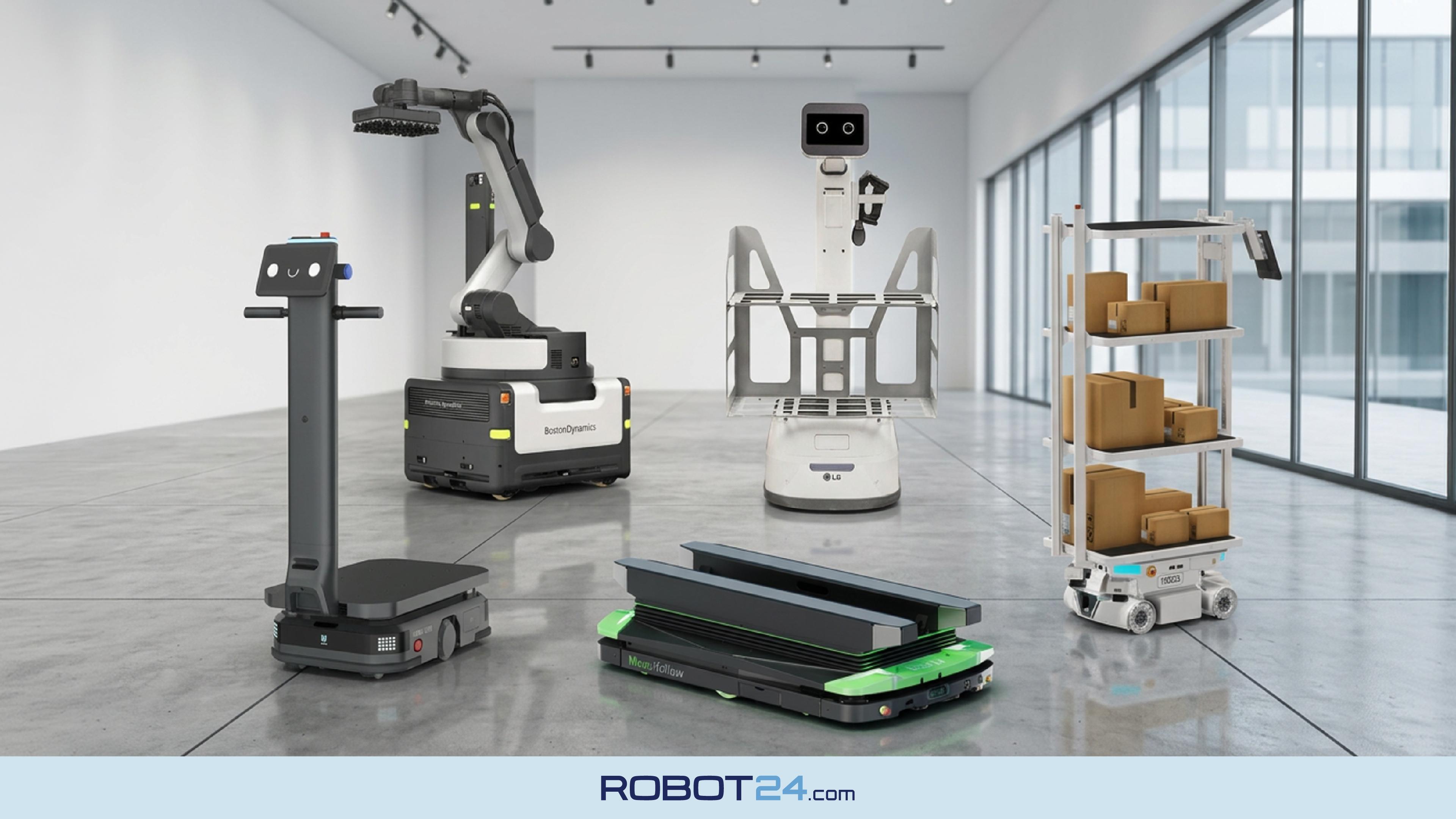
This ranking compares Boston Dynamics’ Stretch, Movu Robotics’ ifollow, Locus Robotics’ Vector, LG’s CLOi CarryBot and PUDU’s T600.
We assess each model using ROBOT24.com’s Market Research Database across five areas: task performance; autonomy and reliability; mobility and environmental suitability; working endurance; and integration, deployment and support. The ranking reflects documented specifications and deployment evidence. The methodology appears below.
At a Glance
| Rank | Robot | Overall score | Robot24 price | Standout specification | Best suited to |
|---|---|---|---|---|---|
| 1 | Boston Dynamics Stretch | 85/100 | Approx. US$300,000–500,000 (industry estimate) | Unloads 600–800 cases per hour, no SKU programming | Trailer and container unloading in distribution centres |
| 2 | Movu Robotics ifollow | 82/100 | US$50,000–120,000 | 1,200 kg payload, works down to –25°C, fleets of 200 | Pallet transport and cold-storage picking |
| 3 | Locus Robotics Vector | 80/100 | US$30,000–35,000 | Omnidirectional Mecanum drive, 60-minute full charge | Cart, tote and case movement across fulfilment floors |
| 4 | PUDU T600 | 80/100 | ~US$15,000–25,000 (estimated) | 600 kg rack lifting, VDA5050 interoperability | Rack transport and line replenishment |
| 5 | LG CLOi CarryBot | 66/100 | Approx. US$26,900 | 18.5-hour typical runtime, WMS integration | Package moves between pick, pack and ship stations |
This comparison is based on Robot24.com Market Research Database records.
The Vector and T600 both round to 80; the Vector ranks ahead on its unrounded score (80.0 against 79.5).
The Robots Behind the Rankings
1. Boston Dynamics Stretch: Loading dock automation
Overall score: 85/100
Stretch comes first as it automates one of the most challenging processes of the warehouse: loading/unloading trailers and containers. Combining 7-DOF robotic arm with the AI-based vision system makes it a good choice for high-throughput distribution centers.
Throughput of 600–800 cases per hour with carton weight of up to 23 kg sets the pace. It helps to reduce the number of personnel who have to load heavy boxes from heated trailers. Its machine learning vision technology recognizes mixed case sizes, does not require SKU programming, plans its own grasping and even recovers fallen boxes.
Omnidirectional drive allows it to operate inside the trailer and deliver cargo to the conveyor belt. Battery provides up to eight hours of operation or even 16 hours when equipped with high-capacity battery pack. WMS/ API integration and fleet management capabilities are provided. However, this robot weighs 1,300 kg, it requires eight to 16 weeks to be deployed, and its industry-estimated price of US$300,000–500,000 is significantly different from the rest of this ranking.
2. Movu Robotics ifollow: Heavy-lift all-round loader/unloader
Overall score: 82/100
For those companies who need to handle pallets, roll cages and trolleys, this solution comes first. Second place is awarded for the highest payload in this group and comprehensive warehouse integration.
Payload of 1,200 kg and speed of 2 m/s allow this robot to be used in transport and collaborative order picking process in cold storage. Conveyor, lift and tank holder interface allows automatic transfer of the load. Setup process requires warehouse analysis, configuration and WMS integration before robot deployment. It works for eight to 10 hours and charges in two hours. The maximum size of the fleet is 200 units, with the price of US$50,000–120,000.
3. Locus Robotics Vector: Omnidirectional and fast recharging robot
Overall score: 80/100
Vector's uniqueness is in its maneuverability. Four Mecanum wheels allow it to move sideways, diagonally and rotate in place, which makes it an option for busy fulfillment floors and compact workcells.
Using 90 m-range 3D LiDAR and dual safety-rated LiDAR scanners in three-stage safety system, it allows to operate safely along with people. Lift, cart and shelf configurations allow to carry up to 272 kg of cargo for picking, putaway, sortation and conveyor feeding processes. It works for eight to 10 hours and gets full charge in 60 minutes with the ability of autonomous opportunistic charging.
This robot gets the third place due to the absence of information about speed, incline, lead-time and warranty in ROBOT24.com reports. It operates in LocusONE fleet management platform of Locus Robotics company together with Locus Origin and Array robots, priced at US$30,000–35,000.
4. PUDU T600: Interoperable rack transporter
Overall score: 80/100
T600 is an affordable robot for heavy rack transportation. It is designed to lift and transport racks with the payload of up to 600 kg, recognize them automatically and navigate underneath to pick them up and place down.
VSLAM and LiDAR SLAM technologies with depth camera allow to perform dynamic path planning. It is able to run for 12 hours without cargo, gets charge to 90% in two hours with autonomous docking. VDA5050 compatibility allows to work in mixed vendor fleets. Integration with elevators, e-gates and IoT systems allows to operate with private cloud or on-premises deployment.
This robot takes the fourth place as it works in 10 mm threshold and 35 mm gap environment, it operates from 0°C to 40°C and Robot24 reports no warranty terms. Price of ~US$15,000–25,000 is the estimated price
5. LG CLOi CarryBot: Long-shift parcel transporter
Overall score: 66/100
This robot completes the ranking and is designed to move small and medium sized packages between picking, packing, inspection and shipping stations. Unique features of this robot are 18.5-hour typical runtime, the longest in this ranking, and autonomous dock charging capability.
It allows to connect to the warehouse management system and fleet, robot and material control systems of LG company, carries a barcode scanner holder and comes in shelf-mounting or rolltainer configurations.
It requires six hours to recharge, and warranty and delivery are quote based. At approximately US$26,900 price, it is appropriate for e-commerce companies operating with light parcels.
The Best Fit Depends on the Operation
In this regard, Boston Dynamics’ Stretch stands out as the first contender by virtue of its automated trailer unloading and high efficiency in handling cases. If a warehouse handles pallets and operates in a cold environment, it would prefer the Movu ifollow due to its capacity of carrying up to 1,200 kg. In addition, an active fulfilment centre that has busy and congested floors would be more inclined towards the Locus Vector because of its ability to move omnidirectionally.
The decision should take into account the object being handled – whether it is cases, carts, racks or pallets, the layout and temperature of the floors, as well as the connectivity of the robots with the warehouse management system.
Ranking Explained
| Parameter | What we assess | Weight |
|---|---|---|
| Task performance | Payload, load types (cases, carts, racks, pallets), throughput, handling capability and documented warehouse workflows. | 25% |
| Autonomy and reliability | Autonomous navigation, perception and safety sensors, obstacle avoidance and safe operation around people and equipment. | 25% |
| Mobility and environmental suitability | Speed, manoeuvrability, aisle width, thresholds and gaps, operating temperature and size and weight. | 20% |
| Working endurance | Runtime per charge, charging time and autonomous or opportunity charging. | 15% |
| Integration, deployment and support | WMS and API integration, fleet management and size, interoperability standards such as VDA5050, elevator and door integration, lead time and warranty. | 15% |
Each criterion receives a score out of 10, converted into a weighted total out of 100. Scores use each robot’s ROBOT24.com market-data record and distinguish included features from optional extras. Price is shown for reference but is not scored. Only models listed as commercially available with a published or estimated price and designed for warehouse or logistics work were eligible.
| Robot | Task performance | Autonomy and reliability | Mobility | Endurance | Integration and support | Total |
|---|---|---|---|---|---|---|
| Boston Dynamics Stretch | 10 | 9 | 6 | 9 | 8 | 85 |
| Movu Robotics ifollow | 9 | 7 | 9 | 7 | 9 | 82 |
| Locus Robotics Vector | 8 | 8 | 8 | 9 | 7 | 80 |
| PUDU T600 | 8 | 8 | 7 | 9 | 8 | 80 |
| LG CLOi CarryBot | 6 | 6 | 6 | 9 | 7 | 66 |
Totals are rounded to the nearest whole number.
More articles on this topic
74 articles ReportThe Best Robots for Office Buildings 2026
 ReportBest Robots for Airports 2026
 ReportThe Best Robots for Shopping Malls 2026ReportBest Robots for Retail Stores 2026
 ReportThe Best Educational Robots for Schools and Universities 2026
 ReportThe Best robots for Hospitals and Healthcare 2026
 ReportThe Best Delivery Robots 2026
 ReportThe Best Commercial Cleaning Robots 2026
 ReportThe Best Restaurant Service Robots 2026
 ReportThe Best Service Robots for Hotels 2026
 ReportThe Best Security Patrol Robots 2026
 ReportThe Best Robot Dogs for Security and Inspection 2026
BUSINESS NEWS WEEKLY LETTER
The Weekly Letter for Robotics Professionals, Summarizing the Most Important Industry Moves, Launches, Deals and Signals.