The Best Educational Robots for Schools and Universities 2026
From first coding lessons to university robotics labs, we compare six educational robots on teaching value, autonomy, mobility, endurance and support.

November 26, 2026 by Business Desk Team
Introduction
Educational robotics transform programming, artificial intelligence, and engineering theory into tangible things. The value of such robotic platforms lies in the range of tasks students are able to accomplish with them, in how they scale in difficulty and complexity from beginner to advanced levels, and in how much teacher or lab assistance is required.
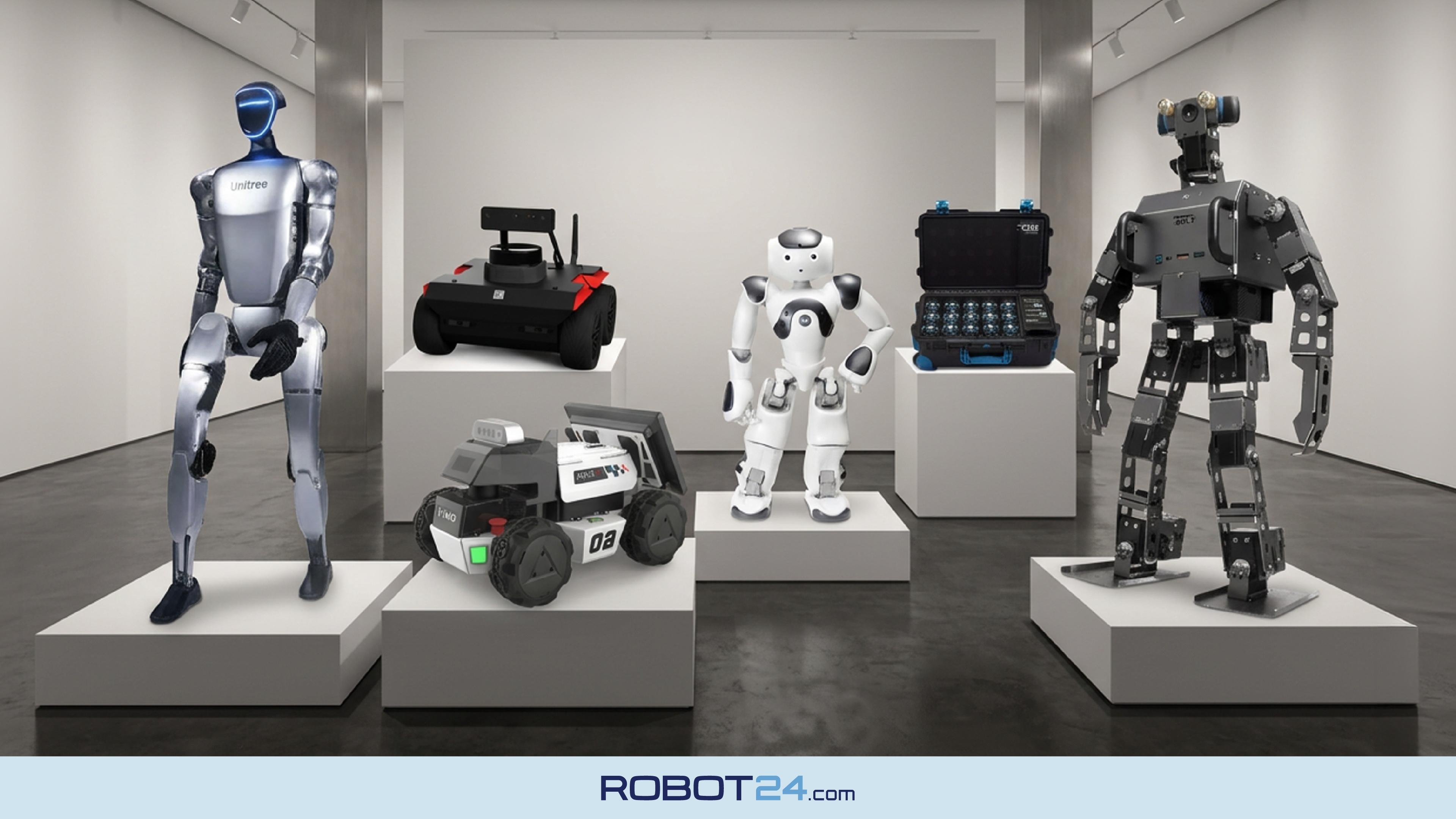
The following ranking evaluates educational robots by Sphero (BOLT+), SoftBank Robotics (NAO 6), ROBOTIS (OP3), Husarion (ROSbot 3 PRO), AgileX (LIMO COBOT), and Unitree (G1 EDU). They cover a wide range of education levels from primary school to postgraduate studies.
Every model is evaluated in terms of its five main parameters: task performance; autonomy and reliability; mobility and environmental fitness; working endurance; and deployment. The methodology of evaluation is provided below.
At a Glance
| Rank | Robot | Overall score | Robot24 price | Standout specification | Best suited to |
|---|---|---|---|---|---|
| 1 | Unitree G1 EDU | 77/100 | US$43,900+ | Up to 43 DOF, 3D LiDAR, ROS 2 and full SDK | University embodied-AI and humanoid research |
| 2 | AgileX LIMO COBOT | 77/100 | US$4,400 | 6-DOF arm on an autonomous base, Jetson Orin Nano | Teaching mobile manipulation and AI vision |
| 3 | Husarion ROSbot 3 PRO | 75/100 | US$4,000–4,800 | LiDAR plus OAK-D Pro depth camera in a 2.84 kg robot | ROS 2, SLAM and navigation courses |
| 4 | Sphero BOLT+ | 70/100 | US$189 (15-robot pack US$3,499) | Draw, Blocks, JavaScript and Python; wireless charging | Coding in primary and secondary schools |
| 5 | SoftBank Robotics NAO 6 | 70/100 | US$9,000–10,500 | 25-DOF humanoid with speech and face recognition; 2-year warranty | Programming, AI and human–robot interaction teaching |
| 6 | ROBOTIS OP3 | 66/100 | Approx. US$13,764 | Open hardware and software humanoid, ROS 2 | Humanoid locomotion research and RoboCup |
This comparison is based on ROBOT24.com Market Research Database records.
Two pairs round to the same score: the G1 EDU ranks ahead of the LIMO COBOT (77.0 against 76.5), and the BOLT+ ahead of the NAO 6 (70.0 against 69.5), on unrounded scores.
The Robots Behind the Rankings
1. Unitree G1 EDU: The University Research Humanoid
Total Score: 77/100
The G1 EDU wins top place with the deepest research capability in this group. Thanks to its small humanoid form-factor and open development stack, it is ideal for university-based embodied AI, locomotion and manipulation research.
The unique advantage of this model is its openness: while Unitree G1 doesn't offer full SDK access, the EDU edition does. For researchers, that means it allows them to train and deploy their reinforcement-learning, imitation-learning and vision-language-action models. With 23 to 43 degrees of freedom (DOF), dexterous hands option, 3D LiDAR, depth camera, up to 100 TOPS of AI compute power, it walks at speeds up to 2 m/s, goes up and down stairs and is capable of fall recovery.
However, at 132 cm height and 35 kg weight, this robot requires supervised laboratory conditions, not classroom use; it has only two hours of battery life, and our records don't list any warranty details. With US$43,900+ sticker price, it ranks top of most university departmental budgets.
2. AgileX LIMO COBOT: All-In-One Mobile Manipulation Platform
Total Score: 77/100
This is an excellent option for teaching both mobile robotics and robotic arm manipulation. This robot takes second place in this ranking due to its broad capabilities at only 1/10th the price of leader, though shorter runtime and smaller scale make it lag behind.
Combining AgileX's LIMO PRO platform and Elephant Robotics' 6-DOF myCobot 280 M5 robotic arm and NVIDIA Jetson Orin Nano, it is capable of autonomous navigation, mobile manipulation and deep learning projects. Combining LiDAR and visual SLAM, YOLO object recognition and MoveIt motion planning with support for ROS and ROS 2, Gazebo simulation, Python and C++ allows students to conduct wide range of projects on these topics.
The only limitation is its runtime of up to 2.5 hours with 2-hour recharge. It can climb 25° slopes and works in temperature range of –10°C to 40°C in IP22 enclosure. It is priced at US$4,400.
3. Husarion ROSbot 3 PRO: Classroom ROS 2 Workhorse
Total Score: 75/100
This robot is designed for teaching ROS 2, SLAM and autonomous navigation at affordable price and compact size. At 2.84 kg, it can fit even a desk and be used in shared laboratory space.
With Slamtec RPLIDAR S2, Luxonis OAK-D Pro depth camera, four ToF sensors and Raspberry Pi 5, it has the same sensor stack as larger research robots. Its aluminum chassis, GPIO, I²C, SPI and UART expansion ports allow it to be used in multi-robot coordination projects throughout a semester.
Taking the third place, it doesn't have an arm, so the manipulation projects would require another platform. It has runtime of 1.5 to five hours depending on use, ships in 2 to 6 weeks and has one-year warranty, costing US$4,000–4,800.
4. Sphero BOLT+: Best School Starting Point
Total Score: 70/100
The BOLT+ offers the easiest way to start coding for school children. Its advantage is four programming levels in one robot: Draw, Blocks, JavaScript and Python, via Sphero Edu app and web app for Chromebooks, Windows, macOS, iOS and Android.
Students can program its movement, sensors and 128 × 128-pixel LCD screen, react to collisions, light and distance and see sensor readings in real-time. Waterproof shell, all-day battery and Qi wireless charging make it convenient for busy classrooms, and a pack of 15 robots costs US$3,499.
It is designed for grades 3 to 10, it is not capable of high-level autonomy and cannot conduct university-level tasks. However, for schools, it could still be the best value among this ranking at US$189 per robot.
5. SoftBank Robotics NAO 6: Classic Teaching Humanoid
Total Score: 70/100
The NAO 6 is one of the most popular teaching humanoids used for STEM lessons, AI education, human-robot interaction research and RoboCup competition. Its 25 DOF, two 5 MP cameras, four microphones and tactile sensors support speech recognition, face and object recognition and expressive motion.
It offers choreographed movements using Choregraphe visual programming tool and further Python, C++ and Java SDKs. At 57.4 cm tall and 5.48 kg weight, it is safe enough for classroom use and has two-year warranty period – the longest one in this ranking.
Lagging behind other robots in the fifth place, its limitation is its endurance and age. It works for 60 to 90 minutes with 90-minute recharge, and it lacks autonomous navigation. The robot was released in 2018 and costs US$9,000–10,500, which makes it a good option for schools and universities focused on social robotics and interaction.
6. ROBOTIS OP3: The Open-Source Humanoid
Total Score: 66/100
Finishing the ranking, the OP3 is a completely open humanoid research platform. Its hardware and software are open, it runs ROS and ROS 2 on Intel Core i3 NUC platform, supporting Gazebo and Webots simulation environments. The robot is known for its long-term presence in humanoid locomotion research and RoboCup community.
Its 20 DOF use DYNAMIXEL actuators, providing walking engine, balance control, inverse kinematics and autonomous stand-up features, along with Logitech HD camera for vision projects. The robot has one-year warranty.
Last place in the ranking is explained by its slow 24 cm/s walking speed, unlisted runtime and its age from 2017. However, it is planned to receive ROS 2 update in 2025. It is available on pre-order basis with estimated price of US$13,764.
The Best Fit Depends on the Classroom
The Unitree G1 EDU leads this assessment through its open SDK, sensors and manipulation options for advanced research. Universities teaching mobile manipulation or ROS 2 on a tighter budget may prioritise the AgileX LIMO COBOT or Husarion ROSbot 3 PRO, while primary and secondary schools may place greater value on the Sphero BOLT+’s low price and beginner-friendly programming. NAO 6 remains a strong choice for social robotics and interaction, and ROBOTIS OP3 for open-source humanoid research.
The final choice depends on the students’ age and level, the subjects being taught, the space available and how many robots each class needs.
Ranking Explained
| Parameter | What we assess | Weight |
|---|---|---|
| Task performance | Teaching and research capability: programming options, sensors, compute, manipulation and the range of projects and subjects the robot supports. | 25% |
| Autonomy and reliability | Autonomous navigation, mapping, perception, fall recovery and behaviours that work out of the box. | 25% |
| Mobility and environmental suitability | Size, weight, durability and safety for classrooms and labs, plus speed, terrain and indoor or outdoor use. | 20% |
| Working endurance | Runtime per charge, charging time, wireless charging and swappable batteries. | 15% |
| Integration, deployment and support | Software ecosystem (ROS, simulation, SDKs, education apps), classroom packs, lead time and warranty. | 15% |
Each criterion receives a score out of 10, converted into a weighted total out of 100. Scores use each robot’s Robot24 record and distinguish included features from optional extras. Price is shown for reference but is not scored. Only models listed as commercially available with a published price and designed for teaching or academic research were eligible.
| Robot | Task performance | Autonomy and reliability | Mobility | Endurance | Integration and support | Total |
|---|---|---|---|---|---|---|
| Unitree G1 EDU | 10 | 9 | 5 | 5 | 8 | 77 |
| AgileX LIMO COBOT | 9 | 8 | 8 | 5 | 7 | 77 |
| Husarion ROSbot 3 PRO | 7 | 8 | 8 | 6 | 8 | 75 |
| Sphero BOLT+ | 6 | 4 | 9 | 9 | 9 | 70 |
| SoftBank Robotics NAO 6 | 9 | 6 | 7 | 3 | 9 | 70 |
| ROBOTIS OP3 | 8 | 7 | 6 | 3 | 8 | 66 |
Totals are rounded to the nearest whole number.
More articles on this topic
74 articles ReportThe Best Robots for Office Buildings 2026
 ReportBest Robots for Airports 2026
 ReportThe Best Robots for Shopping Malls 2026ReportBest Robots for Retail Stores 2026
 ReportThe Best robots for Hospitals and Healthcare 2026
 ReportThe Best Delivery Robots 2026
 ReportThe Best Warehouse Robots and AMRs 2026
 ReportThe Best Commercial Cleaning Robots 2026
 ReportThe Best Restaurant Service Robots 2026
 ReportThe Best Service Robots for Hotels 2026
 ReportThe Best Security Patrol Robots 2026
 ReportThe Best Robot Dogs for Security and Inspection 2026
BUSINESS NEWS WEEKLY LETTER
The Weekly Letter for Robotics Professionals, Summarizing the Most Important Industry Moves, Launches, Deals and Signals.