Loongson Completes ROS 2 Integration on Its Domestic Computing-Powered Intelligent Robot Vehicle
Loongson has ported the full ROS 2 Jazzy stack to a robot vehicle run by its 2K3000 processor, linking mapping, localization, arm control and depth vision on locally developed computing hardware.

November 13, 2026 by Dr Maulik Vyas
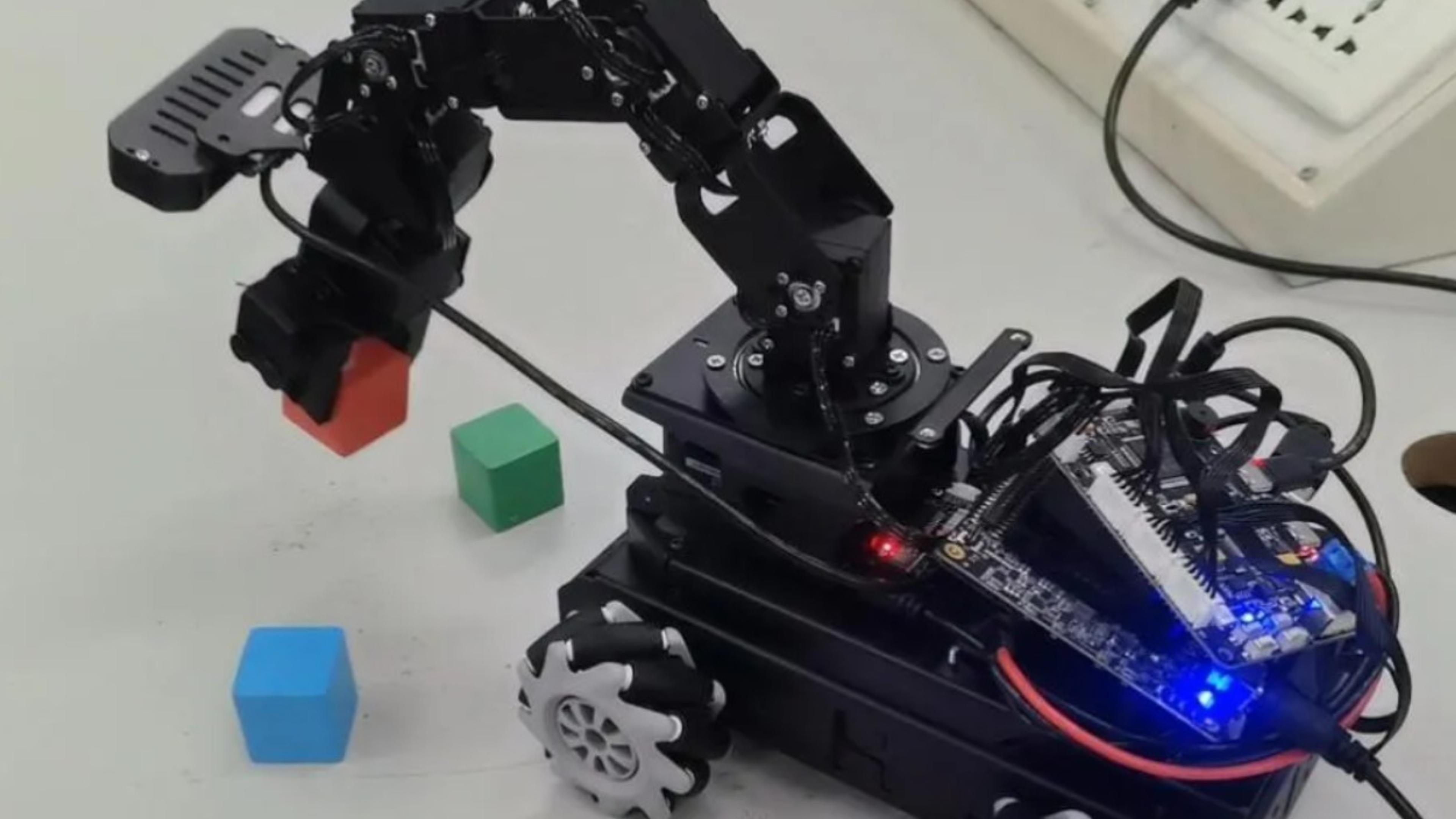
Loongson Zhongke has announced that it completed a full-stack port of ROS 2 Jazzy on its self-developed intelligent robot vehicle, linking mapping and localization, joystick remote control, robotic arm operation and depth vision into a single working chain that is scheduled entirely by the company’s Loongson 2K3000 processor. The announcement was reported by IT Home on Nov. 11, and the vehicle is presented as being capable of environment perception and target grasping on a fully domestic computing base.
ROS 2 is the open-source middleware framework most widely used in robotics, in which sensors, algorithms and actuators are connected through cross-platform, distributed communication into a network of reusable components. By porting the complete stack to its own processor, Loongson says it has verified a reusable development approach for domestic robot platforms, which is relevant to China’s wider effort to build robotics systems on locally controlled computing hardware.
The 2K3000 is manufactured on a 12-nanometer process and integrates eight LA364E cores based on the independently developed LoongArch architecture, with a maximum clock speed of 2.5 GHz, 64 KB first-level instruction and data caches and a shared 6 MB second-level cache. Loongson states that its single-core performance is comparable to ARM Cortex-A76 class processors, with a measured SPEC CPU 2006 Base single-core integer score of 30.
Perception on the vehicle is divided between two sensors, with a LiDAR mounted on the side handling planar perception and a depth camera at the end of the robotic arm providing three-dimensional depth information. Parameters were calibrated for indoor scenes and combined with odometry in order to improve positioning stability and mapping completeness. Movement is provided by Mecanum wheels, which allow forward, backward, lateral, rotating and diagonal motion through the combined speeds of four motors, and joystick values are translated by a Loongson program into velocity commands, with deadzone filtering and a safety enable key.
Work remains unfinished in several areas. Loongson says it will still complete the emergency stop and watchdog functions, integrate action groups into the upper-level program and advance three-dimensional target localization through detection and point cloud fusion.
All of the information comes from Loongson, and the report gives no figures for grasping success rates, speed or latency, so it remains to be seen how well the platform performs in real-time control tasks outside of a prototype setting.
More articles on this topic
278 articles ReportWhat it Really Costs to Own a Personal Assistant Robot at Home
 ReportHumyn Labs Raises $47 Million to Build Real-World Training Data for Robotics
 ReportBoston Dynamics Selects GlobalFoundries as First Semiconductor Customer for Atlas Humanoid Trials
 ReportGenesis AI Raises $500 Million at a $3.5 Billion Valuation to Scale General-Purpose Robots
 ReportMultiway Robotics Showcases Intralogistics Solutions and Wheeled Humanoid at CeMAT ASIA
 ReportFORT Robotics Files Registration Statement for Public Listing Partnership
 ReportRobot Baristas are Learning to Reproduce the Art of Professional Coffee Making
 ReportTARSBOT and Aptiv Plan to Deploy 100 Industrial Robots Across 33 Factory Applications
 ReportSouth Korea Proposes $39 Million for Robot Actuators, Humanoid Batteries and AI Sensors
 ReportBoston Dynamics Puts Wheels on Atlas Humanoid to Test Reinforcement Learning and Motor Limits
 ReportAnt Group Open-Sources LingBot-Touch to Give Robots a Shared Sense of Touch
 ReportArrive AI Invests in Ottonomy with Plans for 50 Autonomous Delivery Robots
BUSINESS NEWS WEEKLY LETTER
The Weekly Letter for Robotics Professionals, Summarizing the Most Important Industry Moves, Launches, Deals and Signals.