ZeroSquare Open-Sources Three Embodied AI Tools to Improve Robot Training with Real-World Data
ZeroSquare released an action model, a self-improvement framework and a real-world interaction dataset, aiming to turn everyday warehouse and retail picking work into training data.

November 20, 2026 by Dr Maulik Vyas
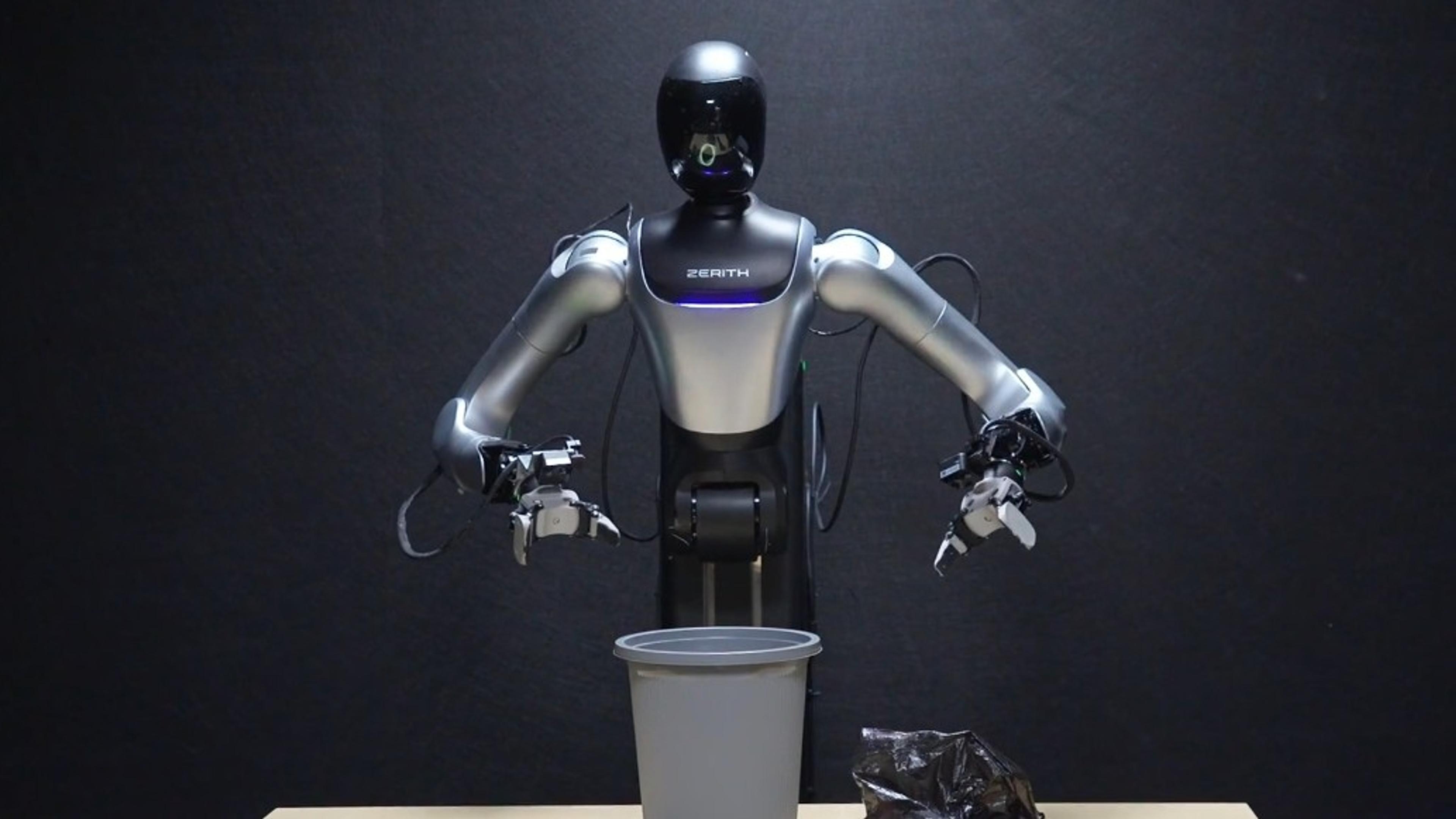
Chinese robotics company ZeroSquare, also known as Zerith Robotics, has released a range of open-source assets designed to support the work of embodied AI developers. In a blog post on the ZeroSquare website, the company describes the range of new tools in detail and explains how they address a key problem in the field of embodied AI – a lack of training data.
These new open-source assets are designed to allow embodied AI developers to leverage commercial fulfillment work (e.g. picking in retail / warehousing environments) to generate useful training data, rather than going through the time-consuming and expensive process of collecting data in a lab for tasks that are already being paid for by others.
The data collection and training is supported by the ZERITH-H1, a wheeled humanoid robot that can collect data of various modalities, such as 2D vision, 3D spatial information, robot joints, force and touch and sound. The robot is equipped with a tactile gripper that is equipped with a high-resolution visuotactile sensor. The data platform of ZeroSquare also supports teleoperated data collection, labeling and data asset management. It can also be used with standard open-source training frameworks, as well as with foundation models that can be post-trained with, such as Pi0 and GR00T.
ZeroSquare’s OpenZerith page on Hugging Face now lists the Zerith-H1-1K dataset as well as several ZERITH-2.5 model variants (e.g. for LIBERO, LIBERO-Plus and MetaWorld) – well known benchmarks for robot manipulation for which often also training data is already available.
Their visuotactile sensing technology is rooted in research from the AI and Robot laboratory at Tsinghua University. And, Zerith notes that many current problems in robot training data stem from missing sensor modalities. Here, they focus on including touch and force information in their hardware.
There are a number of unanswered questions. These include performance benchmarks for ZERITH-V2.5, an explanation of self-improvement in ESI framework, the size of the dataset in the interaction data set, and licensing terms for each of the released assets. We can only get to the bottom of these issues by looking at the released assets themselves.
More articles on this topic
155 articles ReportACE Robotics and KUAIKEDA Set Up Retail Robot Training Base for Convenience Stores
 ReportChinese Chip Manufacturer Expands Into Robotics and Physical AI
 ReportFamilyMart to Roll Out Beverage-Restocking Robots Across Japan
 ReportMegaRobo Raises $200 Million for AI-Powered Lab Automation
 ReportHidonix Launches Hido II Robot for Indoor Mapping Trials
 ReportBrightAI Raises $97 Million to Expand AI Infrastructure Inspection
 ReportRockwell Automation to Buy AGILOX, Expanding European Robot Business
 ReportPostal Operators in Asia Expand Robotics for Parcel Sorting
 ReportRainbow Robotics Partners With Samsung Unit on Factory Automation
 ReportSPARKOZ Plans U.S. Cleaning Robot Production With Pacific Floorcare
 ReportROBOTERA Deploys Humanoids at 11 China Post Hubs
 ReportGeneral Motors Plans to Increase Factory Robotics and Automation by 20% by 2028
BUSINESS NEWS WEEKLY LETTER
The Weekly Letter for Robotics Professionals, Summarizing the Most Important Industry Moves, Launches, Deals and Signals.