Just Eat Says Robot Delivery Still Lacks a Fixed Break-Even Point
The delivery company says Starship robots are active in three U.K. cities, but autonomous orders remain a small share of its business and economics vary by location.

September 25, 2026 by Artem
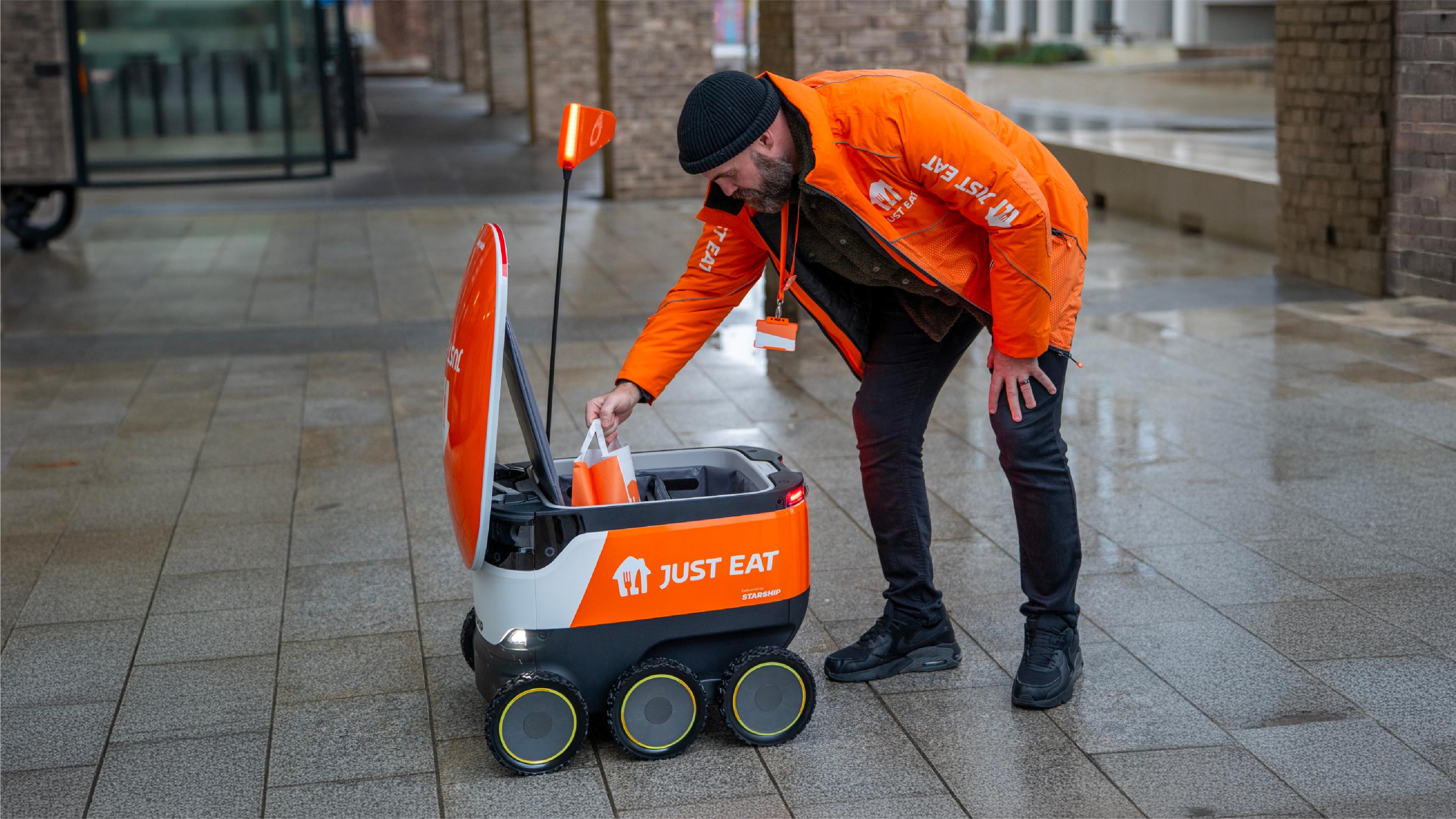
AMSTERDAM — Just Eat Takeaway.com says it is yet to determine when autonomous robot delivery becomes cheaper than using human couriers, even as it continues testing the technology across several U.K. markets.
Zornitsa Chugreeva, senior global innovation director at Amsterdam-based Just Eat Takeaway.com, told ROBOT24.com that the economics depend on delivery distance, robot utilization, local operating costs, infrastructure and the degree of autonomy.
“We don’t currently work with a single fixed city or order-volume threshold at which we say robot delivery becomes cheaper than a human courier,” Chugreeva said.
Rather than setting a minimum city size or number of orders required for expansion, Just Eat evaluates the business case for each location, including customer demand, delivery density, infrastructure and regulation. Its goal, Chugreeva said, is to develop a model in which robots are economically competitive and can add capacity where courier supply is limited.
The company has not disclosed its cost per robot delivery or compared it with the cost of a courier order.
Autonomous delivery also remains a smaller part of Just Eat’s business. Couriers are still its primary delivery method, with robots intended mainly for shorter, predictable journeys where local infrastructure supports their operation.
“Courier delivery remains, and will continue to be, our primary delivery method,” Chugreeva said. “Robots are not a replacement for our couriers.”
The company said its current trials are concentrated in the U.K., primarily with Starship Technologies. Starship robot delivery is live in Milton Keynes, Sunderland and Barnsley, and Just Eat is considering additional locations as permits and operating arrangements are put in place.
In Sunderland, Just Eat started autonomous deliveries Feb. 25 with Starship and Sunderland City Council. The company said at the time that more than 11,000 households could access the service, with orders available from 12 restaurant partners.
Just Eat has tested other robot companies as well. In February, it announced separate trials with Delivers.AI in Bristol and RIVR in Milton Keynes. In her latest comments, however, Chugreeva identified Starship as the primary partner in the three cities where robot delivery is currently live.
Not every robot order reaches its destination. Chugreeva did not disclose a numerical success rate but said “the majority of robot orders” are completed successfully, with mapping and connectivity problems accounting for a small number of technical and operational issues.
Just Eat is now working on a fallback system for orders that a robot cannot complete. The system would automatically transfer an undeliverable order to a courier, including when the destination is outside the robot’s operating range.
That arrangement fits the company’s broader plan to operate robots alongside human couriers. Chugreeva said robots are suited to short-distance deliveries, while couriers remain necessary for longer distances and more complex orders. Customers can choose between the two methods where both are available.
“Long term, we see autonomous delivery as an important complement to our existing courier network, not a replacement for human couriers,” Chugreeva said.
Just Eat ultimately envisions a network combining robots, drones and human couriers. For now, however, the company has not disclosed how many orders its robots handle, what individual trials cost or whether robot delivery has reached cost parity with couriers in any of its markets.
More articles on this topic
63 articles ReportFeather Prices Modular Dual-Arm Robot at $29,990
 ReportAGIBOT’s 300-Robot Theme Park Moves From Plan to Operation
 ReportLeopard Imaging, Lumotive Introduce Long-Range 3D Sensor for Robots
 ReportRealset AI, Flatkey Raise $10M to Expand Real-World Robot Training Data
 ReportOrionStar CleaniBot S55 Pro vs. iKitbot ONE S55 UVC
 ReportRobot Vacuum Shipment Growth Nears 30% for Second Straight Quarter After Acceleration
 ReportUnitree Adds $6,500 Dex5-S to Dexterous Hand Lineup
 ReportSOMA Launches Dual-Arm Research Robot Starting at $8,999
 ReportCognex Strikes $500 Million Deal for Robot Vision Company RealSense
 ReportUnity Opens Simulation Pro Early Access for Robotics Developers
 ReportCircus SE Partners With Royal Prestige for UAE Food-Robot Launch
 ReportRichtech Robotics Lands 200-Robot Cleaning Order From Unnamed Retailer
BUSINESS NEWS WEEKLY LETTER
The Weekly Letter for Robotics Professionals, Summarizing the Most Important Industry Moves, Launches, Deals and Signals.